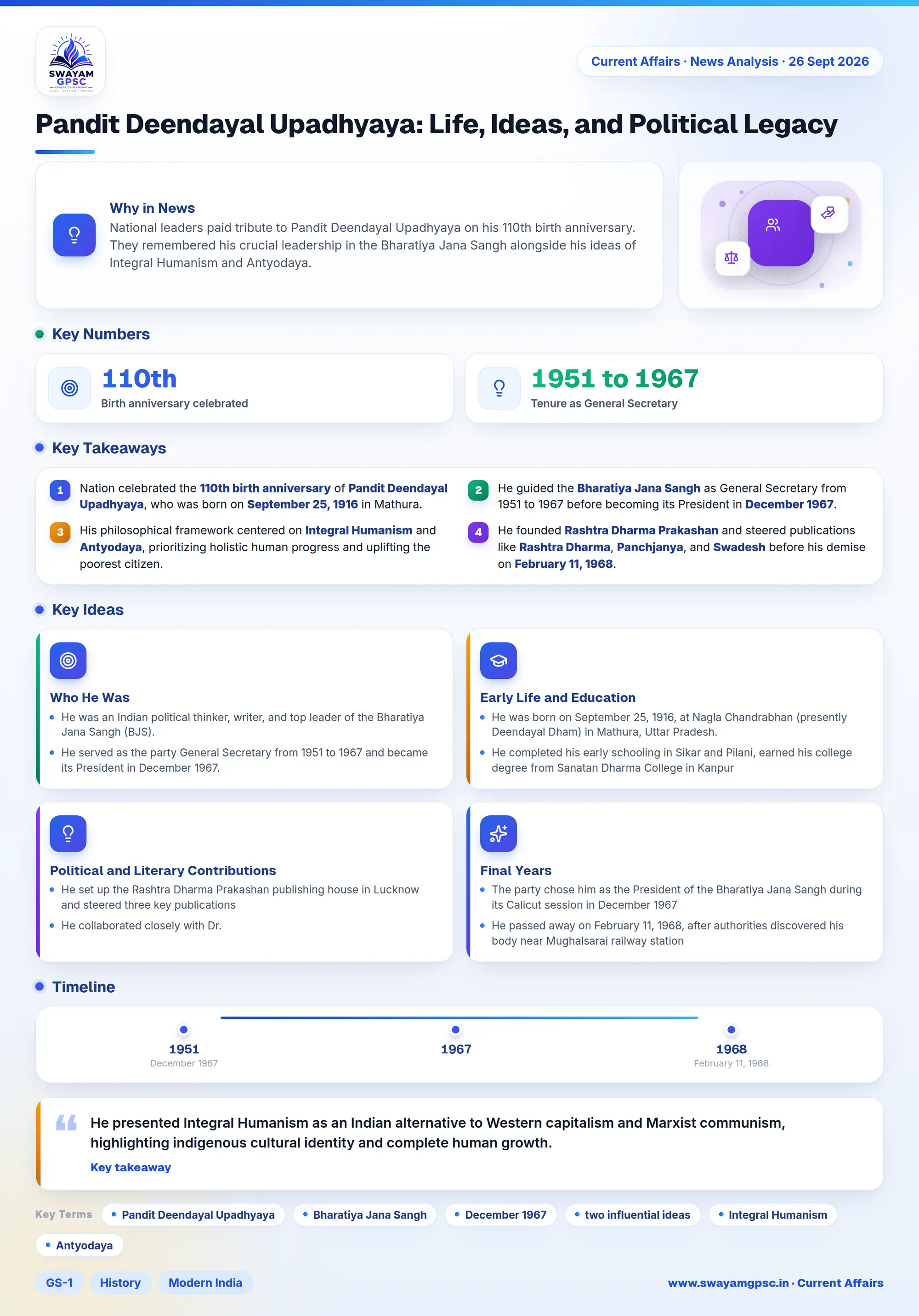
Pandit Deendayal Upadhyaya: Life, Ideas, and Political Legacy
#GS-1 #History #Modern India #Culture #Indian Society #Social Justice #GS-4 #Ethics #Pandit Deendayal Upadhyaya #Integral Humanism #Antyodaya #Bharatiya Jana Sangh
Key takeaways
- Nation celebrated the 110th birth anniversary of Pandit Deendayal Upadhyaya, who was born on September 25, 1916 in Mathura.
- He guided the Bharatiya Jana Sangh as General Secretary from 1951 to 1967 before becoming its President in December 1967.
- His philosophical framework centered on Integral Humanism and Antyodaya, prioritizing holistic human progress and uplifting the poorest citizen.
- He founded Rashtra Dharma Prakashan and steered publications like Rashtra Dharma, Panchjanya, and Swadesh before his demise on February 11, 1968.
Why in News
- National leaders paid tribute to Pandit Deendayal Upadhyaya on his 110th birth anniversary.
- They remembered his crucial leadership in the Bharatiya Jana Sangh alongside his ideas of Integral Humanism and Antyodaya.
Who He Was
- He was an Indian political thinker, writer, and top leader of the Bharatiya Jana Sangh (BJS).
- He served as the party General Secretary from 1951 to 1967 and became its President in December 1967.
- He formulated two influential ideas that shaped Indian socio-political thought.
- His concept of Integral Humanism focused on the balanced growth of body, mind, intellect, and soul, while living in harmony with society and nature.
- His philosophy of Antyodaya stressed that the benefits of progress must reach the poorest person standing at the very end of the line.
Early Life and Education
- He was born on September 25, 1916, at Nagla Chandrabhan (presently Deendayal Dham) in Mathura, Uttar Pradesh.
- He completed his early schooling in Sikar and Pilani, earned his college degree from Sanatan Dharma College in Kanpur, and finished his teacher training at Prayag.
- He joined the RSS in 1937 and dedicated himself as a full-time pracharak, working largely across Uttar Pradesh.
Political and Literary Contributions
- He set up the Rashtra Dharma Prakashan publishing house in Lucknow and steered three key publications: Rashtra Dharma (monthly), Panchjanya (weekly), and Swadesh (daily).
- He collaborated closely with Dr. Syama Prasad Mookerjee during the founding of the Bharatiya Jana Sangh in 1951 and built its organizational network across the country.
- He presented Integral Humanism as an Indian alternative to Western capitalism and Marxist communism, highlighting indigenous cultural identity and complete human growth.
Final Years
- The party chose him as the President of the Bharatiya Jana Sangh during its Calicut session in December 1967, where he strove to build its nationwide reach.
- He passed away on February 11, 1968, after authorities discovered his body near Mughalsarai railway station under disputed circumstances.