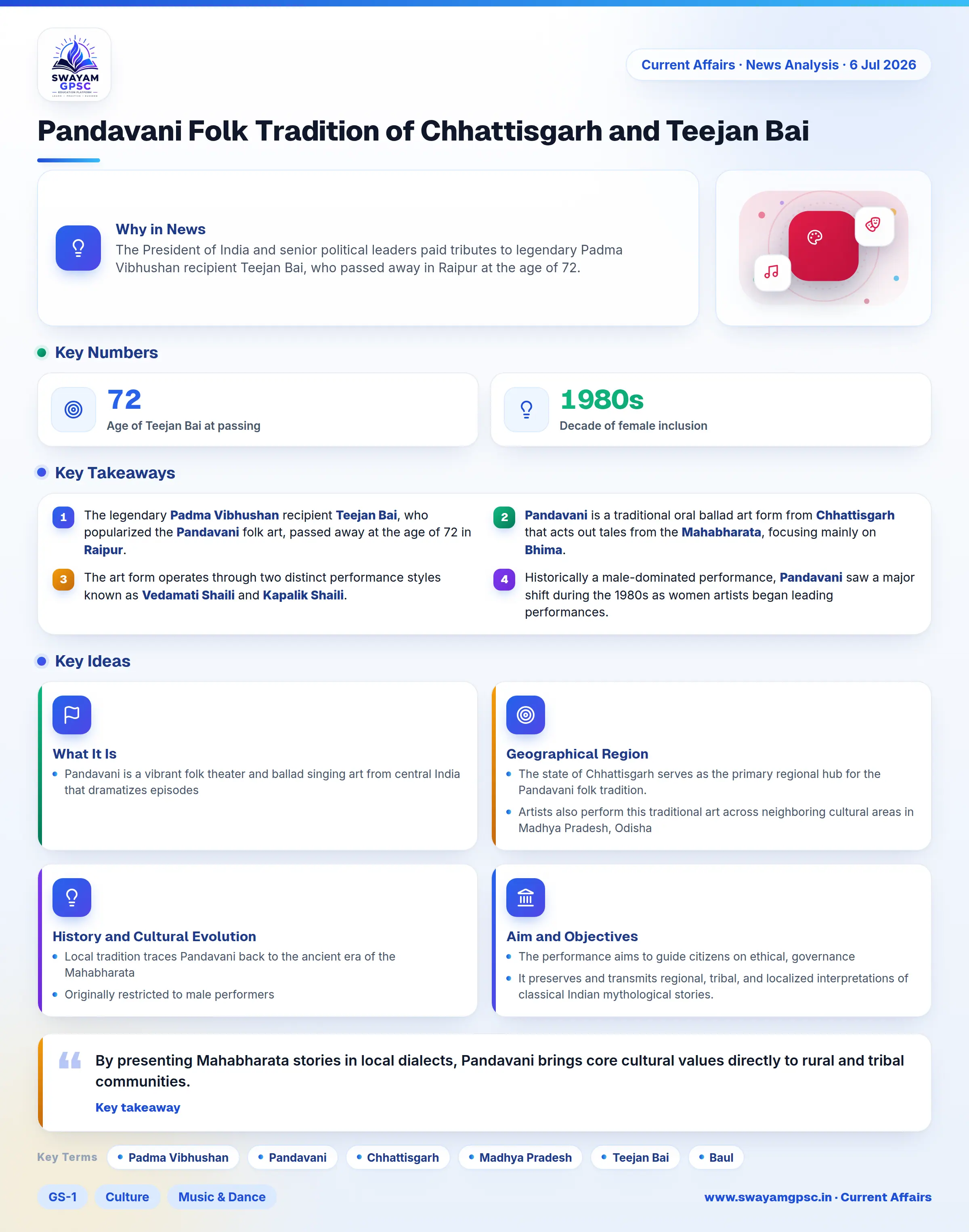
Pandavani Folk Tradition of Chhattisgarh and Teejan Bai
#GS-1 #Culture #Music & Dance #Heritage #Tribal Culture #Current Events #National
Why in News
- The President of India and senior political leaders paid tributes to legendary **Padma Vibhushan** recipient **Teejan Bai**, who passed away in **Raipur** at the age of **72**.
What It Is
- **Pandavani** is a vibrant folk theater and ballad singing art from central India that dramatizes episodes from the **Mahabharata** with **Bhima** as the lead hero.
Geographical Region
- The state of **Chhattisgarh** serves as the primary regional hub for the **Pandavani** folk tradition.
- Artists also perform this traditional art across neighboring cultural areas in **Madhya Pradesh**, **Odisha**, and **Andhra Pradesh**.
History and Cultural Evolution
- Local tradition traces **Pandavani** back to the ancient era of the **Mahabharata**, preserving epic narratives through generations of spoken storytelling.
- Originally restricted to male performers, the tradition experienced a major shift in the **1980s** when **Teejan Bai** and other female artists joined the art form.
- This oral ballad custom shares close artistic ties with Bengal's **Baul** singers and early **Kathak** narrative storytellers.
Aim and Objectives
- The performance aims to guide citizens on ethical, governance, and social dilemmas using philosophical lessons from the **Mahabharata**.
- It preserves and transmits regional, tribal, and localized interpretations of classical Indian mythological stories.
Key Structural Features
- The narrator uses a string instrument like the **Tambura** or **Ektara** as a flexible prop to represent **Bhima's** mace, **Arjuna's** bow, or **Draupadi's** hair.
- Accompanying musicians play the **Harmonium**, **Tabla**, **Dholak**, and **Manjira**, while chorus singers interact with questions and humor.
- The **Vedamati Shaili** represents a structured performance style following **Sabbal Singh Chauhan's** written text in Doha-Chaupai metre.
- The **Kapalik Shaili** represents an improvisational style driven by memory, personal creativity, and dramatic performance, popularized by **Teejan Bai**.
Significance
- By presenting **Mahabharata** stories in local dialects, **Pandavani** brings core cultural values directly to rural and tribal communities.
- Women artists like **Teejan Bai** broke long-standing social barriers, opening doors for female participation and empowerment through folk performance.