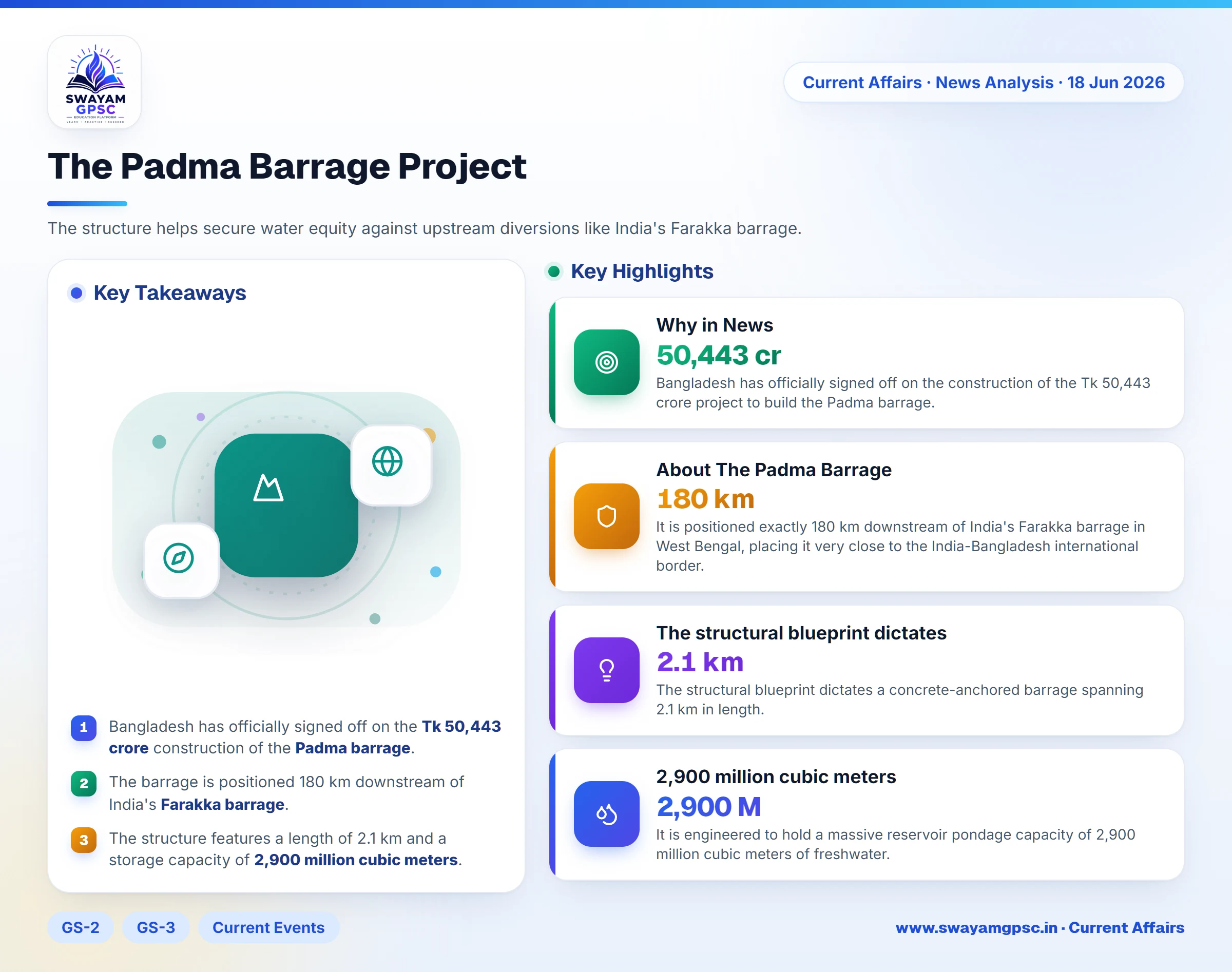
The Padma Barrage Project
#GS-2 #GS-3 #Current Events #International #Infrastructure #Environment #Geography
Key takeaways
- Bangladesh has officially signed off on the Tk 50,443 crore construction of the Padma barrage.
- The barrage is positioned 180 km downstream of India's Farakka barrage.
- The structure features a length of 2.1 km and a storage capacity of 2,900 million cubic meters.
- The project will directly benefit 6.5 crore people across the northern and southwestern regions of Bangladesh.
- The entire construction work is scheduled to be completed over a period of seven years.
Why in News
- Bangladesh has officially signed off on the construction of the Tk 50,443 crore project to build the Padma barrage.
- This project aims to combat seasonal water scarcity and assert lower-riparian control over its water resources.
About The Padma Barrage
- The Padma barrage is a massive, planned transboundary water-management structure designed to act as a large reservoir.
- It serves as a defensive infrastructure choice by Bangladesh to regulate downstream flows and increase groundwater recharge.
- The structure helps secure water equity against upstream diversions like India's Farakka barrage.
- The barrage is being constructed entirely across the main channel of the Padma River.
- It is positioned exactly 180 km downstream of India's Farakka barrage in West Bengal, placing it very close to the India-Bangladesh international border.
- The structural blueprint dictates a concrete-anchored barrage spanning 2.1 km in length.
- It is engineered to hold a massive reservoir pondage capacity of 2,900 million cubic meters of freshwater.
- The project is optimized to directly stabilize agricultural irrigation and drinking water supply for 6.5 crore people living across the vulnerable southwestern and northern regions of Bangladesh.
- It is projected to cost Tk 50,443 crore with an execution timeline spreading over seven years.
About the Padma River
- The Padma River is a major, high-volume transboundary river flowing through Bangladesh.
- It is the main downstream distributary of the Ganges River after it crosses the international boundary from India into Bangladesh.
- The river originates at Devprayag, where the Alaknanda and Bhagirathi rivers merge to form the Ganga.
- After entering Bangladesh near Shibganj, the Ganga officially takes the name Padma.
- The Padma joins the Jamuna at Goalundo and later merges with the Meghna at Chandpur before reaching the Bay of Bengal.
- The Padma flows through extremely low-lying deltaic plains, making the region highly vulnerable to flooding and sea-level rise.
- Reduced river flow promotes heavy silt deposition, raising the riverbed and increasing flood risks during monsoon seasons.
- Sediment carried by the river enriches soils and aquatic ecosystems, supporting fisheries and local livelihoods.
- Freshwater from the Padma maintains the salinity balance of the Sundarbans Mangroves, sustaining its unique mangrove biodiversity.