Padma Awards 2026: Categories, Recipients, and Selection Process
#GS-1 #Culture #Important Personalities #Rapid Fire CA #Quick Facts For Prelims
Key takeaways
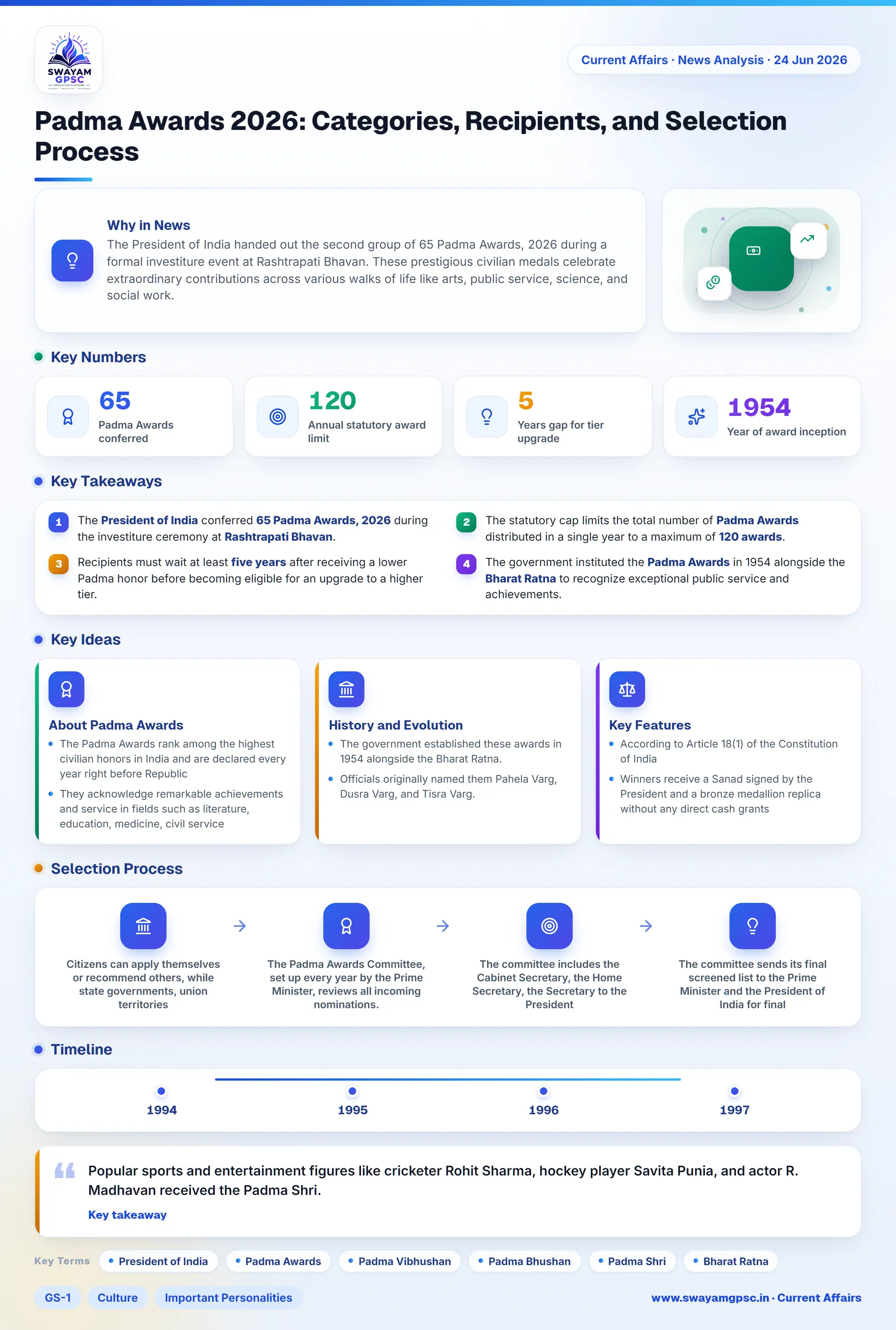
- The President of India conferred 65 Padma Awards, 2026 during the investiture ceremony at Rashtrapati Bhavan.
- The statutory cap limits the total number of Padma Awards distributed in a single year to a maximum of 120 awards.
- Recipients must wait at least five years after receiving a lower Padma honor before becoming eligible for an upgrade to a higher tier.
- The government instituted the Padma Awards in 1954 alongside the Bharat Ratna to recognize exceptional public service and achievements.
Why in News
- The President of India handed out the second group of 65 Padma Awards, 2026 during a formal investiture event at Rashtrapati Bhavan.
- These prestigious civilian medals celebrate extraordinary contributions across various walks of life like arts, public service, science, and social work.
About Padma Awards
- The Padma Awards rank among the highest civilian honors in India and are declared every year right before Republic Day.
- They acknowledge remarkable achievements and service in fields such as literature, education, medicine, civil service, sports, and trade.
- The Padma Vibhushan stands as the second-highest civilian award after the Bharat Ratna, given for exceptional and distinguished service.
- The Padma Bhushan recognizes distinguished service of a high order.
- The Padma Shri honors distinguished service in any field of human endeavor.
History and Evolution
- The government established these awards in 1954 alongside the Bharat Ratna.
- Officials originally named them Pahela Varg, Dusra Varg, and Tisra Varg.
- A presidential notification in January 1955 renamed these tiers to Padma Vibhushan, Padma Bhushan, and Padma Shri.
- The government announced these awards every year without a break, except for temporary pauses in 1978, 1979, 1993, 1994, 1995, 1996, and 1997.
Selection Process
- Citizens can apply themselves or recommend others, while state governments, union territories, and central ministries also submit names between May and September.
- The Padma Awards Committee, set up every year by the Prime Minister, reviews all incoming nominations.
- The committee includes the Cabinet Secretary, the Home Secretary, the Secretary to the President, and several eminent civil society members.
- The committee sends its final screened list to the Prime Minister and the President of India for final approval.
Key Features
- According to Article 18(1) of the Constitution of India, recipients cannot use these awards as titles or prefixes on letterheads and books.
- Winners receive a Sanad signed by the President and a bronze medallion replica without any direct cash grants or travel perks.
- The total number of awards given in a single year cannot cross a legal cap of 120 awards, excluding posthumous awards and NRIs.
- A person must wait at least five years after receiving a lower award before getting an upgrade to a higher tier.
- The government avoids posthumous awards unless special circumstances justify honoring someone who passed away shortly before the announcement.
Notable Awardees and Categories
- Former Supreme Court judge K.T. Thomas and journalist P. Narayanan received the Padma Vibhushan for public affairs and literature.
- Prominent Padma Bhushan recipients include oncologist Dattatreyudu Nori, industrialist S.K.M. Maeilanandhan, and social worker Vellappally Natesan.
- Late Jharkhand leader Shibu Soren received a posthumous Padma Bhushan.
- Tennis star Vijay Amritraj, actor Mammootty, and singer Alka Yagnik also received the Padma Bhushan.
- Aerospace scientist Chandramouli Gaddamanugu received the Padma Shri for his work on the Akash missile system during Operation Sindoor.
- Social worker Budhri Tati won the Padma Shri for promoting education in the Naxal-affected Bastar region.
- Folk artist Guru Sangyusang Pongener and Georgian wrestling coach Vladimir Mestvirishvili also earned the Padma Shri.
- Popular sports and entertainment figures like cricketer Rohit Sharma, hockey player Savita Punia, and actor R. Madhavan received the Padma Shri.