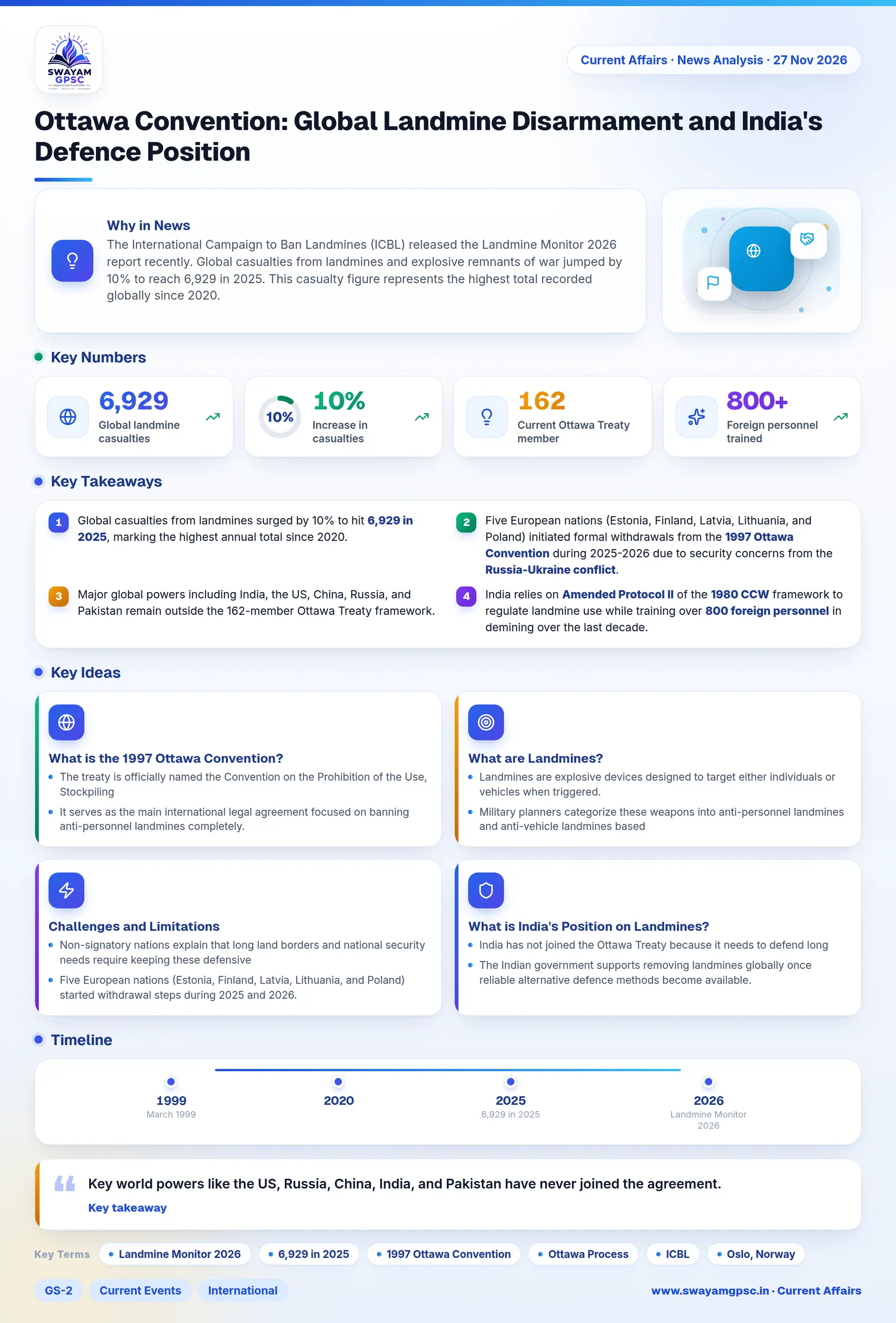
Ottawa Convention: Global Landmine Disarmament and India's Defence Position
#GS-2 #Current Events #International #Groupings & Agreements Involving India and/or Affecting India's Interests #Governance & Social Justice #Security Issues #Humanitarian Disarmament
Key takeaways
- Global casualties from landmines surged by 10% to hit 6,929 in 2025, marking the highest annual total since 2020.
- Five European nations (Estonia, Finland, Latvia, Lithuania, and Poland) initiated formal withdrawals from the 1997 Ottawa Convention during 2025-2026 due to security concerns from the Russia-Ukraine conflict.
- Major global powers including India, the US, China, Russia, and Pakistan remain outside the 162-member Ottawa Treaty framework.
- India relies on Amended Protocol II of the 1980 CCW framework to regulate landmine use while training over 800 foreign personnel in demining over the last decade.
Why in News
- The International Campaign to Ban Landmines (ICBL) released the Landmine Monitor 2026 report recently.
- Global casualties from landmines and explosive remnants of war jumped by 10% to reach 6,929 in 2025.
- This casualty figure represents the highest total recorded globally since 2020.
- Heavy fighting in Myanmar and Syria primarily drove this sudden increase in civilian injuries and deaths.
- This rise coincides with the first-ever formal state withdrawals from the 1997 Ottawa Convention.
- These developments have raised serious concerns regarding the future of international humanitarian disarmament efforts.
What is the 1997 Ottawa Convention?
- The treaty is officially named the *Convention on the Prohibition of the Use, Stockpiling, Production and Transfer of Anti-Personnel Mines and on their Destruction*.
- It serves as the main international legal agreement focused on banning anti-personnel landmines completely.
- The treaty grew out of the Ottawa Process, a partnership between civil society groups and governments outside standard UN channels.
- The ICBL and the International Committee of the Red Cross led this diplomatic movement alongside supportive nations.
- Delegates adopted the treaty text in Oslo, Norway, back in September 1997.
- Official signatures opened in Ottawa, Canada, in December 1997 and later at UN Headquarters, gathering 133 signatories.
- The agreement formally entered into force in March 1999.
- The ICBL and its founding coordinator Jody Williams received the 1997 Nobel Peace Prize for their disarmament efforts.
- This treaty strictly bans anti-personnel mines, but it does not prohibit anti-vehicle mines or command-detonated devices.
- Recent accessions by Lebanon, the Marshall Islands, and Tonga brought total treaty membership to 162 countries despite five European departures.
- Major military nations including India, the United States, China, Russia, and Pakistan remain non-signatories.
What are Landmines?
- Landmines are explosive devices designed to target either individuals or vehicles when triggered.
- Military planners categorize these weapons into anti-personnel landmines and anti-vehicle landmines based on their intended target.
- These hidden explosives stay dangerous for decades after armed conflicts end, causing long-term civilian trauma and loss of life.
- Landmine contamination prevents farmers from accessing agricultural fields, disrupting local food security and rural livelihoods.
- Unexploded weapons slow down economic recovery and physical reconstruction in post-conflict zones.
- Explosive Remnants of War refer to unexploded bombs or abandoned munitions that continue threatening civilians after combat ends.
Challenges and Limitations of the Ottawa Convention
- Key world powers like the US, Russia, China, India, and Pakistan have never joined the agreement.
- Non-signatory nations explain that long land borders and national security needs require keeping these defensive weapons.
- Five European nations (Estonia, Finland, Latvia, Lithuania, and Poland) started withdrawal steps during 2025 and 2026.
- These countries cited fresh security threats from the ongoing Russia-Ukraine conflict as their reason for leaving.
- Recent departures and renewed landmine production risk weakening global norms around humanitarian law.
- New accessions by Lebanon, the Marshall Islands, and Tonga show that some international support for disarmament remains active.
- The treaty targets victim-activated personnel mines but leaves out anti-vehicle mines and command-triggered explosives.
- Article 3 permits governments to hold back small stocks of landmines for military training purposes.
- Without an independent inspection agency, treaty compliance relies almost entirely on self-reporting and diplomatic pressure.
- Developing nations frequently fail to finish mine removal within the standard 10-year deadline due to high costs and limited tools.
- Ongoing fighting in Ukraine, Myanmar, Syria, and Yemen continues to create new mined zones faster than workers can clear them.
- Shortages in funding delay healthcare, artificial limb fitting, and financial support for mine survivors.
What is India's Position on Landmines?
- India has not joined the Ottawa Treaty because it needs to defend long, disputed borders with non-member nations like China and Pakistan.
- The Indian government supports removing landmines globally once reliable alternative defence methods become available.
- India is a full party to the 1980 Convention on Certain Conventional Weapons (CCW) and its Amended Protocol II of 1996.
- This framework regulates how armies use landmines rather than banning the weapons outright.
- The Indian Armed Forces regularly submit compliance reports and educate soldiers on their obligations under Protocol II.
- India funds village safety programs and ensures troops clear landmines after operations so farmers can return to their land.
- The government provides financial compensation, medical aid, and prosthetic limbs to civilians injured by landmines.
- Indian military experts have helped clear landmine fields abroad, including projects in Sri Lanka and Afghanistan.
- India has trained over 800 foreign personnel in mine clearance and bomb disposal methods over the past ten years.
- The Landmine Monitor 2026 lists India among nations that manufacture or plan to manufacture anti-personnel landmines.
- The report highlights that non-state armed groups inside India also construct improvised landmines, creating security risks.
Ottawa Treaty (1997) vs CCW Amended Protocol II (1996)
- The Ottawa Treaty emerged from civil society efforts in 1997, while CCW Amended Protocol II was adopted under UN auspices in 1996.
- The Ottawa framework imposes a complete ban on anti-personnel landmines, whereas Protocol II regulates their usage design and placement.
- The Ottawa Treaty applies rules universally in all settings, while Protocol II applies to international and internal armed conflicts.
- The Ottawa agreement demands total stockpile destruction, whereas Protocol II requires mines to contain enough metal for standard detectors to find.
- India is not a party to the Ottawa Treaty, but it remains an active State Party to CCW Amended Protocol II.