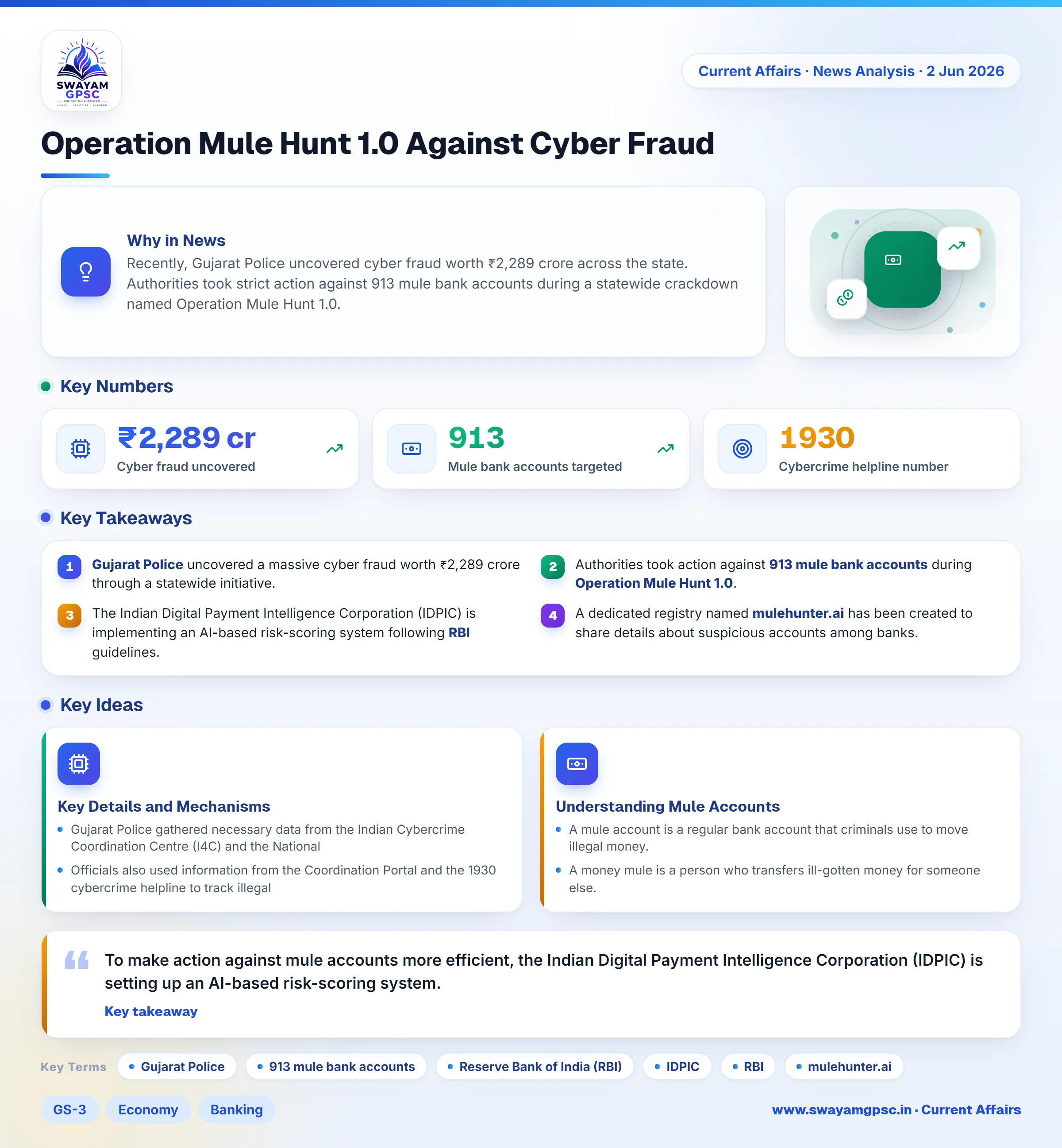
Operation Mule Hunt 1.0 Against Cyber Fraud
#GS-3 #Economy #Banking #Cyber Security #Infrastructure #Gujarat #National #Rapid Fire CA #Quick Facts For Prelims
Key takeaways
- Gujarat Police uncovered a massive cyber fraud worth ₹2,289 crore through a statewide initiative.
- Authorities took action against 913 mule bank accounts during Operation Mule Hunt 1.0.
- The Indian Digital Payment Intelligence Corporation (IDPIC) is implementing an AI-based risk-scoring system following RBI guidelines.
- A dedicated registry named mulehunter.ai has been created to share details about suspicious accounts among banks.
Why in News
- Recently, Gujarat Police uncovered cyber fraud worth ₹2,289 crore across the state.
- Authorities took strict action against 913 mule bank accounts during a statewide crackdown named Operation Mule Hunt 1.0.
Key Details and Mechanisms
- Gujarat Police gathered necessary data from the Indian Cybercrime Coordination Centre (I4C) and the National Cybercrime Reporting Portal (NCRP).
- Officials also used information from the Coordination Portal and the 1930 cybercrime helpline to track illegal transfers.
- To make action against mule accounts more efficient, the Indian Digital Payment Intelligence Corporation (IDPIC) is setting up an AI-based risk-scoring system.
- This system follows guidelines issued by the Reserve Bank of India (RBI) to improve digital payment safety.
- Each financial transaction will be marked as low risk, medium risk, or high risk under this framework.
- This risk classification helps banks spot suspicious accounts quickly and take necessary preventive steps.
- The IDPIC acts as the nodal agency and manages a dedicated registry called mulehunter.ai.
- Banks use this registry to share important details about suspicious accounts safely with each other.
Understanding Mule Accounts
- A mule account is a regular bank account that criminals use to move illegal money.
- A money mule is a person who transfers ill-gotten money for someone else.
- Transnational cybercriminals often use bank accounts belonging to shell companies and regular individuals as mule accounts.
- Criminals easily exploit the bulk payout facility provided by banks to carry out these illegal operations.