NITI Aayog's Strategic Roadmap to Make Ayurveda a Global Healthcare Leader
#GS-2 #Governance & Social Justice #Health #GS-3 #Economy #Growth #Current Events #National #Ayurveda #NITI Aayog
Why in News
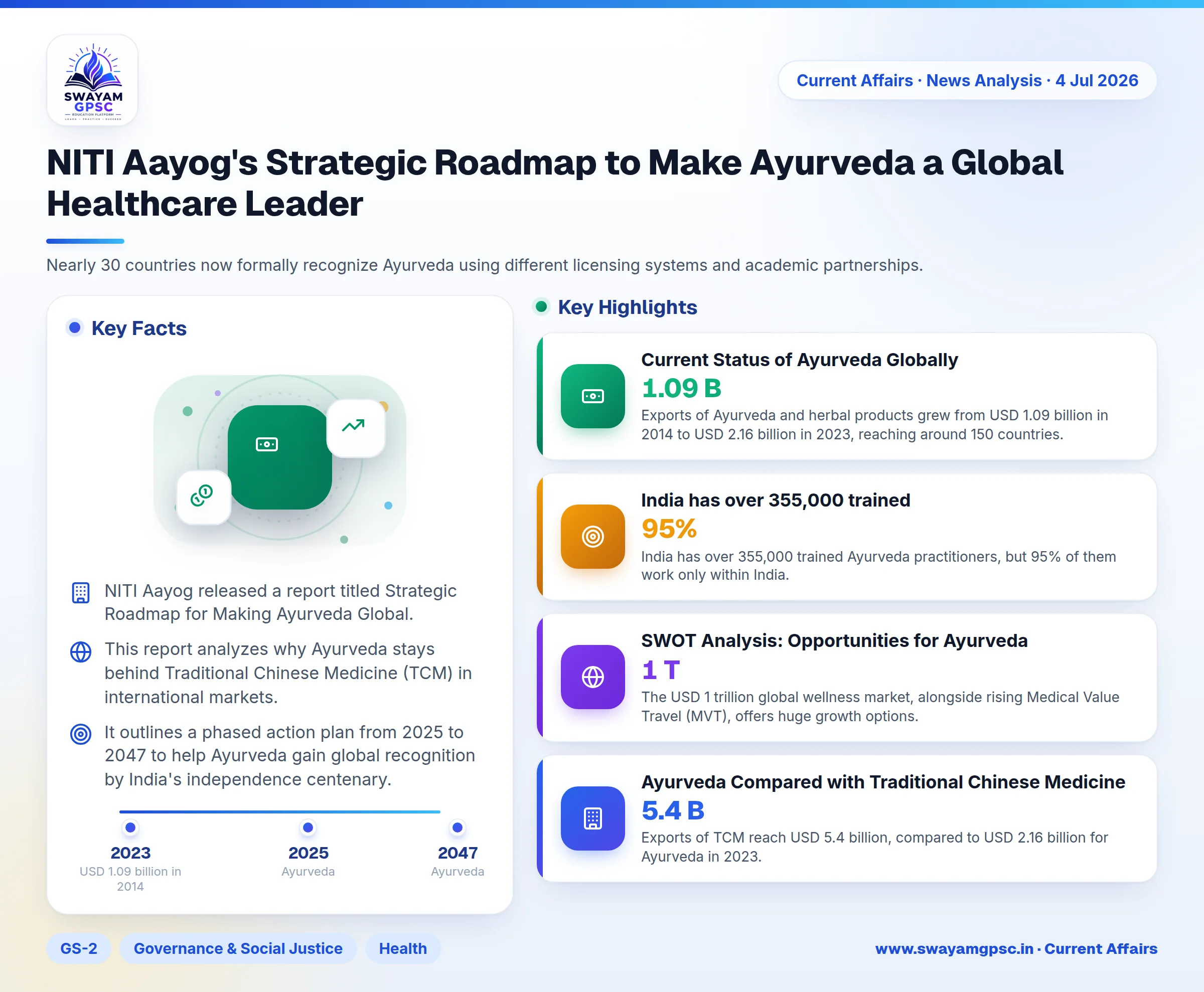
- NITI Aayog released a report titled Strategic Roadmap for Making Ayurveda Global.
- This report analyzes why Ayurveda stays behind Traditional Chinese Medicine (TCM) in international markets.
- It outlines a phased action plan from 2025 to 2047 to help Ayurveda gain global recognition by India's independence centenary.
Current Status of Ayurveda Globally
- Exports of Ayurveda and herbal products grew from USD 1.09 billion in 2014 to USD 2.16 billion in 2023, reaching around 150 countries.
- Nearly 30 countries now formally recognize Ayurveda using different licensing systems and academic partnerships.
- India has over 355,000 trained Ayurveda practitioners, but 95% of them work only within India.
- Research on Ayurveda takes place in nearly 70 countries, aided by the WHO Global Traditional Medicine Centre (GTMC) in Jamnagar, Gujarat.
- Institutions like the University of Mauritius and Western Sydney University host Ayush academic Chairs, though a uniform global curriculum is missing.
- The WHO included Ayurveda, Siddha, and Unani (ASU) in the ICD-11 classification under its TM-2 module.
- The WHO started coding ASU treatments under the ICHI framework to improve tracking, billing, and global clinical research.
SWOT Analysis: Strengths of Ayurveda
- Ayurveda focuses on preventive health and overall wellness, matching the modern global demand for holistic healing.
- Its Prakriti-based system uses plant therapies to provide personal health solutions for each individual.
- Backed by over 5,000 years of knowledge, global Yoga adoption, and WHO ICD-11 inclusion, Ayurveda holds high cultural trust.
- Ayurveda works well alongside modern medicine, especially for chronic diseases, preventive health, and rehabilitation.
SWOT Analysis: Weaknesses of Ayurveda
- Many foreign nations do not treat Ayurveda as an official medical system and lack clear regulations for it.
- A shortage of certified Ayurveda doctors abroad and missing international study standards slow down its growth.
- Because Ayurvedic treatment depends on the individual, producing Randomized Controlled Trial (RCT) evidence remains difficult.
- High testing costs, uneven Good Manufacturing Practices (GMP) quality, and a lack of health insurance coverage limit foreign sales.
SWOT Analysis: Opportunities for Ayurveda
- Programs like Ayush Chairs, Ayush Scholarships, and the Ayush Visa can help Ayurveda expand across borders.
- Working closely with the GTMC and applying ICHI health codes will build international confidence in Ayurveda.
- The USD 1 trillion global wellness market, alongside rising Medical Value Travel (MVT), offers huge growth options.
- Conducting solid scientific research and sharing clear evidence will boost Ayurveda's international standing.
SWOT Analysis: Threats Facing Ayurveda
- Lack of coordination between doctors, scientists, colleges, factories, and regulators delays international success.
- Exporters sell most Ayurvedic goods as dietary supplements instead of prescription medicines, reducing their market value.
- Rapid growth of Traditional Chinese Medicine (TCM), backed by government support, creates stiff competition.
- Balancing core ancient Ayurvedic concepts with strict modern scientific rules remains a tough task.
Ayurveda Compared with Traditional Chinese Medicine
- TCM has over 34,000 licensed acupuncturists in the US across 47 states, while Ayurveda has only about 5,000 practitioners abroad.
- Exports of TCM reach USD 5.4 billion, compared to USD 2.16 billion for Ayurveda in 2023.
- China built over 30 overseas TCM centres using the Belt and Road Initiative (BRI), whereas India relies on Ayush Information Cells and the GTMC.
- Countries like the US, Japan, and Germany offer health insurance for TCM, while Ayurveda insurance remains limited outside India.
- TCM benefits from a dedicated ISO technical committee for quality standards, which Ayurveda currently lacks.
Short Term Strategy: Building the Foundation (Up to 2029)
- Form a high-level Mission Steering Group (MSG) under the Ayush Minister to guide trade, education, research, and diplomacy.
- Launch a Global Ayurveda Register (GAR) under NCISM to verify credentials and offer professional training for global doctors.
- Build a Global Information Portal offering clear details on foreign visas, licenses, and official health rules.
- Speed up WHO-GMP quality certificates for top Ayurvedic medicine makers and publish a public directory of certified facilities.
- Create an Export Edition of the Ayurvedic Pharmacopoeia that sets strict safety standards for raw materials and heavy metals.
- Launch a real-time Ayurveda Trade Dashboard and assign accurate HS codes to boost trade under Free Trade Agreements.
Medium Term Strategy: Market Integration (Up to 2035)
- Register main Ayurvedic medicines under the European Union (EU) Traditional Herbal Medicinal Products Directive (THMPD) framework.
- Test medical insurance coverage for Ayurvedic remedies in selected OECD nations on a pilot basis.
- Sign Mutual Recognition Arrangements (MRAs) with G20, BRICS, and ASEAN partners to allow doctors to work abroad easily.
- Offer Ayurveda elective courses in foreign medical colleges using the existing Ayush Chair network.
- Create medical tourism centers abroad, starting in Mauritius, with bundled Ayush Visa deals covering treatments and online follow-ups.
- Conduct clinical trials in multiple countries via WHO Collaborating Centres and update the Traditional Knowledge Digital Library (TKDL).
Long Term Strategy: Systemic Integration (Up to 2047)
- Integrate Ayurveda officially into the national healthcare systems of at least 20 countries.
- Secure health insurance cover in at least 10 countries for conditions like back pain, knee arthritis, stress, and women's health.
- Establish a network of International Ayurveda Centres of Excellence providing medical care, training, research, and public health tracking.
- Position Ayurveda globally as an evidence-backed, highly trusted healthcare choice by 2047.
Conclusion
- NITI Aayog's roadmap turns Ayurveda from wellness spa treatments into a fully regulated global pharmacy system.
- Combining ancient knowledge with modern scientific testing will help India match the international success of Traditional Chinese Medicine.
- Standardized licensing and quality control convert India's cultural heritage into real economic strength.
- This long-term effort aims to make Ayurveda a core pillar of worldwide healthcare by 2047.