NITI Aayog Report on India's Caregiving Ecosystem
#GS-2 #GS-3 #Governance & Social Justice #Indian Society #Economy #Current Events #Women #Health #Growth #Employment #Constitution #National
Key takeaways
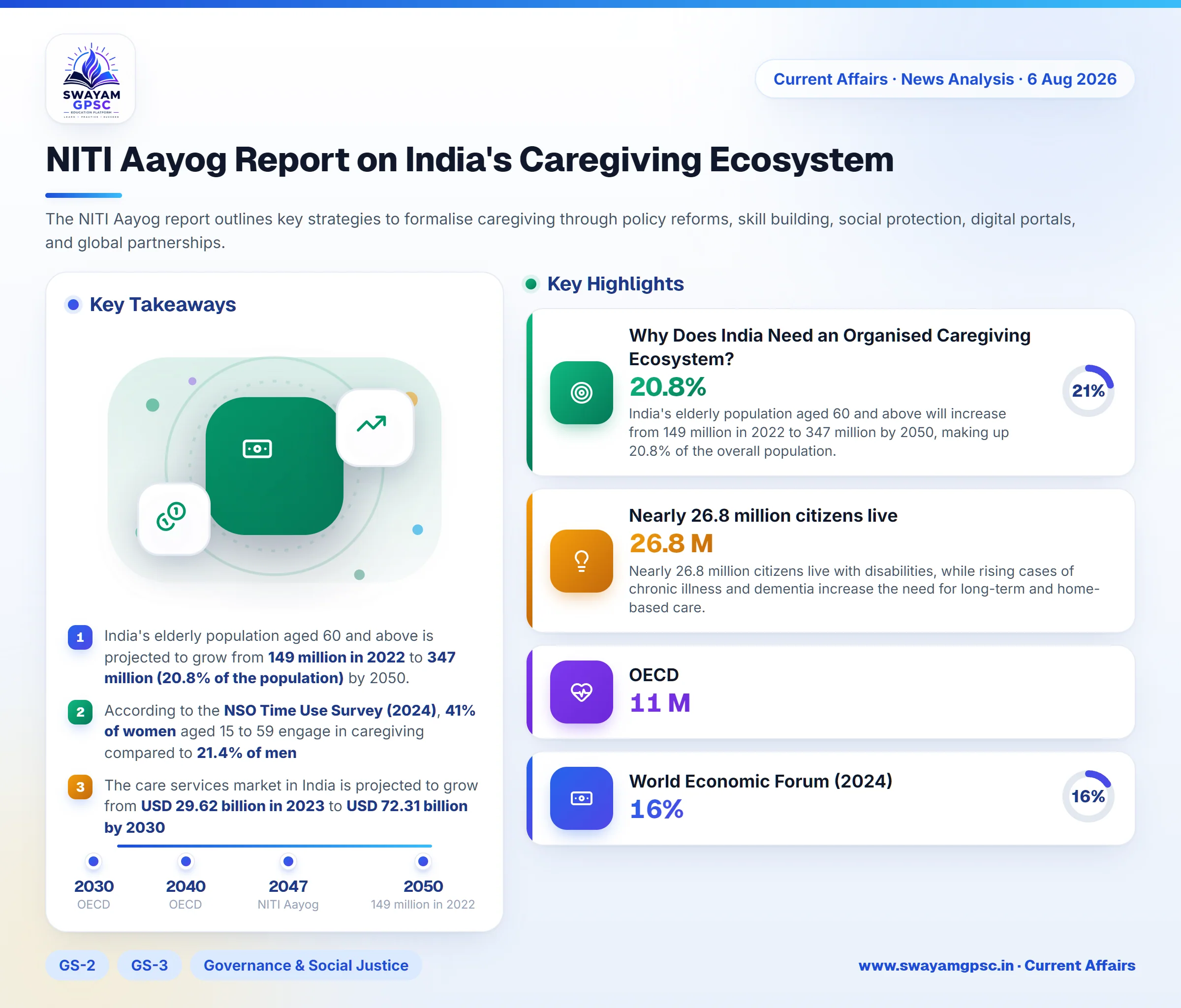
- India's elderly population aged 60 and above is projected to grow from 149 million in 2022 to 347 million (20.8% of the population) by 2050.
- According to the NSO Time Use Survey (2024), 41% of women aged 15 to 59 engage in caregiving compared to 21.4% of men, with women spending 140 minutes daily on care duties.
- The care services market in India is projected to grow from USD 29.62 billion in 2023 to USD 72.31 billion by 2030, representing a CAGR of 13.76%.
- NITI Aayog's report recommends establishing a National Caregiver Council (NCC) as an apex body for caregiver regulation, certification, and standard-setting.
- Globally, the World Health Organization (WHO) predicts a shortage of nearly 11 million health workers by 2030, offering India an opportunity to become a hub for skilled care professionals.
Why in News?
- NITI Aayog published a report titled Reimagining Care: Strategies for Empowering Caregivers in Viksit Bharat@2047. This report creates a roadmap to build a professional caregiving ecosystem and positions India as a global provider of trained care workers.
Summary
- The NITI Aayog report outlines key strategies to formalise caregiving through policy reforms, skill building, social protection, digital portals, and global partnerships.
- Strengthening the care economy helps address India's growing elderly population, empowers women economically, creates new jobs, and supports the vision of Viksit Bharat@2047.
Why Does India Need an Organised Caregiving Ecosystem?
- India's elderly population aged 60 and above will increase from 149 million in 2022 to 347 million by 2050, making up 20.8% of the overall population.
- Nearly 26.8 million citizens live with disabilities, while rising cases of chronic illness and dementia increase the need for long-term and home-based care.
- The World Health Organization (WHO) expects a global shortage of 11 million healthcare workers by 2030, while OECD countries will need 13.5 million additional care workers by 2040.
- The World Economic Forum (2024) reports that the care economy supplies 16% of global jobs, while unpaid care work contributes USD 11 trillion without formal market recognition. India's care services market will expand from USD 29.62 billion in 2023 to USD 72.31 billion by 2030, growing at a compound annual rate of 13.76%.
- According to the NSO Time Use Survey (2024), 41% of women aged 15 to 59 perform caregiving tasks compared to 21.4% of men. Women spend 140 minutes daily on care, while men spend only 74 minutes.
- About 10% of India's population currently acts as unpaid and untrained family caregivers. Professional training can convert this group into a skilled workforce for Viksit Bharat@2047.
- Ageing nations like Japan, Germany, and the UK need caregivers, creating opportunities for India to export trained personnel through Government-to-Government (G2G) agreements.
- Organising care services improves care quality for vulnerable groups and expands the Purple Economy by training Persons with Disabilities (PwDs) as caregivers.
What is the Care Economy?
- The care economy includes all paid and unpaid care services that support personal health, daily living, and well-being across households, businesses, and non-profit groups.
- Professional caregiving aligns with Article 41 of the Constitution, which instructs the State to support the elderly, sick, and disabled while securing their right to work.
India's Existing Caregiving Landscape
- The Department of Social Justice and Empowerment (DoSJE) runs the PM Special - Training of Geriatric Caregivers and created the SHATAYU Dashboard and JEEVAN App.
- The Department of Empowerment of Persons with Disabilities (DEPwD) offers a Certificate Course in Caregiving (CCCG) through the Rehabilitation Council of India (RCI).
- The Ministry of Health and Family Welfare (MoHFW) implements the National Programme for Health Care of the Elderly (NPHCE), while NIMHANS offers training in dementia and geriatric care.
- The Ministry of Skill Development and Entrepreneurship (MSDE) and Ministry of External Affairs (MEA) manage NSQF aligned certifications and Pre-Departure Orientation Training (PDOT) for international jobs.
- Karnataka offers a Carer's Monthly Allowance Scheme and supports caregivers through Self-Help Groups (SHGs).
- Kerala runs programmes like K4Care, Aswasakiranam, and the Triple Win Programme with Germany for palliative and geriatric care.
Care Economy vs. Silver Economy vs. Purple Economy
- The care economy covers all paid and unpaid care work for children, senior citizens, sick persons, and people with disabilities.
- The silver economy consists of commercial activities, products, and services tailored specifically for senior citizens.
- The purple economy promotes the active participation of Persons with Disabilities (PwDs) as trained care workers and economic contributors.
Care Economy vs. Monetized Economy
- Unpaid care work remains invisible in traditional national account statistics, whereas monetized economic activities directly increase calculated Gross Domestic Product (GDP).
- Care work focuses on maintaining human health and building human capital, whereas the monetized economy generates market goods and services for trade.
- Women perform most unpaid caregiving work due to traditional social norms, while the monetized economy offers a broader mix of formal and informal employment.
- Informal caregiving lacks legal frameworks, written contracts, and social safety nets, whereas formal economic jobs generally offer statutory labor protections.
- Society often views caregiving as a family obligation, whereas formal economic work receives official recognition as income-generating labor.
Challenges in India's Caregiving Ecosystem
- Caregiving lacks formal recognition as a regulated profession, which leaves the sector without standard quality guidelines or legal oversight.
- Family caregiving remains unpaid and places a heavy burden on women, restricting their entry into the formal labor force.
- Although the Rights of Persons with Disabilities (RPwD) Act, 2016 acknowledges high-support needs, family caregivers still lack financial aid, health insurance, and pension coverage.
- Existing training courses do not match international requirements, and specialized training for dementia or palliative care remains scarce.
- Rural regions lack formal care facilities due to local migration, and respite care services for exhausted caregivers remain extremely rare.
- The sector lacks standardized background checks, centralized digital health platforms, and official mechanisms to address complaints.
Strategies Proposed by NITI Aayog to Empower Caregivers
- Draft a National Policy on Caregiving to formalise care services and improve coordination between the Central and state governments.
- Set up a National Caregiver Council (NCC) to regulate training, maintain a national caregiver registry, and resolve public complaints.
- Introduce NSQF aligned training programs with specialized tracks for geriatric, stroke, dementia, and palliative care.
- Establish Government-to-Government (G2G) partnerships with Japan, Germany, the UK, and Australia to support ethical overseas recruitment and language training.
- Strengthen specialized institutions like RCI, NISD, and the National Centre for Ageing to expand training capacity.
- Extend insurance coverage under the Unorganised Workers' Social Security Act, 2008, and promote care startups using Mudra and Startup India.
- Support family caregivers through Self-Help Groups (SHGs), Ayushman Arogya Mandirs, and local Corporate Social Responsibility (CSR) projects.
- Provide caregivers with statutory leave, short-term relief care, and mental health counseling to prevent burnout.
- Build a National Digital Caregiver Portal featuring verified background checks, caregiver registries, and online multilingual training.
- Learn from international practices such as Japan's Long-Term Care Insurance (LTCI), Australia's digital training modules, China's use of elder-care robotics, and Sweden's shared social care model.
Conclusion
- Building a structured caregiving system is a strategic investment that strengthens human development, gender equity, and economic expansion.
- By standardizing caregiver training and building robust support systems, India can satisfy domestic care demands while providing skilled care professionals to the world under Viksit Bharat@2047.