NIPUN Bharat Mission and Foundational Learning in India
#GS-2 #Governance & Social Justice #Education #Government Policies & Interventions #NIPUN Bharat Mission #Foundational Literacy and Numeracy
Why in News
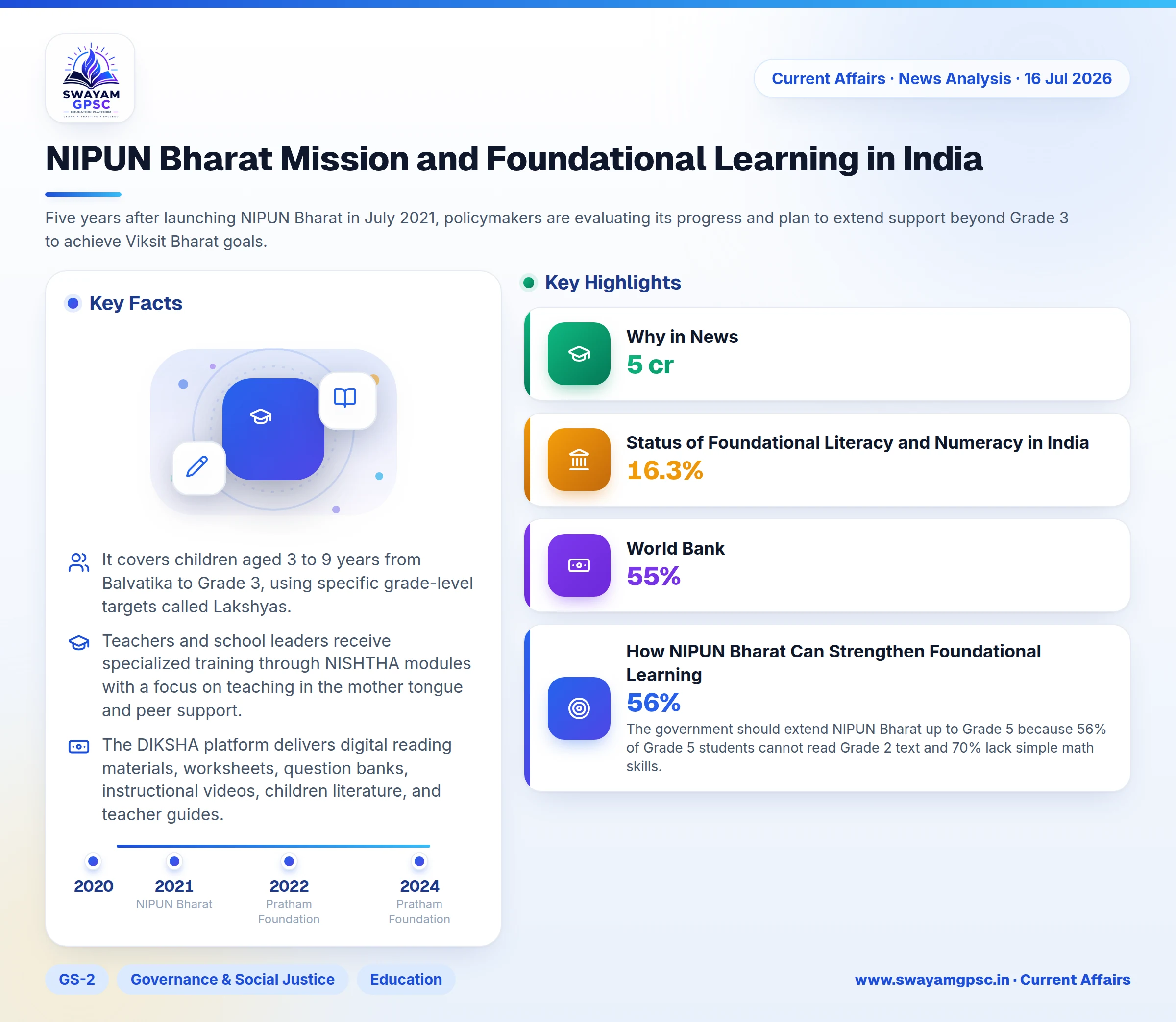
- Five years after launching NIPUN Bharat in July 2021, policymakers are evaluating its progress and plan to extend support beyond Grade 3 to achieve Viksit Bharat goals.
- The National Education Policy (NEP) 2020 made foundational literacy and numeracy (FLN) the highest priority because over 5 crore primary students lacked basic reading and math skills.
Key Features of NIPUN Bharat Mission
- NIPUN Bharat stands for National Initiative for Proficiency in Reading with Understanding and Numeracy, launched in July 2021 by the Ministry of Education under Samagra Shiksha and NEP 2020.
- The mission targets that every child gets essential skills in reading, writing, and basic math by the end of Grade 3, or at least by Grade 5, target year 2026-27.
- It covers children aged 3 to 9 years from Balvatika to Grade 3, using specific grade-level targets called Lakshyas.
- The teaching approach uses child-centered, play-based, activity-based, toy-based, storytelling, art-integrated, and sports-integrated methods suited to a child's home language.
- Foundational literacy focuses on oral speech, decoding words, reading speed, understanding, and writing, while foundational numeracy covers basic math operations, numbers, shapes, measurement, and data handling.
- Teachers and school leaders receive specialized training through NISHTHA modules with a focus on teaching in the mother tongue and peer support.
- The DIKSHA platform delivers digital reading materials, worksheets, question banks, instructional videos, children literature, and teacher guides.
- The program relies on stress-free and continuous skill tests to spot learning gaps, while IT portals track individual child progress and conduct annual surveys.
- The Department of School Education and Literacy under the Ministry of Education runs this mission through the centrally sponsored Samagra Shiksha scheme.
- Samagra Shiksha combined three earlier programs, including Sarva Shiksha Abhiyan, Rashtriya Madhyamik Shiksha Abhiyan, and Teacher Education, to support education holistically from pre-school to Class 12.
- A five-tier implementation structure operates across national, state, district, block, and school levels with help from School Management Committees, local bodies, and parents.
- The mission aims to raise learning standards, lower school dropouts, help students move to higher classes easily, and build skills needed for future jobs.
Status of Foundational Literacy and Numeracy in India
- Foundational learning means a child can read simple sentences with complete understanding and solve basic math sums by the end of Class 3.
- These core skills help children learn complex subjects in higher classes and build critical thinking and problem-solving abilities.
- Even though NEP 2020 gave top priority to foundational learning, a large number of primary students still struggle with basic skills.
- The Annual Status of Education Report (ASER) by NGO Pratham Foundation shows that government school Class 3 students who can read Class 2 text grew slowly from 16.3% in 2022 to 23.4% in 2024.
- The World Bank defines learning poverty as the inability to read a simple text by age 10, and India suffers from a high learning poverty rate of around 55%, which worsened after Covid-19.
Policy Frameworks for FLN
- NEP 2020 officially declared foundational learning as a national task, making basic reading and math by Grade 3 necessary for all future schooling.
- Samagra Shiksha Abhiyan acts as an overarching program for pre-school through Class 12, focusing on raising classroom quality across India.
- The PM SHRI scheme aims to upgrade over 14,500 schools into showcase institutions that demonstrate effective NEP 2020 implementation.
- DIKSHA serves as the national digital repository, offering quality digital content for both students and teachers across the country.
How NIPUN Bharat Can Strengthen Foundational Learning for Viksit Bharat
- The government should extend NIPUN Bharat up to Grade 5 because 56% of Grade 5 students cannot read Grade 2 text and 70% lack simple math skills.
- India needs to make Balvatika universal because 57% of children enter primary school without proper school readiness.
- Teacher training must shift from one-time workshops to regular hybrid learning matched with NPST standards, especially for Multi-Grade Multi-Level (MGML) classrooms that form 70% of primary schools.
- States should create a dedicated mentor group that visits classrooms regularly, watches lessons, and offers constructive feedback to teachers.
- Assessment tools like PARAKH Rashtriya Sarvekshan (PRS) and the Foundational Learning Study (FLS) need alignment, alongside competency testing for Grade 5.
- The government should publish a district-level NIPUN Index, involve parents through reading fairs, and restart the National Steering Committee for direct outcome tracking.
Frequently Asked Questions on NIPUN Bharat
- NIPUN Bharat is a national learning mission started in July 2021 to ensure basic reading and math skills for all children by Grade 3.
- NIPUN stands for National Initiative for Proficiency in Reading with Understanding and Numeracy.
- Foundational literacy is the skill to read with comprehension, express thoughts in writing, and communicate clearly.
- Foundational numeracy means understanding basic numbers, doing simple arithmetic, and applying everyday math reasoning.
- Foundational learning matters because it forms the bedrock for future education, critical thinking, higher academic growth, and workforce productivity.