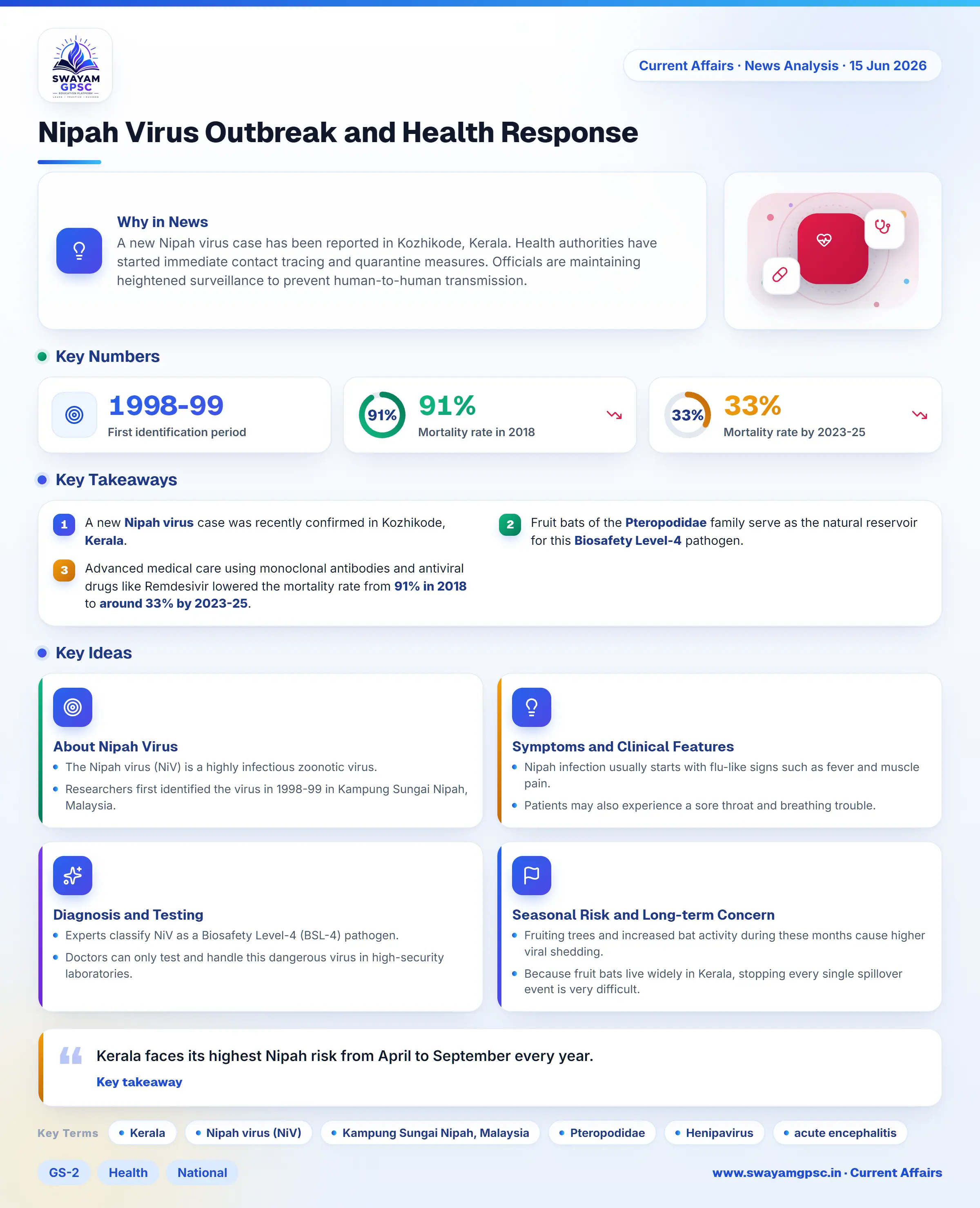
Nipah Virus Outbreak and Health Response
#GS-2 #Health #National #Rapid Fire CA #Quick Facts For Prelims
Key takeaways
- A new Nipah virus case was recently confirmed in Kozhikode, Kerala.
- Fruit bats of the Pteropodidae family serve as the natural reservoir for this Biosafety Level-4 pathogen.
- Advanced medical care using monoclonal antibodies and antiviral drugs like Remdesivir lowered the mortality rate from 91% in 2018 to around 33% by 2023-25.
Why in News
- A new Nipah virus case has been reported in Kozhikode, Kerala.
- Health authorities have started immediate contact tracing and quarantine measures.
- Officials are maintaining heightened surveillance to prevent human-to-human transmission.
About Nipah Virus
- The Nipah virus (NiV) is a highly infectious zoonotic virus.
- Researchers first identified the virus in 1998-99 in Kampung Sungai Nipah, Malaysia.
- According to the World Health Organization (WHO), the virus spreads from animals to humans.
- Fruit bats of the Pteropodidae family serve as the natural reservoir for the virus.
- Pigs act as intermediate hosts before the virus reaches humans.
- The virus belongs to the Henipavirus genus within the Paramyxoviridae family.
- It can spread directly between humans, making it a serious public health threat that requires quick containment.
Symptoms and Clinical Features
- Nipah infection usually starts with flu-like signs such as fever and muscle pain.
- Patients may also experience a sore throat and breathing trouble.
- Severe cases can develop into acute encephalitis, which causes brain swelling.
- This severe brain swelling leads to convulsions, confusion, coma, and sometimes death.
- Some infected people show no symptoms at all, which makes tracking and stopping the spread much harder.
Diagnosis and Testing
- Experts classify NiV as a Biosafety Level-4 (BSL-4) pathogen.
- Doctors can only test and handle this dangerous virus in high-security laboratories.
- Medical teams confirm the infection using real-time polymerase chain reaction (RT-PCR) tests.
- Other diagnostic tools include ELISA, serum neutralisation tests, and histopathology.
Seasonal Risk and Long-term Concern
- Kerala faces its highest Nipah risk from April to September every year.
- Fruiting trees and increased bat activity during these months cause higher viral shedding.
- Because fruit bats live widely in Kerala, stopping every single spillover event is very difficult.
- The state government focuses mainly on constant surveillance, quick testing, and fast containment.
Treatment and Prevention
- Scientists have not created any approved vaccine for humans or animals yet.
- Doctors treat patients using strict isolation and intensive supportive care.
- Medical teams in Kerala now use monoclonal antibodies and antiviral drugs such as Remdesivir.
- These better treatments have reduced the death rate from 91% in 2018 down to around 33% by 2023-25.