A New Phase in India and Nepal Relations
#GS-2 #India and its Neighbourhood #Bilateral Groupings & Agreements #Effect of Policies & Politics of Countries on India's Interests #International #Economy #Infrastructure #Energy
Key takeaways
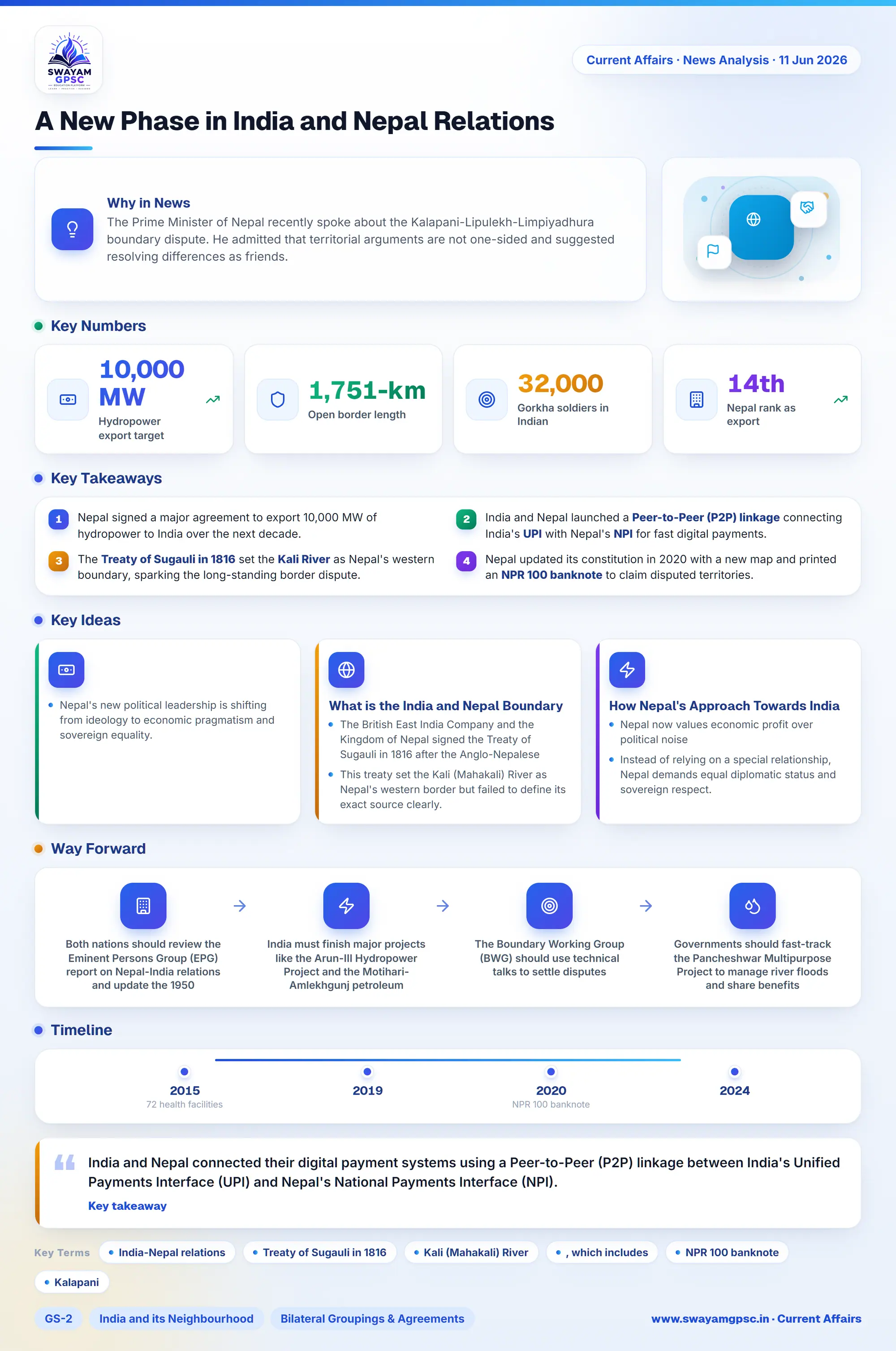
- Nepal signed a major agreement to export 10,000 MW of hydropower to India over the next decade.
- India and Nepal launched a Peer-to-Peer (P2P) linkage connecting India's UPI with Nepal's NPI for fast digital payments.
- The Treaty of Sugauli in 1816 set the Kali River as Nepal's western boundary, sparking the long-standing border dispute.
- Nepal updated its constitution in 2020 with a new map and printed an NPR 100 banknote to claim disputed territories.
- Bilateral trade grew as Nepal became India's 14th largest export destination in 2024-25, up from 28th in 2014.
Why in News
- The Prime Minister of Nepal recently spoke about the Kalapani-Lipulekh-Limpiyadhura boundary dispute.
- He admitted that territorial arguments are not one-sided and suggested resolving differences as friends.
- High-level meetings, including a visit by Nepal's Foreign Minister to India, hint at a practical shift in India-Nepal relations.
Summary
- Nepal's new political leadership is shifting from ideology to economic pragmatism and sovereign equality.
- This change offers a great chance to build a balanced and forward-looking partnership between both nations.
- Despite ongoing disputes over borders, security, and water sharing, both countries can grow closer through better connectivity and energy trade.
What is the India and Nepal Boundary Dispute
- The British East India Company and the Kingdom of Nepal signed the Treaty of Sugauli in 1816 after the Anglo-Nepalese War.
- This treaty set the Kali (Mahakali) River as Nepal's western border but failed to define its exact source clearly.
- Nepal claims that the Kali River originates from the westernmost stream at Limpiyadhura, which includes Kalapani, Lipulekh, and Limpiyadhura inside its land.
- To back this claim, Nepal updated its constitution with a new map in 2020 and later printed the map on a new NPR 100 banknote.
- India states that the river starts near Kalapani, making the area part of Pithoragarh district, Uttarakhand under Indian administration.
- This region sits right next to China, and the Lipulekh Pass is a vital trade route for the Kailash Mansarovar Yatra.
How Nepal's Approach Towards India is Changing
- Nepal now values economic profit over political noise, agreeing to export 10,000 MW of hydropower to India over the next decade.
- Instead of relying on a special relationship, Nepal demands equal diplomatic status and sovereign respect.
- Kathmandu now treats border issues as technical problems to solve through talks rather than public protests.
- Nepal wants to run an independent foreign policy based on historical facts rather than playing India and China against each other.
Key Outcomes of Nepal's Minister for Foreign Affairs Visit to India
- India and Nepal connected their digital payment systems using a Peer-to-Peer (P2P) linkage between India's Unified Payments Interface (UPI) and Nepal's National Payments Interface (NPI).
- This new link allows fast and cheap money transfers across the border to improve financial inclusion.
- Digital India Bhashini and Kathmandu University signed an MoU to build a voice-based language translation tool in Nepal.
- Both nations officially started the India-Nepal Mutual Legal Assistance Agreement (MLAA) to fight cross-border crime together.
- India handed over 72 health facilities and 12 cultural heritage projects built under the Earthquake Reconstruction Assistance Programme after the 2015 earthquake.
India-Nepal Bilateral Relations
- Ties with Nepal form a key pillar of India's Neighbourhood First policy, backed by strong economic and security ties.
- India is Nepal's biggest trading partner, and Nepal became India's 14th largest export destination in 2024-25, up from 28th in 2014.
- Nepal sends items like edible oil, tea, and jute to India while buying fuel, steel, and vehicles in return.
- The Gorkha Regiment of the Indian Army forms a strong defense bond by employing roughly 32,000 Gorkha soldiers from Nepal.
- Both armies practice combat readiness every year through the joint military exercise named 'Surya Kiran'.
- New rail lines like Jayanagar - Bijalpura - Bardibas mark Nepal's first broad-gauge railway.
- The Mechi Bridge spans the Mechi River to connect the Panitanki Bypass in West Bengal, India with Nepal.
- The Motihari (India) to Amlekhgunj (Nepal) pipeline, finished in 2019, works as South Asia’s first cross-border petroleum pipeline.
- Under the Power Trade Agreement (2024), Nepal will supply 10,000 MW of hydroelectricity to India over ten years.
- People can now scan and pay across the border using cross-border QR payments via UPI interoperability with Nepal’s FonePay.
- Water sharing and flood control follow old treaties like the Kosi Agreement (1954), Gandak Agreement (1959), and rules for the Karnali and Mahakali (1996) rivers.
- India always acts as the first responder for disaster relief in Nepal, which was clearly seen during the 2015 earthquake.
- Cultural ties grow through spiritual trails like the Buddhist and Ramayana circuits under the Swadesh Darshan Scheme, connecting holy sites like Lumbini and Janakpur.
Why is the India-Nepal Relationship Strategically Important
- Nepal acts as a natural wall between India and China, protecting the northern plains from security risks.
- A peaceful Nepal keeps the vital Chicken's Neck corridor safe for connecting mainland India to the Northeast.
- The 1,751-km open border helps people connect easily, but it also demands joint efforts to stop smuggling and crime.
- Through the Belt and Road Initiative (BRI), China tries to build influence inside Nepal.
- India must expand rail and trade links to keep Nepal closely tied to the South Asian economy.
- Nepal's rivers help control floods in North India, while its hydropower potential supports India's clean energy goals.
Challenges
- China's push into Nepal via the BRI and projects like the Pokhara International Airport worries Indian planners.
- In 2015-16, protests over Nepal's constitution led to fuel shortages that many in Nepal blamed on India, hurting trust.
- Nepal's leaders now demand strict diplomatic equality instead of accepting a traditional special status.
- The open border allows criminals and smugglers to move freely, while India's Sashastra Seema Bal (SSB) works hard to catch people bringing in Fake Indian Currency Notes (FICN).
- Disagreements over the Kosi, Gandak, and Mahakali rivers often cause arguments about flood control and water sharing.
- Delays in the 5,040 MW Pancheshwar Multipurpose Project and waterlogging near the border create regular friction.
- Media reports and nationalist politics often make boundary arguments worse, such as the row over the NPR 100 currency note.
Way Forward
- Both nations should review the Eminent Persons Group (EPG) report on Nepal-India relations and update the 1950 Treaty of Peace and Friendship.
- India must finish major projects like the Arun-III Hydropower Project and the Motihari-Amlekhgunj petroleum pipeline expansion on time.
- The Boundary Working Group (BWG) should use technical talks to settle disputes over Kalapani-Lipulekh-Limpiyadhura without political noise.
- Governments should fast-track the Pancheshwar Multipurpose Project to manage river floods and share benefits fairly.
- Both countries must operationalize the 10,000 MW of hydropower export deal and build strong power grids.
- Leaders should respect Nepal's desire for absolute sovereign equality and shift away from old paternalistic frameworks.
- India should use railways, digital links, and trade to prove it is Nepal's most trusted economic partner.