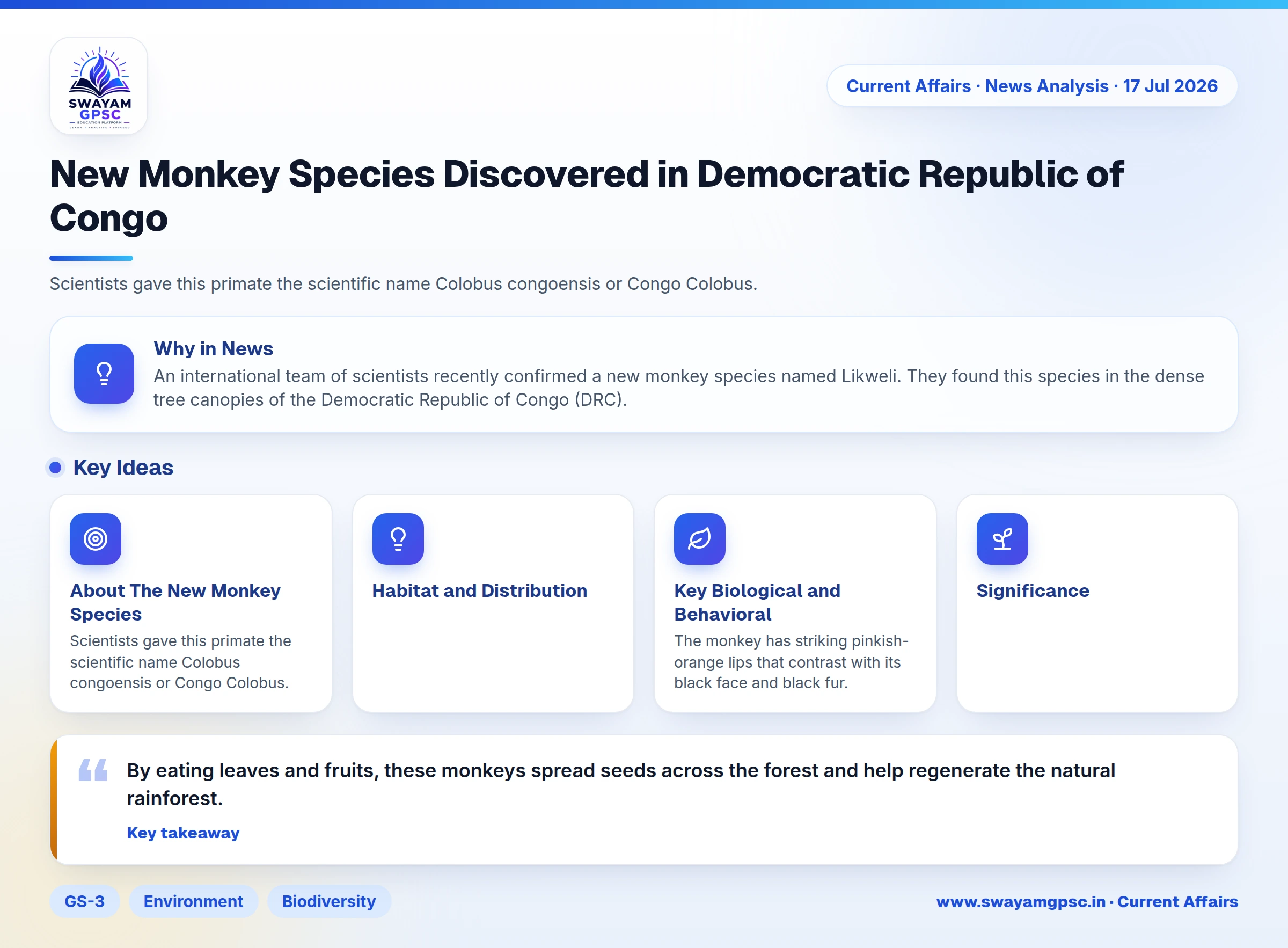
New Monkey Species Discovered in Democratic Republic of Congo
#GS-3 #Environment #Biodiversity #Wildlife #Current Events #International #Species in News
Why in News
- An international team of scientists recently confirmed a new monkey species named Likweli. They found this species in the dense tree canopies of the Democratic Republic of Congo (DRC).
About The New Monkey Species
- Scientists gave this primate the scientific name Colobus congoensis or Congo Colobus. It belongs to the Colobus genus, which includes tree-dwelling African monkeys that lack thumbs and feed mainly on leaves.
Habitat and Distribution
- This rare species lives exclusively in high-altitude tree canopies inside Lomami National Park in central-eastern Democratic Republic of Congo.
- The species stays hidden in a specific, isolated part of the tropical rainforest that offers suitable food and dense tree branches.
Key Biological and Behavioral Characteristics
- The monkey has striking pinkish-orange lips that contrast with its black face and black fur. Scientists believe these bright lips help them attract mates or identify group members in dark forests.
- Like other colobus monkeys, this species lacks thumbs. Their hands function like curved hooks, which helps them swing easily through dense forest branches.
- These shy animals avoid humans by spending nearly their entire lives high up in the rainforest canopy.
- They make a loud, deep roaring sound that echoes over long distances. Researchers often locate these hidden monkeys by listening to their vocal calls rather than seeing them.
Significance
- By eating leaves and fruits, these monkeys spread seeds across the forest and help regenerate the natural rainforest.
- Identifying them as a new species helps secure legal protection, targeted conservation programs, and international funding to stop poaching.