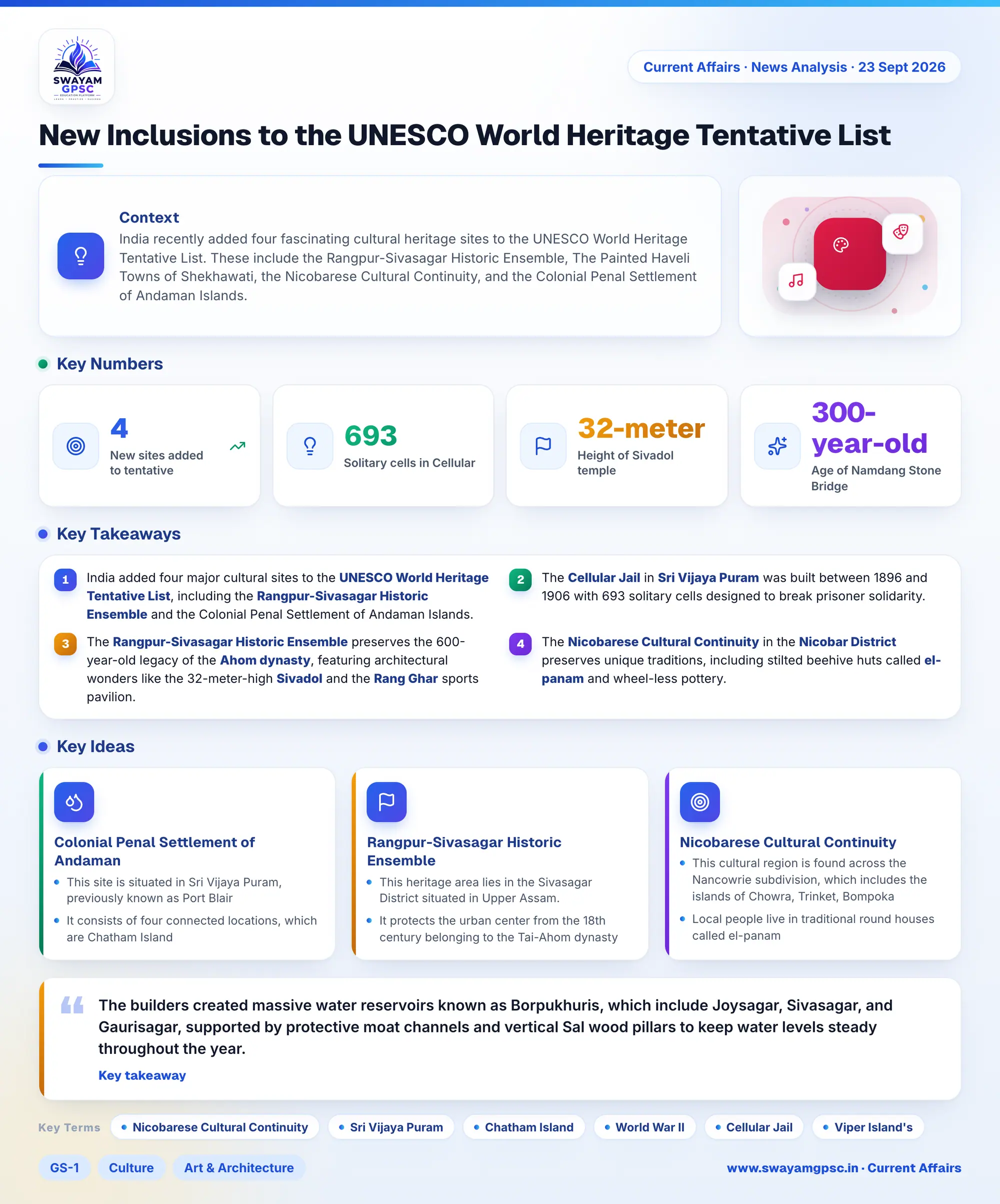
New Inclusions to the UNESCO World Heritage Tentative List
#GS-1 #Culture #Art & Architecture #Heritage #Tribal Culture #Current Events #National #Gujarat
Key takeaways
- India added four major cultural sites to the UNESCO World Heritage Tentative List, including the Rangpur-Sivasagar Historic Ensemble and the Colonial Penal Settlement of Andaman Islands.
- The Cellular Jail in Sri Vijaya Puram was built between 1896 and 1906 with 693 solitary cells designed to break prisoner solidarity.
- The Rangpur-Sivasagar Historic Ensemble preserves the 600-year-old legacy of the Ahom dynasty, featuring architectural wonders like the 32-meter-high Sivadol and the Rang Ghar sports pavilion.
- The Nicobarese Cultural Continuity in the Nicobar District preserves unique traditions, including stilted beehive huts called el-panam and wheel-less pottery.
Context
- India recently added four fascinating cultural heritage sites to the UNESCO World Heritage Tentative List.
- These include the Rangpur-Sivasagar Historic Ensemble, The Painted Haveli Towns of Shekhawati, the Nicobarese Cultural Continuity, and the Colonial Penal Settlement of Andaman Islands.
Colonial Penal Settlement of Andaman Islands
- This site is situated in Sri Vijaya Puram, previously known as Port Blair, located in the South Andaman District within the Union Territory of Andaman and Nicobar Islands.
- It consists of four connected locations, which are Chatham Island, Netaji Subhas Chandra Bose Island also known as Ross Island, Viper Island, and the Cellular Jail.
- Together, these locations trace how British colonial imprisonment changed physically from the year 1858 until World War II.
- The Cellular Jail was constructed between 1896 and 1906 using a design with seven radial wings built around a central tower.
- It contained 693 solitary cells specifically created to break the political unity of prisoners through total isolation.
- Viper Island's chain-gang jail finished construction in 1867 and operated as a punishment center equipped with stone lock-ups, solitary cells, and gallows for stubborn political prisoners.
- Ross Island functioned as the administrative capital and was famously called the Paris of the East.
- Chatham Island featured a steam sawmill built to process local padauk timber, which ranked among the largest and oldest in all of Asia.
Rangpur-Sivasagar Historic Ensemble
- This heritage area lies in the Sivasagar District situated in Upper Assam.
- It protects the urban center from the 18th century belonging to the Tai-Ahom dynasty, which was established as Rangpur by Swargadeo Rudra Singha in 1704.
- This site connects Northeast India directly with ancient overland travel routes leading into Southeast Asia.
- Temples in this region feature octagonal bases and curved spires, including the 32-meter-high Sivadol, which is among the tallest Shiva temples in India, alongside Joydol and the Ghanashyam House decorated with terracotta.
- The area preserves the Rang Ghar, an oval sports stadium featuring a boat-shaped roof, along with Talatal Ghar, an underground military fort, and the Namdang Stone Bridge built 300 years ago from a single massive rock slab.
- The builders created massive water reservoirs known as Borpukhuris, which include Joysagar, Sivasagar, and Gaurisagar, supported by protective moat channels and vertical Sal wood pillars to keep water levels steady throughout the year.
Nicobarese Cultural Continuity in the Central Group of Nicobar Islands
- This cultural region is found across the Nancowrie subdivision, which includes the islands of Chowra, Trinket, Bompoka, and Kamorta inside the Nicobar District of the Andaman and Nicobar Islands.
- Local people live in traditional round houses called el-panam, which look like stilted beehives built without windows using palm thatch to survive heavy tropical monsoons under the care of extended family units named tuhet.
- Women on Chowra Island continue the ancient craft of making pottery without using a potter's wheel, while local residents build outrigger wooden canoes called hodi or ap that hold deep spiritual meaning.
- The community uses carved wooden figures called Kareau and painted boards named Hentakoi to ward off evil while blending traditional folklore with symbols of 19th-century sea trade.
- Their traditional lifestyle follows a specific calendar system featuring community events like Takoi taboos, the Ossuary Feast, and the yearly Panuohonot pig festival that includes stick fighting and canoe races.