Need for Nuclear Risk Reduction Framework Post-New START Treaty
#GS-2 #Current Events #International #GS-3 #Science & Technology #Defence #Government Policies & Interventions #Effect of Policies & Politics of Countries on India's Interests #Nuclear Technology
Key takeaways
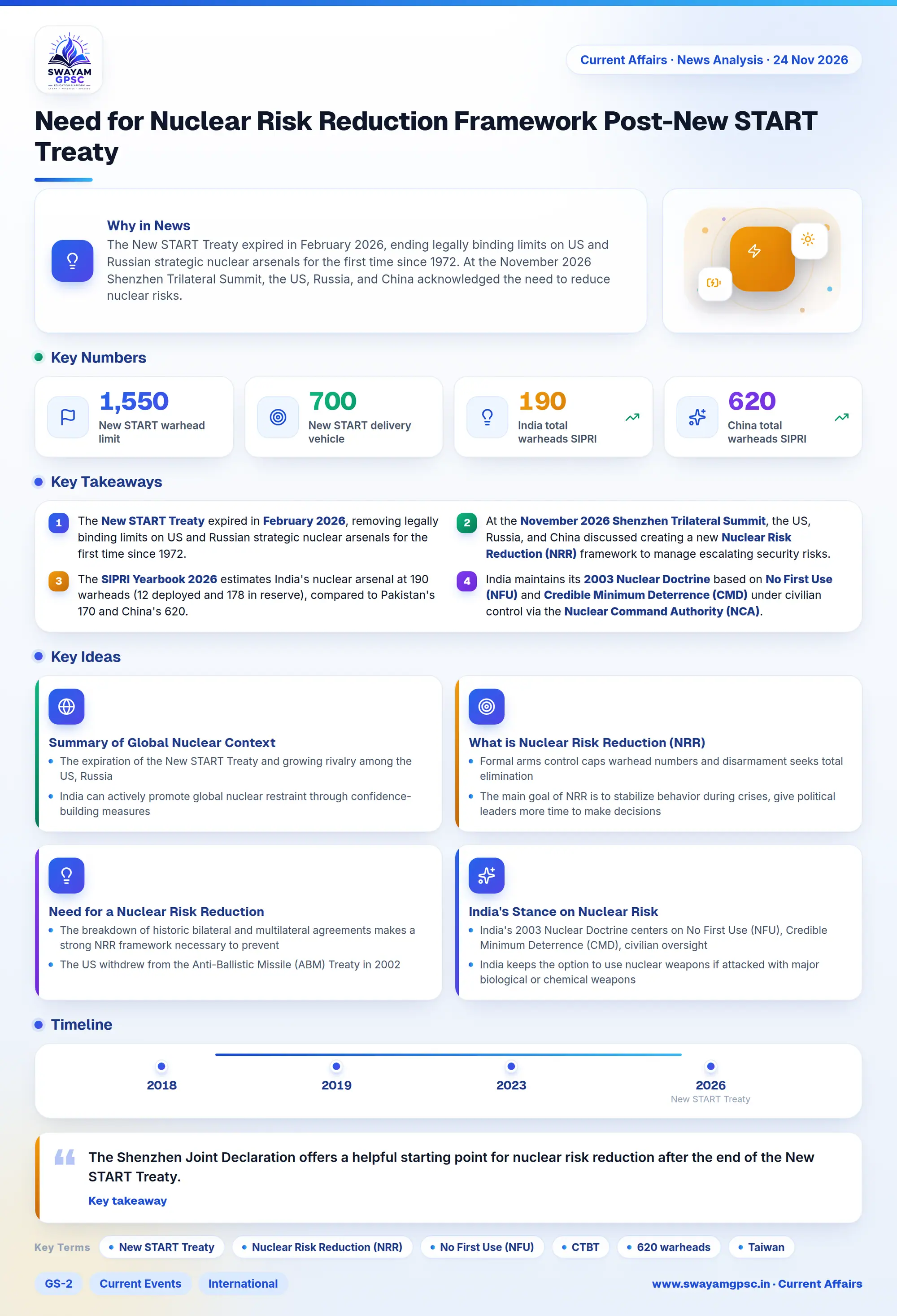
- The New START Treaty expired in February 2026, removing legally binding limits on US and Russian strategic nuclear arsenals for the first time since 1972.
- At the November 2026 Shenzhen Trilateral Summit, the US, Russia, and China discussed creating a new Nuclear Risk Reduction (NRR) framework to manage escalating security risks.
- The SIPRI Yearbook 2026 estimates India's nuclear arsenal at 190 warheads (12 deployed and 178 in reserve), compared to Pakistan's 170 and China's 620.
- India maintains its 2003 Nuclear Doctrine based on No First Use (NFU) and Credible Minimum Deterrence (CMD) under civilian control via the Nuclear Command Authority (NCA).
Why in News
- The New START Treaty expired in February 2026, ending legally binding limits on US and Russian strategic nuclear arsenals for the first time since 1972.
- At the November 2026 Shenzhen Trilateral Summit, the US, Russia, and China acknowledged the need to reduce nuclear risks.
- These major powers renewed calls for a structured Nuclear Risk Reduction (NRR) framework amid an increasingly precarious global security environment lacking binding nuclear treaties.
Summary of Global Nuclear Context
- The expiration of the New START Treaty and growing rivalry among the US, Russia, and China highlight the urgent need for a credible Nuclear Risk Reduction (NRR) framework to prevent accidental nuclear escalation.
- India can actively promote global nuclear restraint through confidence-building measures, its No First Use (NFU) policy, maintaining human control over AI, and strengthening nuclear command-and-control systems.
What is Nuclear Risk Reduction (NRR)
- Formal arms control caps warhead numbers and disarmament seeks total elimination, but Nuclear Risk Reduction (NRR) focuses on practical operational steps to stop nuclear weapon use from accidents, miscalculations, technical glitches, or crisis escalation.
- The main goal of NRR is to stabilize behavior during crises, give political leaders more time to make decisions, and stop conventional wars from escalating into nuclear conflicts.
- Key NRR tools include direct political and military hotlines, advance launch notices for missiles, de-alerting procedures, and rules protecting Nuclear Command, Control, and Communications (NC3) from cyber or space attacks.
Need for a Nuclear Risk Reduction Framework
- The breakdown of historic bilateral and multilateral agreements makes a strong NRR framework necessary to prevent an uncontrolled nuclear arms race.
- The US withdrew from the Anti-Ballistic Missile (ABM) Treaty in 2002, which removed caps on strategic missile defense systems.
- The Intermediate-Range Nuclear Forces (INF) Treaty collapsed in 2019, ending the ban on ground-launched missiles with ranges between 500 km and 5,500 km.
- The US walked away from the Joint Comprehensive Plan of Action (JCPOA) in 2018, which damaged global trust in American treaty commitments.
- The Comprehensive Nuclear-Test-Ban Treaty (CTBT) of 1996 never took effect, and Russia officially withdrew its ratification of the treaty in 2023.
- The New START Treaty, active from 2010 to 2026, previously restricted deployed strategic warheads to 1,550 and delivery vehicles to 700, supported by 18 annual on-site inspections.
- Strategic priorities among major nuclear powers remain divided, creating complex tripolar deterrence dynamics.
- The US demands a three-way agreement that includes China, pointing to Beijing's rapid and secretive nuclear expansion.
- Russia views nuclear parity as essential to its global standing, refuses to pressure China, insists on including Britain and France, and previously halted New START inspections while revoking its CTBT ratification.
- China refuses fixed numeric caps, noting its smaller stockpile of around 620 warheads compared to over 5,000 warheads each held by the US and Russia, relying on strategic secrecy to prevent a disarming first strike.
- These competing strategies emphasize the urgent need for an inclusive NRR system to address deep mistrust and escalation risks.
- Active global hot spots like Taiwan, the war in Ukraine, and tensions involving the US, Israel, and Iran increase the risk of military miscalculations.
- Emerging technologies like Artificial Intelligence (AI) in military systems, hypersonic weapons, and cyber warfare reduce reaction times and raise the risk of technical errors.
- Multilateral progress on AI safety has stalled, as seen when both the US and Russia voted against a UN General Assembly First Committee draft resolution on Artificial Intelligence in the military domain in late 2026.
- High-tech military hardware like hypersonic glide vehicles, MIRVs, Anti-Satellite (ASAT) weapons, and dual-use missiles make it hard to tell conventional attacks apart from nuclear strikes, requiring clear transparency rules.
- China's refusal to accept equal nuclear caps makes a formal three-way treaty unlikely soon, making interim risk-reduction steps essential.
India's Stance on Nuclear Risk Reduction
- India's 2003 Nuclear Doctrine centers on No First Use (NFU), Credible Minimum Deterrence (CMD), civilian oversight, and a de-alerted operational state to reduce risks.
- India keeps the option to use nuclear weapons if attacked with major biological or chemical weapons, while the Nuclear Command Authority (NCA) maintains political control over nuclear decisions.
- India and Pakistan rely on practical Bilateral Nuclear Confidence-Building Measures (NCBMs) to prevent accidental escalation.
- The 1988 Agreement on the Prohibition of Attack against Nuclear Installations and Facilities stops both countries from striking nuclear sites and requires an annual exchange of facility lists.
- The Lahore Declaration (1999) promotes peaceful dispute resolution and steps to prevent unauthorized or accidental nuclear use.
- The 2005 Agreement on Pre-Notification of Flight Testing of Ballistic Missiles requires advance warnings before missile tests to prevent false alarms.
- The 2007 Agreement on Reducing the Risk from Accidents Relating to Nuclear Weapons establishes clear steps to report nuclear accidents quickly.
- Direct contact between both nations is maintained through dedicated military hotlines between Directors General of Military Operations (DGMO).
- India maintains a voluntary, self-imposed ban on explosive nuclear testing while supporting global disarmament.
- India advocates for complete, verifiable, and equal nuclear disarmament worldwide and supports the Fissile Material Cut-off Treaty (FMCT).
- India supports practical risk reduction like de-alerting systems, even while staying out of treaties it considers unfair, such as the Non-Proliferation Treaty (NPT) and the CTBT.
- India joined the Hague Code of Conduct against Ballistic Missile Proliferation (HCOC) in 2016, showing its commitment to international transparency.
- To handle complex regional dynamics with China and Pakistan, India builds strong second-strike assets like SSBNs and protects its NC3 systems against cyber and space threats.
- The SIPRI Yearbook 2026 estimates India's nuclear arsenal at 190 warheads (12 deployed and 178 in reserve), compared to Pakistan's 170 and China's 620.
Measures Needed to Strengthen Global NRR Efforts
- Major powers can use reciprocal steps like Presidential Nuclear Initiatives (PNIs) to keep New START limits voluntarily while holding technical discussions through the P5 Process.
- Global agreements should establish Meaningful Human Control over automated systems, banning fully autonomous AI from making nuclear launch decisions.
- Nations must separate conventional and nuclear communication lines while setting clear rules against cyber or ASAT attacks on early-warning satellites.
- Countries should expand pre-test notification rules under the Hague Code of Conduct to cover hypersonic missiles, MIRVs, and space launches.
- Nuclear states should adopt No-First-Use (NFU) policies and sign protocols for all five Nuclear-Weapon-Free Zones (NWFZs) to offer binding security promises to non-nuclear states.
- India needs to harden its NC3 systems against digital and space attacks while building reliable Continuous At-Sea Deterrence (CASD) capabilities.
- India can open Track 1.5 and Track 2 dialogue channels with China to set up practical crisis-management steps.
- While keeping its core No First Use (NFU) policy intact, India can use strategic ambiguity with proportional response options to stop rivals from exploiting deterrence gaps.
- Governments should keep nuclear safety talks separate from broader diplomatic disputes and use platforms like the P5 Process and the Conference on Disarmament.
- International forums must include non-nuclear countries in NRR discussions to reflect their security concerns and contributions to global peace.
Conclusion
- The Shenzhen Joint Declaration offers a helpful starting point for nuclear risk reduction after the end of the New START Treaty.
- The success of this effort depends on turning diplomatic statements into clear, verifiable safety rules that prevent accidental military escalation.