Naxal-Free India: How Integrated Security and Socio-Economic Development Eliminated Extremism
#GS-2 #Governance & Social Justice #Good Governance #Civil Services #GS-3 #Economy #Infrastructure #Current Events #National #Government Policies & Interventions #Welfare Schemes #Internal Security #Left-Wing Extremism
Key takeaways
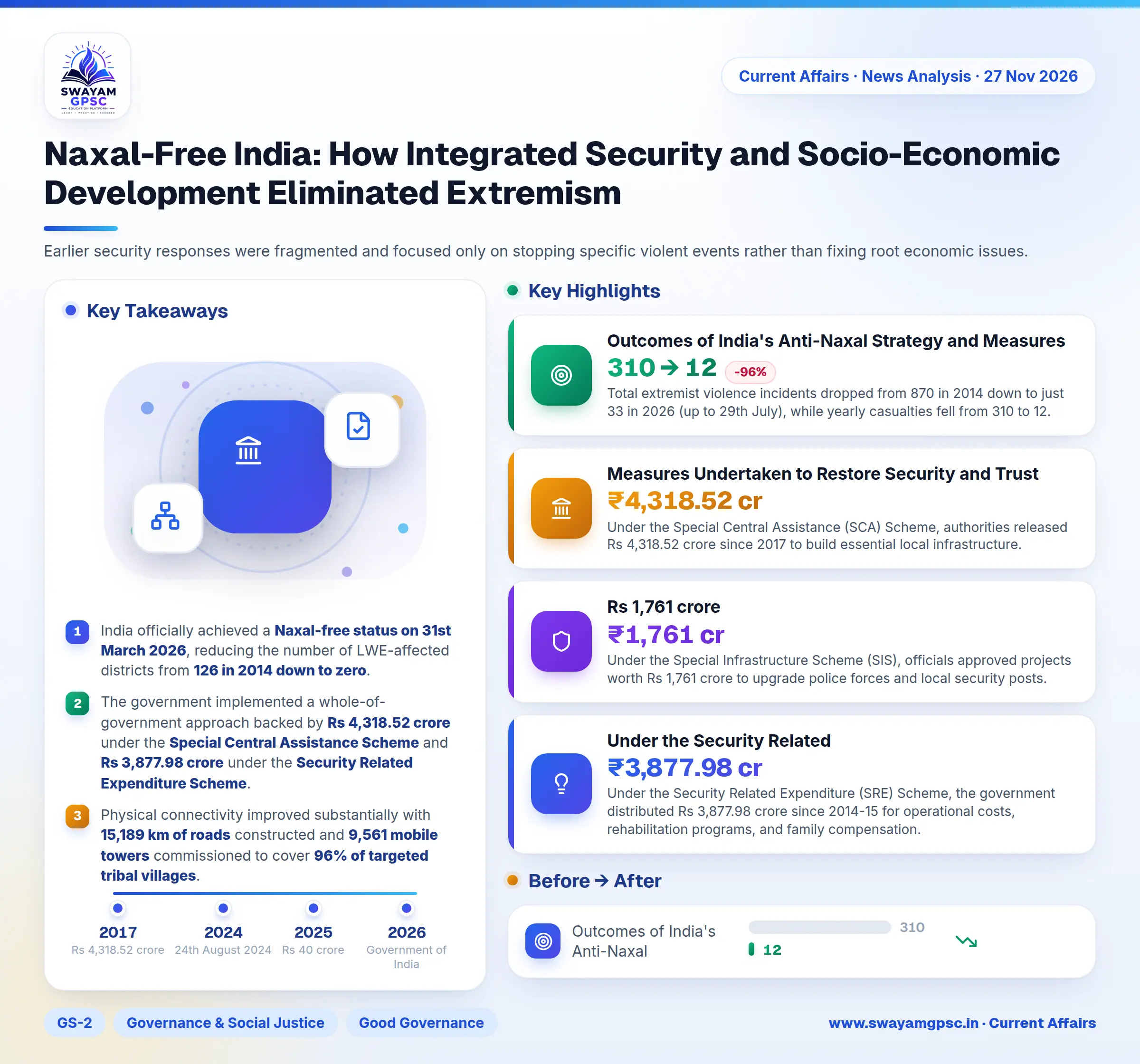
- India officially achieved a Naxal-free status on 31st March 2026, reducing the number of LWE-affected districts from 126 in 2014 down to zero.
- The government implemented a whole-of-government approach backed by Rs 4,318.52 crore under the Special Central Assistance Scheme and Rs 3,877.98 crore under the Security Related Expenditure Scheme.
- Physical connectivity improved substantially with 15,189 km of roads constructed and 9,561 mobile towers commissioned to cover 96% of targeted tribal villages.
- Extremist violence saw a dramatic decline from 870 incidents in 2014 down to 33 in 2026, alongside the surrender of 8,526 Naxalites by November 2026.
Why in News
- The Government of India announced that the country achieved Naxal-free status on 31st March 2026.
- This achievement marks a major milestone in India's internal security after nearly six decades of fighting Left-Wing Extremism (LWE).
India's Integrated Strategy to Address LWE
- For almost six decades, LWE damaged remote regions and harmed tribal communities through violence, poor roads, weak local governance, and lack of basic services.
- Earlier security responses were fragmented and focused only on stopping specific violent events rather than fixing root economic issues.
- Since 2014, the central government has used a unified approach built on security actions, infrastructure building, and public welfare schemes.
- The first pillar focuses on restoring public trust by strengthening security operations, improving surrender policies, and increasing official administrative presence in vulnerable villages.
- The second pillar expands physical roads, mobile phone networks, and local economic opportunities across previously isolated areas.
- The third pillar delivers essential public services, protects tribal cultural identity, and connects affected families directly to central development programs.
- This combined approach creates a positive cycle where strong security allows continuous development, development builds public trust, and trust helps deliver government welfare effectively.
Measures Undertaken to Restore Security and Trust
- Left-Wing Extremism started with the Naxalbari uprising of 1967 in West Bengal based on Maoist political thought, leading to the formation of the CPI (Maoist) in 2004.
- Between 2004 and 2014, extremism caused 17,542 violent incidents, leading to 1,913 security personnel deaths and 5,019 civilian deaths, reaching a peak in 2010 with 1,936 incidents.
- Previous government actions lacked proper coordination between neighboring states and did not address underlying socio-economic difficulties.
- The National Policy and Action Plan (2015) introduced a complete state approach combining strong security actions with targeted economic programs.
- This 2015 policy used a four-part strategy that enhanced police forces, accelerated local development, protected land rights, and managed public communication under the Ministry of Home Affairs (MHA).
- On 24th August 2024, the government set a firm deadline to eliminate Naxalism completely by 31st March 2026.
- The government provided strong financial support to affected states using specific national development schemes.
- Under the Special Central Assistance (SCA) Scheme, authorities released Rs 4,318.52 crore since 2017 to build essential local infrastructure.
- Under the Special Infrastructure Scheme (SIS), officials approved projects worth Rs 1,761 crore to upgrade police forces and local security posts.
- Under the Security Related Expenditure (SRE) Scheme, the government distributed Rs 3,877.98 crore since 2014-15 for operational costs, rehabilitation programs, and family compensation.
- Security forces built new forward posts in remote areas to protect residents, expand local governance, and improve operational capability.
- Central and state authorities integrated specialized units including CoBRA, CRPF, District Reserve Guard (DRG), Special Task Force (STF), Jharkhand Jaguar, and Greyhounds.
- Security teams deployed high-tech tools like Unmanned Aerial Vehicles (UAVs), surveillance drones, satellite maps, and artificial intelligence to gather accurate operational intelligence.
- Targeted field operations cleared long-standing extremist bases and restored government presence across once-inaccessible regions.
- Specific joint actions like Operation Black Forest, Operation Octopus, Operation Double Bull, Operation Thunderstorm, Operation Bhimbandh, and Operation Chakrabandha successfully cleared Naxal control from Gumla, Lohardaga, and Latehar districts in Jharkhand.
- These strategic police actions broke up command networks within the CPI (Maoist), allowing local civil administration to return.
- Central agencies adopted a joint strategy to track down and freeze illicit funding channels supporting armed groups.
- A special cell inside the National Investigation Agency (NIA) seized over Rs 40 crore, the Enforcement Directorate (ED) attached Rs 12 crore, and state police confiscated Rs 40 crore by December 2025.
- By June 2026, the NIA filed 100 charge sheets across 112 registered LWE cases.
- Clear surrender rules offered active cadres financial support and peaceful reintegration options to leave armed violence.
- Surrender guidelines offer Rs 5 lakh for senior leaders, Rs 2.5 lakh for lower ranks, a monthly stipend of Rs 10,000 for 36 months, and weapon surrender bonuses.
- By November 2026, a total of 8,526 Naxalites surrendered to government authorities across multiple states.
- The Nayi Disha, Nayi Pahal campaign saw 16 Maoists surrender in Ranchi on 28th July 2026 and 8 Maoists surrender in Bijapur on 29th July 2026.
- Local community groups, journalists, and public leaders actively assisted with social reintegration and public trust initiatives.
- Restoring basic safety allowed government departments to construct roads, build schools, open bank branches, and deliver essential benefits across tribal regions.
- This security framework turned tactical operational gains into permanent civic stability, economic growth, and lasting peace.
Measures to Strengthen Infrastructure and Connectivity
- The central government prioritized building core physical and digital connections to link remote tribal villages with national economic markets.
- Workers constructed 15,189 km of roads under the Road Requirement Plan (RRP) and the Road Connectivity Project for LWE Affected Areas (RCPLWEA).
- The Border Roads Organisation (BRO) stepped in to complete key roads and bridges where regular civilian contractors faced security threats.
- Engineers installed 9,561 mobile towers, providing cellular coverage to 96% of targeted villages (44,728 out of 46,592).
- Improved mobile coverage helps rural residents access digital classes, telemedicine services, and online government payments easily.
- New rail line projects improved long-distance freight movement, regional economic output, and passenger transport across former security zones.
- Engineers completed the 95 km Dalli Rajhara-Rowghat rail line, while authorities approved the 140 km Rowghat-Jagdalpur line and sanctioned the 153 km Dantewada-Manuguru line.
- Under the 150 km Kirandul-Jagdalpur Doubling Project, railway authorities successfully opened the 130 km combined stretch between Jagdalpur-Kamalur and Bacheli-Kirandul.
Measures to Strengthen Governance, Welfare and Tribal Empowerment
- Local administrations adapted standard operational procedures so remote rural residents could access essential social welfare benefits easily.
- The UIDAI and Postal Department conducted special drives to issue Aadhaar cards, while establishing 294 new post offices across the Bastar division.
- Local officials allowed manual cash payments and paper attendance records for employment guarantee works in places lacking stable mobile internet.
- Sanitation grants under the Swachh Bharat Mission were processed directly through Village Sanitation Committees, while health officials accepted offline applications for Ayushman Bharat cards.
- These practical adjustments proved that flexible local administration is essential for delivering government welfare to remote areas.
- The government opened a modern 240-bed Super Speciality Hospital at Jagdalpur under the Pradhan Mantri Swasthya Suraksha Yojana (PMSSY) in May 2026.
- Additionally, 11 CAPF field hospitals opened their doors to provide medical care directly to surrounding tribal families.
- State agencies expanded specialized educational institutes and vocational training centers to build skills among local youth.
- The government sanctioned 259 Eklavya Model Residential Schools (EMRS), bringing 179 into full operation across affected regions.
- Authorities invested nearly Rs 800 crore to set up 47 Industrial Training Institutes (ITIs) and 49 Skill Development Centres (SDCs).
- These specialized programs provided practical job skill training to over 90,000 tribal youth and women.
- Under the Tribal Youth Exchange Programme (TYEP), 37,655 young people visited major Indian cities since 2014 to learn about national institutions.
- The Civic Action Programme (CAP) gives funds to security forces so they can run medical camps, organize sports, and distribute useful household items.
- The central government provided Rs 221.88 crore since 2014 under CAP to help security personnel build positive relations with local villagers.
- The government designated 38 districts as Legacy and Thrust Districts to ensure continuous development funding and prevent any return of violence.
Welfare and Tribal Empowerment in LWE-Affected Regions
- Government agencies focused on improving direct service delivery for housing, medical care, and job opportunities to uphold tribal dignity.
- Rehabilitation frameworks help former insurgents return to normal life by offering housing under Pradhan Mantri Awas Yojana (PMAY) and business setup funds.
- Children of surrendered cadres get free schooling up to Class XII, while villages that successfully removed Naxal influence received special development grants.
- The government balanced counter-insurgency policies with strong legal protections for local land rights and traditional forest access.
- Authorities distributed 21,26,273 land title deeds to tribal families under the Forest Rights Act (FRA), 2006.
- The Special Central Assistance (SCA) program helped local authorities construct critical missing public works like small bridges and primary clinics.
- The Aspirational Districts Programme (ADP) coordinated multiple public welfare programs to improve local health, education, and farm income outputs.
- Expanding Eklavya Model Residential Schools (EMRS) ensured high-quality free residential schooling for tribal students in remote areas.
- The Pradhan Mantri Janjati Adivasi Nyaya Maha Abhiyan (PM-JANMAN) targets Particularly Vulnerable Tribal Groups (PVTGs) with clean drinking water and concrete houses.
- The Dharti Aaba Janjatiya Gram Utkarsh Abhiyan coordinates efforts across central ministries to fix infrastructure gaps and create sustainable rural jobs.
Case Study: Chhattisgarh's Transition from Naxalism to Development
- The creation of the Bastariya Battalion in 2017 recruited local tribal youth into security roles, improving local ground intelligence and public trust.
- Workers built over 3,240 km of roads and installed 889 mobile towers across Bastar, connecting remote villages to regional business hubs.
- A target package for 3,000 surrendered cadres backed by Rs 20 crore provided practical technical skills and self-employment startup aid.
- Under the Shaheed Veer Gundadhur Seva Dera Initiative (2026), authorities converted one-third of CAPF security posts into multi-use public service centers.
- Cultural events like Bastar Pandum and the Bastar Olympics helped preserve indigenous tribal customs while building strong community bonds.
Outcomes of India's Anti-Naxal Strategy and Measures to Consolidate Peace
- The total count of officially recognized LWE-affected districts fell from 126 in 2014 down to zero by March-April 2026.
- Total extremist violence incidents dropped from 870 in 2014 down to just 33 in 2026 (up to 29th July), while yearly casualties fell from 310 to 12.
- Under the Seva Sankalp Abhiyan on 15th October 2026, authorities provided medical care equipment and support devices to victims of past violence.
- On 8th November 2026, the Prime Minister celebrated Diwali in Bastar, marking the country's first festival following the official Naxal-free declaration.
- During this visit, officials noted that zero CRPF personnel died on duty in security operations over the preceding year, a major security success after 47 years.
- Shifting focus from military operations toward long-term local employment and civic institutions is necessary to protect peace permanently.
Conclusion
- Ending Naxalism marks a major achievement for India's domestic security, proving that combining security actions with socio-economic development works effectively.
- The main objective now is preserving these security gains, strengthening local democratic bodies, and ensuring full delivery of public welfare schemes to all citizens.