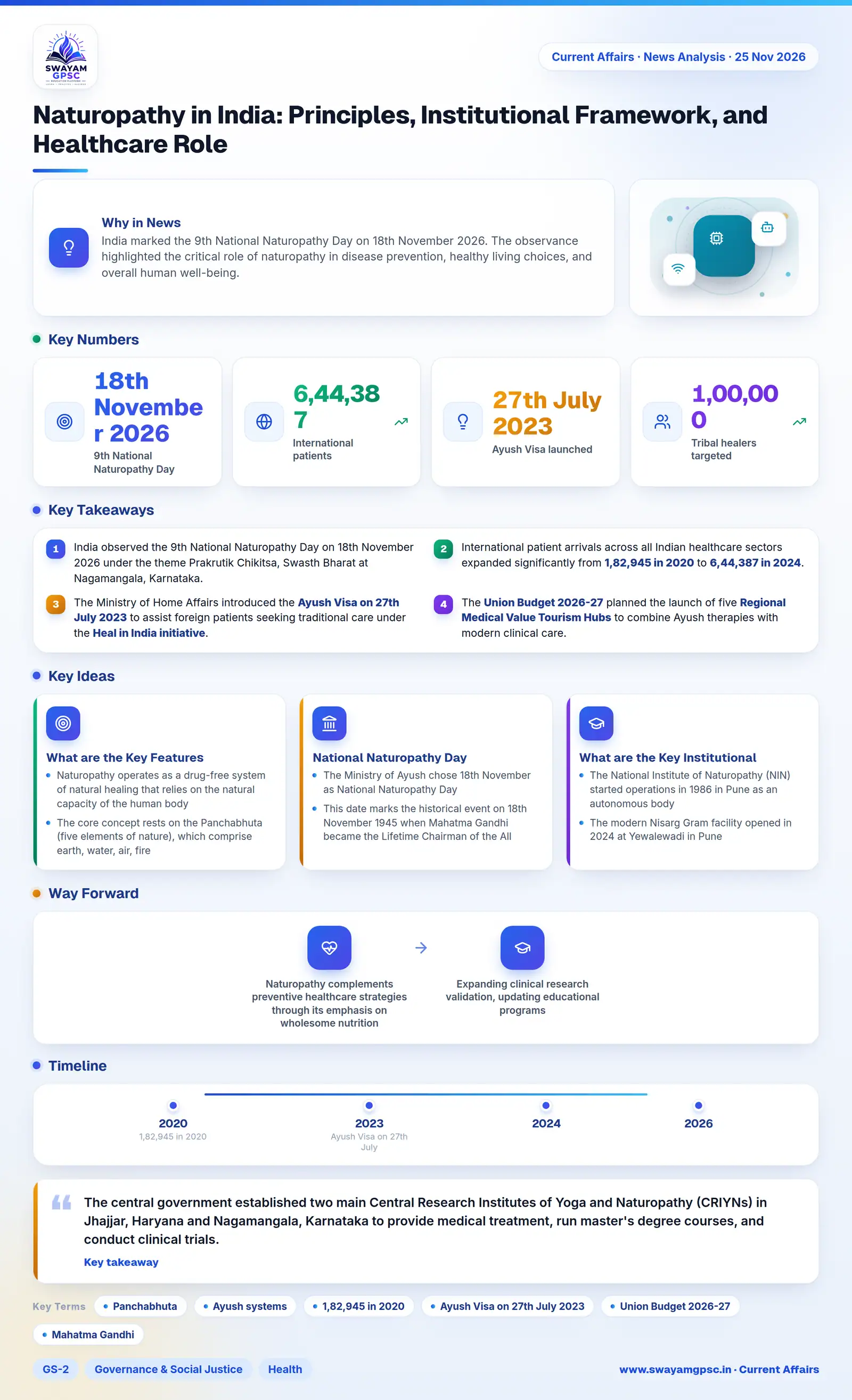
Naturopathy in India: Principles, Institutional Framework, and Healthcare Role
#GS-2 #Governance & Social Justice #Health #GS-3 #Science & Technology #Achievements of Indians in Science & Technology #Government Policies & Interventions #Current Events #National
Key takeaways
- India observed the 9th National Naturopathy Day on 18th November 2026 under the theme Prakrutik Chikitsa, Swasth Bharat at Nagamangala, Karnataka.
- International patient arrivals across all Indian healthcare sectors expanded significantly from 1,82,945 in 2020 to 6,44,387 in 2024.
- The Ministry of Home Affairs introduced the Ayush Visa on 27th July 2023 to assist foreign patients seeking traditional care under the Heal in India initiative.
- The Union Budget 2026-27 planned the launch of five Regional Medical Value Tourism Hubs to combine Ayush therapies with modern clinical care.
- The Ministry of Tribal Affairs aims to recognize 1,00,000 tribal healers as community health partners to strengthen remote healthcare delivery.
Why in News
- India marked the 9th National Naturopathy Day on 18th November 2026.
- The observance highlighted the critical role of naturopathy in disease prevention, healthy living choices, and overall human well-being.
What are the Key Features of Naturopathy in India?
- Naturopathy operates as a drug-free system of natural healing that relies on the natural capacity of the human body to heal itself.
- The core concept rests on the Panchabhuta (five elements of nature), which comprise earth, water, air, fire, and ether.
- The guiding principles follow a Return to Nature philosophy that encourages wholesome dietary habits, modest living, and inner harmony alongside environmental balance.
- Therapeutic treatments rely on natural interventions like fasting schedules, specialized diets, hydrotherapy water treatments, mud applications, cold packs, therapeutic baths, and massages.
- Specialized facilities such as Nisarg Gram offer added therapies including magnetotherapy, chromotherapy color treatments, physical therapy, yoga practices, and Saatvik meal plans.
- The primary healthcare approach focuses on preventive measures, balanced nutrition, daily physical exercise, adequate sleep cycles, and structured stress management.
- Medical professionals use naturopathy as a supportive treatment alongside primary treatments for long-term conditions, allergies, autoimmune diseases, joint degeneration, and stress issues, though clinical proof of its success varies.
- The focus on lifestyle corrections makes this field helpful for managing weight problems, preventing modern lifestyle illnesses, and promoting healthy aging.
- Indian naturopathic practice combines Yoga techniques with traditional understandings of the Panchabhuta concept to treat health problems and build complete wellness.
- Official healthcare frameworks list Yoga and Naturopathy within the Ayush systems, placing them alongside Ayurveda, Unani, Siddha, Sowa Rigpa, and Homoeopathy.
- Government institutions support this sector through structured degree courses such as the Bachelor of Naturopathy and Yogic Sciences (BNYS), clinical research funding via the Central Council for Research in Yoga and Naturopathy (CCRYN), professional practitioner licensing, and expanded hospital capacity.
- This natural system helps establish India as a key international destination for specialized medical travel and wellness visits, alongside traditional practices like Yoga and Ayurveda.
- Official data shows foreign patient visits across all Indian medical sectors grew from 1,82,945 in 2020 up to 6,44,387 in 2024.
- The Ministry of Home Affairs introduced the special Ayush Visa on 27th July 2023 to help international patients and their caregivers enter India under the Heal in India initiative.
- The Union Budget 2026-27 outlined plan details to build five Regional Medical Value Tourism Hubs that will combine traditional Ayush care with advanced modern medical services and wellness options.
National Naturopathy Day
- The Ministry of Ayush chose 18th November as National Naturopathy Day, establishing an annual celebration starting back in 2018.
- This date marks the historical event on 18th November 1945 when Mahatma Gandhi became the Lifetime Chairman of the All India Nature Cure Foundation Trust in Pune and signed its founding papers.
- Mahatma Gandhi helped establish natural cure principles across India by promoting natural living habits, proper community sanitation, simple diets, and routine physical movement.
- In 1946, Mahatma Gandhi led an extensive nature cure public campaign from Uruli Kanchan, Maharashtra.
- The 9th National Naturopathy Day in 2026 hosted its primary events at the Central Research Institute of Yoga and Naturopathy (CRIYN) located in Nagamangala, Karnataka.
- The chosen theme for the 2026 event was Prakrutik Chikitsa, Swasth Bharat.
- Event discussions centered on preventive measures such as natural nutrition, active daily living, structured yoga, mental relaxation, and targeted methods to prevent obesity.
- The celebration supports the larger Fit and Healthy India goal by strengthening scientific research in naturopathy, maintaining strict educational quality, and safely incorporating these practices into main healthcare systems.
What are the Key Institutional Initiatives for Promoting Naturopathy in India?
- The National Institute of Naturopathy (NIN) started operations in 1986 in Pune as an autonomous body under the Ministry of Ayush to guide professional education, training courses, clinical research, and quality standards.
- The modern Nisarg Gram facility opened in 2024 at Yewalewadi in Pune, creating a comprehensive campus with India's first national naturopathy hospital, a specialized medical college, and modern research laboratories.
- NIN holds distinction as the first Central Government body to offer a complete Bachelor of Naturopathy and Yogic Sciences (BNYS) degree program affiliated directly with a Central University.
- The Nisarg Arogya Sadhana Kendra was set up by NIN with help from the Maharashtra Government to bring natural healthcare methods and local dietary knowledge to tribal populations.
- The Ministry of Tribal Affairs launched a goal to identify and train 1,00,000 tribal healers to act as community health leaders across local areas.
- The Ministry of Ayush formed the Naturopathy Registration Board (NRB) under NIN authority to handle national practitioner registry files and grant accreditation to training centers and treatment hospitals.
- The Central Council for Research in Yoga and Naturopathy (CCRYN) began operations in 1978 under Ayush funding to run scientific evaluations and publish validated research studies.
- The central government established two main Central Research Institutes of Yoga and Naturopathy (CRIYNs) in Jhajjar, Haryana and Nagamangala, Karnataka to provide medical treatment, run master's degree courses, and conduct clinical trials.
- Government leaders laid foundation stones in 2024 to build two new CRIYN centers located in Khorda, Odisha and Raipur, Chhattisgarh.
Way Forward
- Naturopathy complements preventive healthcare strategies through its emphasis on wholesome nutrition, consistent physical activity, and balanced daily habits.
- Expanding clinical research validation, updating educational programs, and combining natural methods safely with hospital care will boost public health outcomes and help fulfill the goal of Prakrutik Chikitsa, Swasth Bharat.