National Urban Co-operative Finance and Development Corporation Limited
#GS-3 #Economy #Banking #Cooperatives #GS-2 #Governance & Social Justice #Regulatory Bodies
Key takeaways
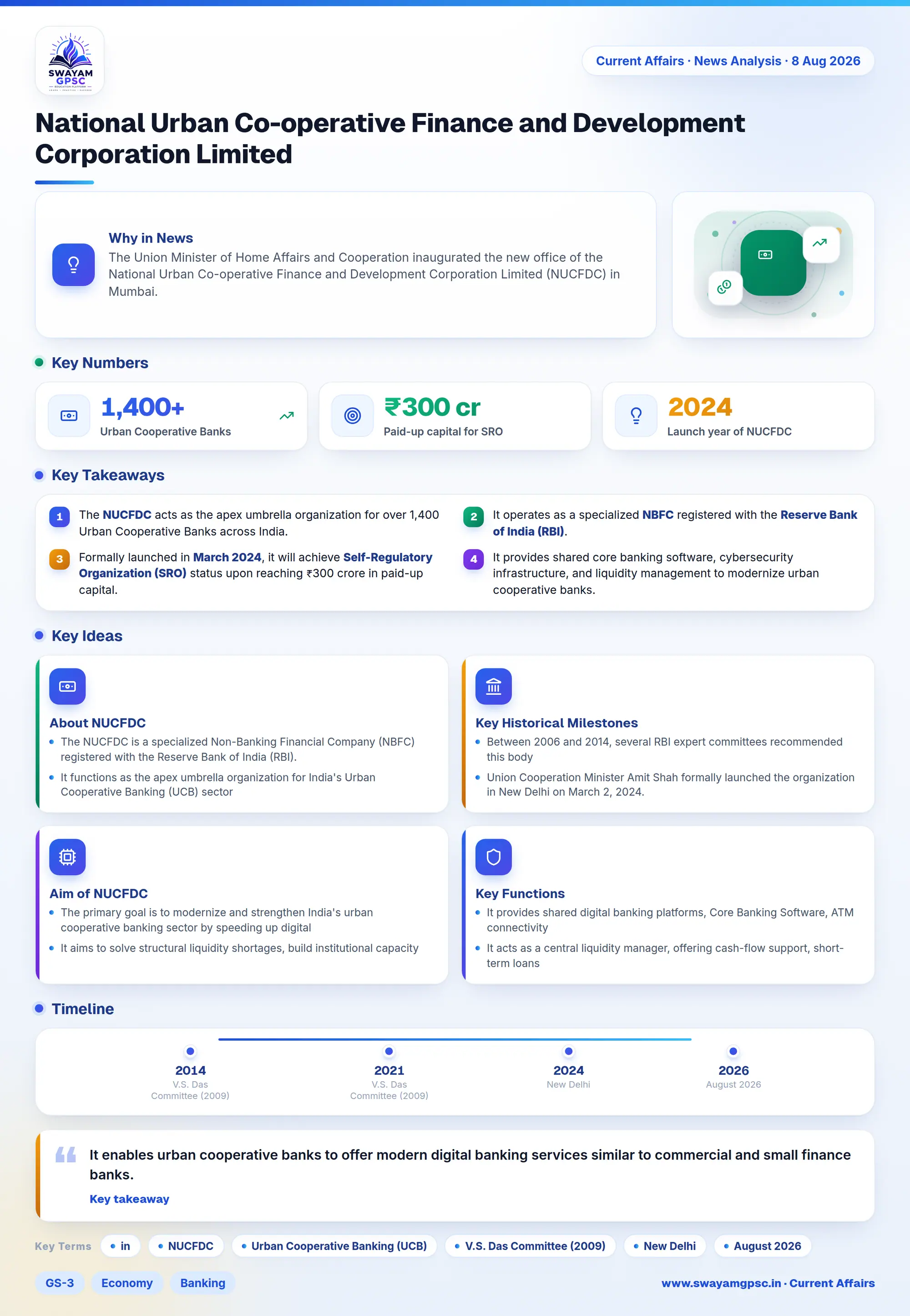
- The NUCFDC acts as the apex umbrella organization for over 1,400 Urban Cooperative Banks across India.
- It operates as a specialized NBFC registered with the Reserve Bank of India (RBI).
- Formally launched in March 2024, it will achieve Self-Regulatory Organization (SRO) status upon reaching ₹300 crore in paid-up capital.
- It provides shared core banking software, cybersecurity infrastructure, and liquidity management to modernize urban cooperative banks.
Why in News
- The Union Minister of Home Affairs and Cooperation inaugurated the new office of the National Urban Co-operative Finance and Development Corporation Limited (NUCFDC) in Mumbai.
About NUCFDC
- The NUCFDC is a specialized Non-Banking Financial Company (NBFC) registered with the Reserve Bank of India (RBI).
- It functions as the apex umbrella organization for India's Urban Cooperative Banking (UCB) sector, pooling resources from over 1,400 UCBs and thousands of branches.
Key Historical Milestones
- Between 2006 and 2014, several RBI expert committees recommended this body, including the Viswanathan Committee (2006 & 2021), V.S. Das Committee (2009), Malegam Committee (2010), and R. Gandhi Committee (2014), inspired by global models like Rabobank (Netherlands) and Crédit Agricole (France).
- Union Cooperation Minister Amit Shah formally launched the organization in New Delhi on March 2, 2024.
- In August 2026, officials inaugurated its new office in Mumbai alongside a dedicated Security Operations Centre (SOC) for cybersecurity.
Aim of NUCFDC
- The primary goal is to modernize and strengthen India's urban cooperative banking sector by speeding up digital adoption.
- It aims to solve structural liquidity shortages, build institutional capacity, and help small UCBs compete with modern digital banks.
Key Functions
- It provides shared digital banking platforms, Core Banking Software, ATM connectivity, and cybersecurity hubs at affordable shared costs.
- It acts as a central liquidity manager, offering cash-flow support, short-term loans, and facilitating the trade of Priority Sector Lending (PSL) certificates.
- It delivers non-fund services like standardized regulatory compliance tools, board training, and professional capacity-building programs.
- It uses collective bargaining to negotiate bulk purchases of software and hardware, significantly reducing operational expenses for small banks.
- It aims to become a Self-Regulatory Organization (SRO) upon reaching a paid-up capital of ₹300 crore, helping the RBI with local supervision.
Significance
- It enables urban cooperative banks to offer modern digital banking services similar to commercial and small finance banks.
- It strengthens governance, cybersecurity, and risk management, which boosts public trust in cooperative banks.