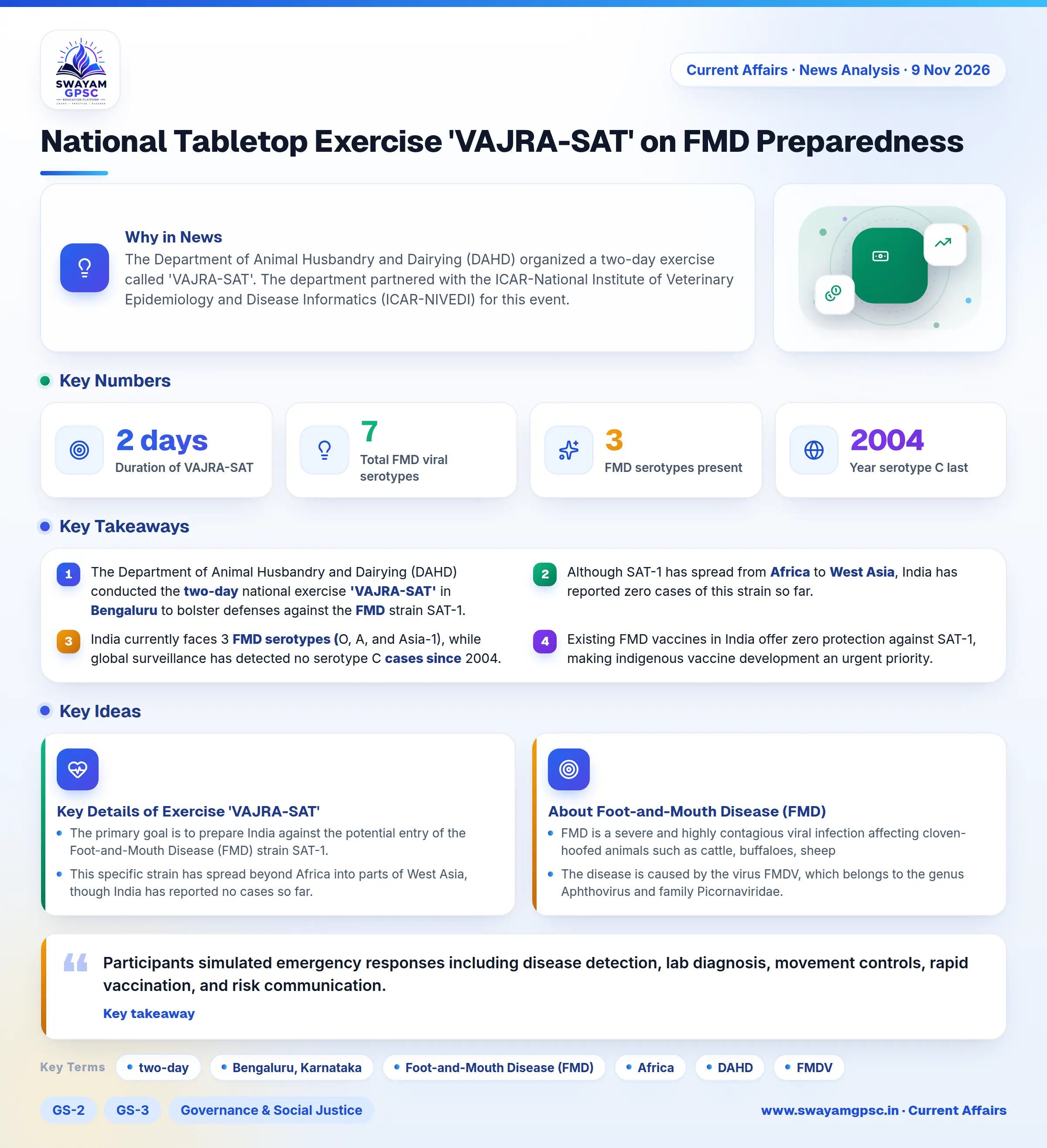
National Tabletop Exercise 'VAJRA-SAT' on FMD Preparedness
#GS-2 #GS-3 #Governance & Social Justice #Economics of Animal-Rearing #Current Events #Government Policies & Interventions #National #Rapid Fire CA
Key takeaways
- The Department of Animal Husbandry and Dairying (DAHD) conducted the two-day national exercise 'VAJRA-SAT' in Bengaluru to bolster defenses against the FMD strain SAT-1.
- Although SAT-1 has spread from Africa to West Asia, India has reported zero cases of this strain so far.
- India currently faces 3 FMD serotypes (O, A, and Asia-1), while global surveillance has detected no serotype C cases since 2004.
- Existing FMD vaccines in India offer zero protection against SAT-1, making indigenous vaccine development an urgent priority.
Why in News
- The Department of Animal Husbandry and Dairying (DAHD) organized a two-day exercise called 'VAJRA-SAT'.
- The department partnered with the ICAR-National Institute of Veterinary Epidemiology and Disease Informatics (ICAR-NIVEDI) for this event.
- The national exercise took place in Bengaluru, Karnataka, focusing on disease preparedness.
Key Details of Exercise 'VAJRA-SAT'
- The primary goal is to prepare India against the potential entry of the Foot-and-Mouth Disease (FMD) strain SAT-1.
- This specific strain has spread beyond Africa into parts of West Asia, though India has reported no cases so far.
- The official theme for the exercise is 'Detect Early, Confirm Fast, Contain Together'.
- Participants simulated emergency responses including disease detection, lab diagnosis, movement controls, rapid vaccination, and risk communication.
- The exercise stressed the importance of risk-based surveillance, epidemiological intelligence, and early-warning systems.
- The DAHD proposed upgrading regional FMD labs and RDDLs using the Pandemic Fund with support from ICAR-NIFMD.
- Experts highlighted the urgent need to develop an indigenous SAT-1 vaccine because current Indian FMD vaccines do not cover this strain.
About Foot-and-Mouth Disease (FMD)
- FMD is a severe and highly contagious viral infection affecting cloven-hoofed animals such as cattle, buffaloes, sheep, goats, and pigs.
- The disease is caused by the virus FMDV, which belongs to the genus Aphthovirus and family Picornaviridae.
- There are seven total serotypes: O, A, C, SAT-1, SAT-2, SAT-3, and Asia-1.
- India currently experiences serotypes O, A, and Asia-1, while SAT strains have never been detected in the country.
- Global health authorities have not detected serotype C anywhere in the world since 2004.
- Vaccines must target specific strains because immunity against one serotype does not protect animals against others.
- The virus spreads easily through direct animal contact, contaminated farm equipment, and airborne particles.
- Infected animals suffer from high fever, painful blisters on the mouth, feet, and teats, alongside a sharp fall in milk production.