National Health Accounts 2023-24 Highlights Public Spending Rise
#GS-2 #Governance & Social Justice #Health #Government Policies & Interventions #GS-3 #Economy #Budgeting #Planning #National Health Accounts (NHA) #National Health Policy 2017 #PM-JAY #Ayushman Bharat Digital Mission #Non-Communicable Diseases #Ayushman Arogya Mandirs
Key takeaways
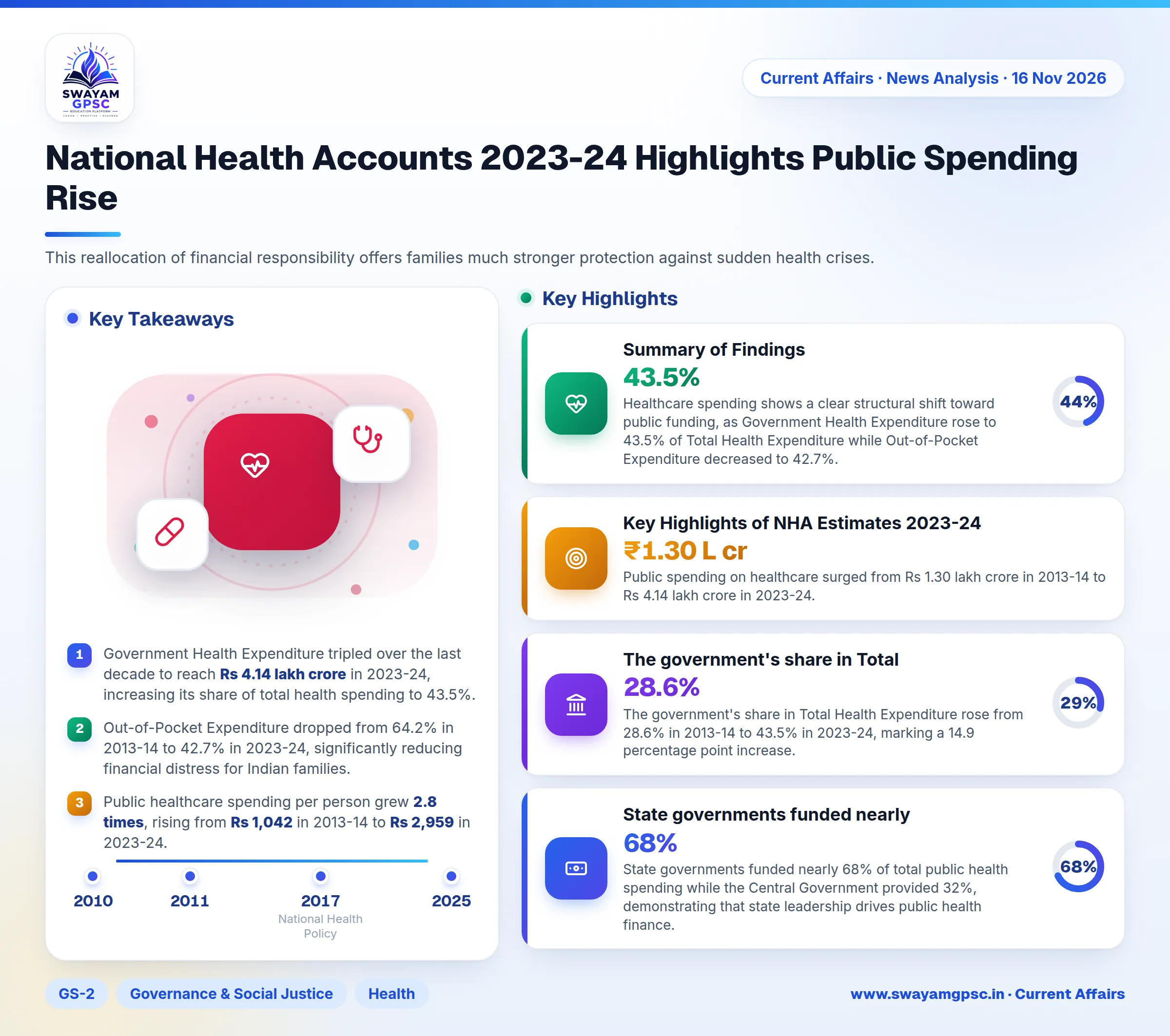
- Government Health Expenditure tripled over the last decade to reach Rs 4.14 lakh crore in 2023-24, increasing its share of total health spending to 43.5%.
- Out-of-Pocket Expenditure dropped from 64.2% in 2013-14 to 42.7% in 2023-24, significantly reducing financial distress for Indian families.
- Public healthcare spending per person grew 2.8 times, rising from Rs 1,042 in 2013-14 to Rs 2,959 in 2023-24.
- Despite progress, public health spending remains at 1.43% of GDP, falling short of the 2.5% target set by the National Health Policy 2017.
Why in News
- The Union Ministry of Health and Family Welfare published the National Health Accounts (NHA) Estimates for India 2023-24.
- The report reveals that public funding for healthcare tripled over the last ten years.
- The data confirms that Out-of-Pocket Expenditure (OOPE) paid directly by households dropped significantly over the same timeframe.
Summary of Findings
- Healthcare spending shows a clear structural shift toward public funding, as Government Health Expenditure rose to 43.5% of Total Health Expenditure while Out-of-Pocket Expenditure decreased to 42.7%.
- This reallocation of financial responsibility offers families much stronger protection against sudden health crises.
- Persistent challenges like low overall public spending, high medicine costs, regional imbalances, and rising non-communicable diseases still block access to cheap treatment.
Key Highlights of NHA Estimates 2023-24
- Public spending on healthcare surged from Rs 1.30 lakh crore in 2013-14 to Rs 4.14 lakh crore in 2023-24.
- The government's share in Total Health Expenditure rose from 28.6% in 2013-14 to 43.5% in 2023-24, marking a 14.9 percentage point increase.
- State governments funded nearly 68% of total public health spending while the Central Government provided 32%, demonstrating that state leadership drives public health finance.
- Out-of-pocket medical payments by families dropped from 64.2% in 2013-14 down to 42.7% in 2023-24, representing a 21.5 percentage point reduction.
- This substantial drop in personal medical payments shields Indian families from catastrophic financial debt caused by severe illnesses.
- Public health spending per individual grew by 2.8 times, rising from Rs 1,042 per citizen in 2013-14 to Rs 2,959 in 2023-24.
- Total Health Expenditure across India reached Rs 9.52 lakh crore in 2023-24, representing 3.29% of the national Gross Domestic Product.
- Current operational health spending comprised 87.9% of overall health expenditure, while capital infrastructure investments accounted for the remaining 12.1%.
- Government spending directed specifically toward primary healthcare facilities expanded to Rs 1.53 lakh crore.
- Primary care absorbed 46% of current health operational spending, followed by secondary medical care at 35% and tertiary medical care at 14%.
- This budgetary distribution supports the core objective of the National Health Policy 2017, which emphasizes primary care to deliver Universal Health Coverage.
- Social security health spending, including government health insurance schemes and medical cost reimbursements, grew from 6% of Total Health Expenditure in 2013-14 to 11% in 2023-24.
- Private health insurance payments expanded from 3.4% of Total Health Expenditure in 2013-14 to 10.2% in 2023-24, pointing to wider commercial policy uptake.
Overview of National Health Accounts
- The NHA provides detailed insights into health spending across India by tracking where funds originate, who controls the budgets, and who provides the medical services.
- These financial reports are compiled every year using the globally recognized System of Health Accounts (SHA) 2011 measurement framework.
- The National Health Accounts Technical Secretariat (NHATS), operating under the National Health Systems Resource Centre (NHSRC) within the Ministry of Health and Family Welfare, produced this 11th edition for 2023-24.
Challenges in India's Healthcare Financing
- Despite absolute spending increases, public health expenditure remains low at 1.43% of GDP, missing the National Health Policy 2017 target of 2.5% of GDP by 2025.
- Indian households paid Rs 4.06 lakh crore directly from their savings for care in 2023-24, keeping personal health burdens heavy despite percentage declines.
- This spending share far exceeds the global average of 18-20%, pushing millions of vulnerable families into poverty due to unexpected medical emergencies.
- Major government protection schemes like PM-JAY focus almost entirely on inpatient hospital care, leaving day-to-day outpatient care uncovered.
- Outpatient consultations and diagnostic tests form the largest portion of out-of-pocket costs, yet these expenses receive almost no subsidies or insurance benefits.
- A Parliamentary Standing Committee report titled Affordability and Accessibility of Healthcare Facilities in Public and Private Sectors noted that over 40 crore citizens form a missing middle without any health cover.
- Expenses on prescription and over-the-counter drugs consume 30.2% of current health expenditure, creating a continuous financial drain on household income.
- Modern medical infrastructure and specialized doctors remain concentrated in cities, leaving rural areas and less developed states behind.
- Private medical centers managed 31.91% of current health operational spending in 2023-24 compared to 16.77% handled by public hospitals.
- Weak enforcement of the Clinical Establishments (Registration and Regulation) Act, 2010 enables private providers to charge high tariffs, order unnecessary tests, and push up health costs.
- Because health remains a State subject under the Constitution, economic differences between states lead to major disparities in public health funding.
- Less prosperous states like Bihar, Uttar Pradesh, and Jharkhand spend far less money per person on healthcare than affluent southern states.
- Growing lifestyle conditions such as diabetes, hypertension, and heart disease combine with weak preventive measures to threaten future health budgets.
Way Forward
- Both central and state governments must open fiscal room to raise public health spending to 2.5% of GDP, closing rural infrastructure gaps and increasing doctor numbers.
- State governments must rigorously implement the Clinical Establishments (Registration and Regulation) Act, 2010 to stop unfair private pricing practices.
- Enforcing standardized treatment rules, requiring transparent price display boards, and capping diagnostic fees will protect patients from excessive charges.
- Accelerating the Ayushman Bharat Digital Mission (ABDM) will build shared digital health records that reduce duplicate testing and streamline program funding.
- Health funding must shift toward preventive care by upgrading sub-centers into Ayushman Arogya Mandirs and adopting a comprehensive One Health model.
Conclusion
- The NHA 2023-24 data confirms that recent health financing reforms are moving India in the right direction, but achieving Universal Health Coverage demands deeper changes.
- India can transform healthcare into an economic strength by regulating private medical costs, expanding digital tools, and reaching the 2.5% GDP investment target.