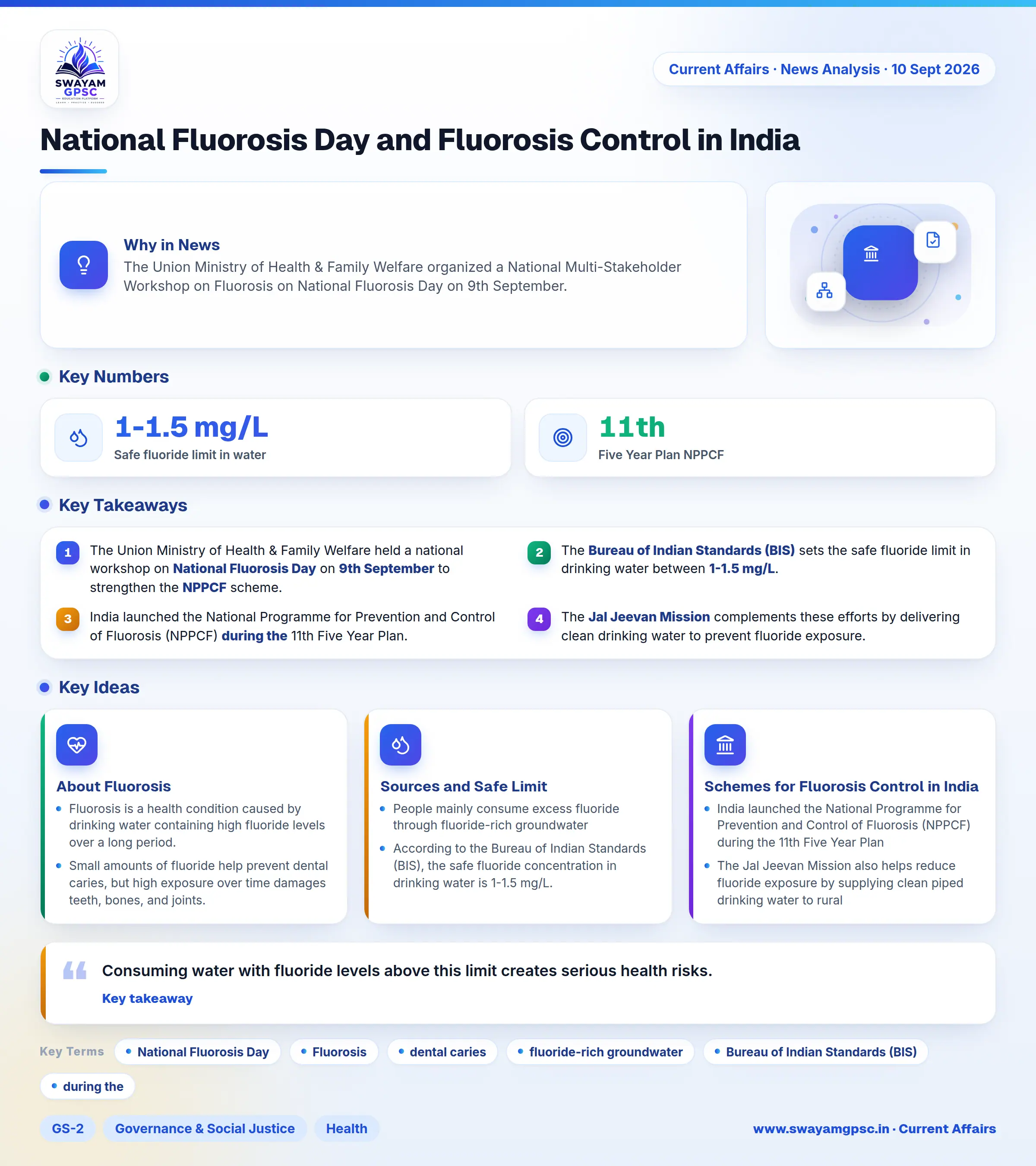
National Fluorosis Day and Fluorosis Control in India
#GS-2 #Governance & Social Justice #Health #National #NPPCF #Jal Jeevan Mission
Key takeaways
- The Union Ministry of Health & Family Welfare held a national workshop on National Fluorosis Day on 9th September to strengthen the NPPCF scheme.
- The Bureau of Indian Standards (BIS) sets the safe fluoride limit in drinking water between 1-1.5 mg/L.
- India launched the National Programme for Prevention and Control of Fluorosis (NPPCF) during the 11th Five Year Plan.
- The Jal Jeevan Mission complements these efforts by delivering clean drinking water to prevent fluoride exposure.
Why in News
- The Union Ministry of Health & Family Welfare organized a National Multi-Stakeholder Workshop on Fluorosis on National Fluorosis Day on 9th September.
- This workshop focused on strengthening prevention, early detection, management, and control of fluorosis under the National Programme for Prevention and Control of Fluorosis (NPPCF).
About Fluorosis
- Fluorosis is a health condition caused by drinking water containing high fluoride levels over a long period.
- Small amounts of fluoride help prevent dental caries, but high exposure over time damages teeth, bones, and joints.
Sources and Safe Limit
- People mainly consume excess fluoride through fluoride-rich groundwater, especially in regions with high natural fluoride deposits.
- According to the Bureau of Indian Standards (BIS), the safe fluoride concentration in drinking water is 1-1.5 mg/L.
- Consuming water with fluoride levels above this limit creates serious health risks.
Schemes for Fluorosis Control in India
- India launched the National Programme for Prevention and Control of Fluorosis (NPPCF) during the 11th Five Year Plan to improve surveillance, diagnosis, and treatment.
- The Jal Jeevan Mission also helps reduce fluoride exposure by supplying clean piped drinking water to rural households.