National Family Health Survey 6 Insights
#GS-2 #Governance & Social Justice #Health #Poverty #Current Events #National #GS-1 #Indian Society #Women #Social Justice
Key takeaways
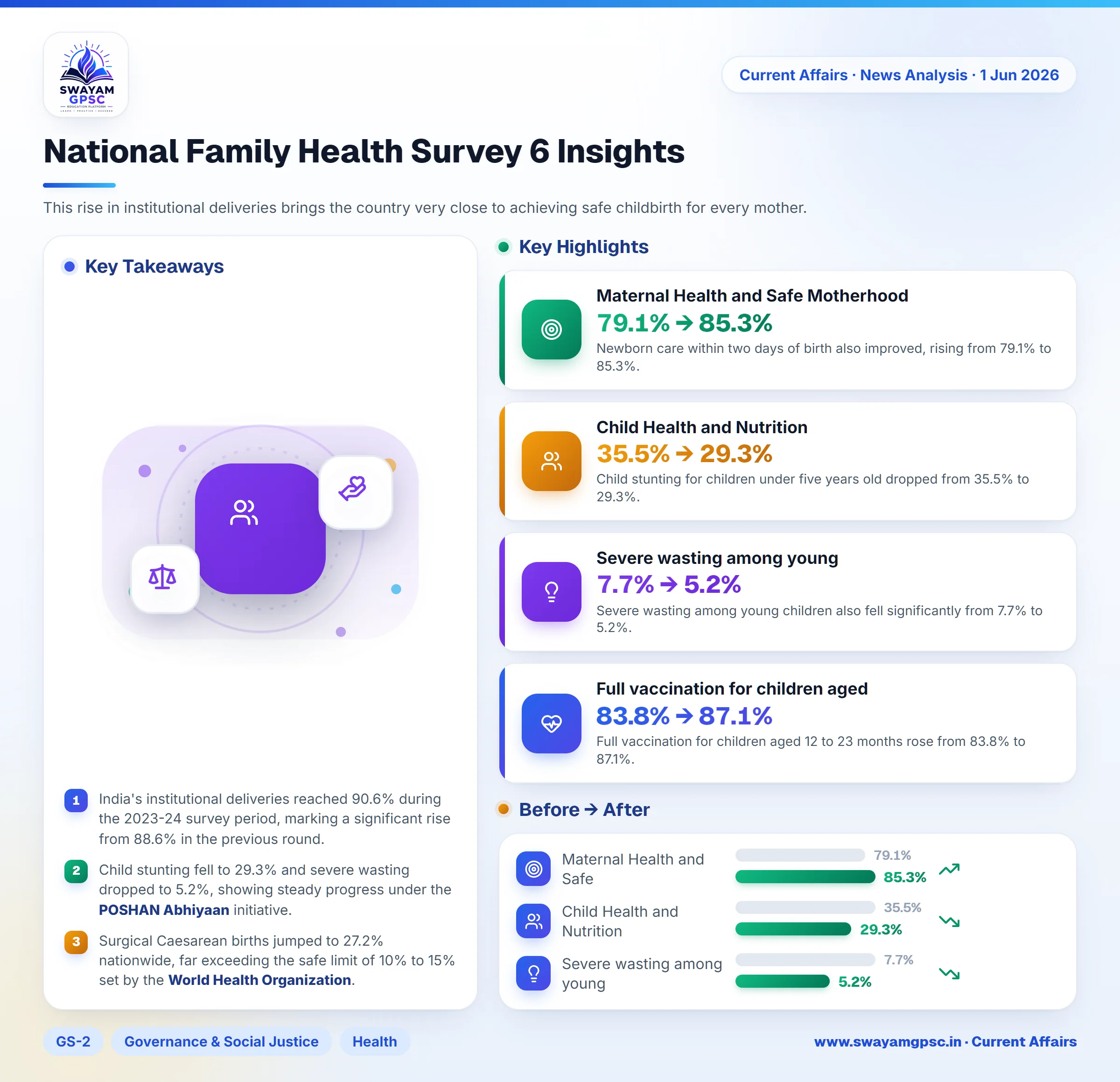
- India's institutional deliveries reached 90.6% during the 2023-24 survey period, marking a significant rise from 88.6% in the previous round.
- Child stunting fell to 29.3% and severe wasting dropped to 5.2%, showing steady progress under the POSHAN Abhiyaan initiative.
- Surgical Caesarean births jumped to 27.2% nationwide, far exceeding the safe limit of 10% to 15% set by the World Health Organization.
- Internet usage among Indian women nearly doubled, rising from 33.3% to 64.3% according to the National Family Health Survey-6 data.
- The Total Fertility Rate in India stayed stable at 2.0, which remains below the international replacement level of 2.1.
Why in News
- The Ministry of Health and Family Welfare released the latest data from the National Family Health Survey-6 for the 2023-24 period.
- This new survey shows that India achieved a major milestone in healthcare for mothers and children.
- In simple words, 90.6% of all births in India now happen in proper medical institutions like hospitals.
- This rise in institutional deliveries brings the country very close to achieving safe childbirth for every mother.
Summary
- The survey shows major progress in child health, nutrition, family planning, and the empowerment of women.
- Key government programs like Janani Suraksha Yojana and POSHAN Abhiyaan drove these positive changes.
- However, the report also highlights new worries like rising obesity rates and more surgeries during childbirth.
- India still needs to work on improving nutrition and stopping the rise of lifestyle-related diseases.
Maternal Health and Safe Motherhood
- Institutional deliveries grew from 88.6% in the previous survey to 90.6% in the latest round.
- Trained healthcare workers now assist in 91.3% of all births, which is up from 89.4% earlier.
- Newborn care within two days of birth also improved, rising from 79.1% to 85.3%.
- Pregnancy registrations for antenatal care reached 95.9%, and first-trimester care tracking increased to 76.2%.
- More mothers now take iron folic acid tablets, with 54.9% taking them for at least 100 days during pregnancy.
- In addition, the share of pregnant women taking these supplements for 180 days or more grew to 37.8%.
- Government initiatives like the Janani Suraksha Yojana and Pradhan Mantri Matru Vandana Yojana helped make these improvements possible.
Child Health and Nutrition
- Child stunting for children under five years old dropped from 35.5% to 29.3%.
- Severe wasting among young children also fell significantly from 7.7% to 5.2%.
- The percentage of underweight children under five saw a slight decrease, moving from 32.1% down to 31.8%.
- More infants aged six to eight months now receive solid food along with breast milk, rising to 59.5%.
- Full vaccination for children aged 12 to 23 months rose from 83.8% to 87.1%.
- Public health centers provided the vast majority of these vaccinations, accounting for 95.6% of the total.
- Better storage facilities and the new U-WIN digital platform helped boost the Universal Immunization Programme.
- Specifically, rotavirus vaccination rates jumped from 36.4% to 85.4% due to these digital tracking upgrades.
- The coverage for the second dose of the measles vaccine also grew from 58.6% to 71.8%.
- Cases of acute respiratory infections among children fell to 1.9%, while severe diarrhea fell to 0.5%.
- Almost all babies under six months, around 95.6%, now receive only breast milk.
- Breastfeeding within the first hour of birth improved by nearly ten percentage points, reaching 50.1%.
- Programs like POSHAN 2.0 and the Integrated Child Development Services drove these nutritional improvements.
Demographic Trends
- India's Total Fertility Rate remained steady at 2.0, which is below the replacement level of 2.1.
- This means that India's population is now on a path toward long-term stabilization.
- Use of family planning methods increased, with the contraceptive rate rising from 66.7% to 69.1%.
Women's Empowerment and Financial Inclusion
- Internet usage among women nearly doubled, climbing from 33.3% to 64.3% in the latest survey.
- Mobile phone ownership among women also saw a healthy increase, rising from 53.9% to 63.6%.
- More women now run their own bank accounts, with the number rising from 78.6% to 89.0%.
- Use of clean menstrual hygiene products among young women aged 15 to 24 grew to 79.2%.
- Schemes like the Menstrual Hygiene Scheme and affordable products from Jan Aushadhi centers helped this progress.
- Families with health insurance grew from 41.0% to 60.2%, largely due to the Ayushman Bharat scheme.
National Family Health Survey Overview
- The survey is a large-scale study that collects health and family data from households across India.
- The first round of this survey started back in the 1992-93 period.
- The International Institute for Population Sciences in Mumbai coordinates and guides this nationwide survey.
- The main goal is to give the government reliable district-level data to help design better health policies.
Key Features of NFHS-6
- The sixth round covered 6.79 lakh households across 715 districts in India.
- Field workers used tablets and computers for interviews to validate the data in real time.
- This round also tracked newer topics like Direct Benefit Transfer and women's self-help groups.
- Researchers expanded medical testing to include physical measurements, blood tests, and HIV testing.
Challenges
- Caesarean section births jumped from 21.5% to 27.2%, which exceeds the safe limit set by the World Health Organization.
- In private hospitals, C-sections reached 54.1%, suggesting that commercial interests might drive these surgical births.
- India now faces a double challenge of both undernutrition and rising obesity rates.
- Obesity among women aged 15 to 49 rose to 30.7%, with urban women reaching 42.8%.
- For men in the same age bracket, obesity rates rose to 27.3%.
- Chronic diseases like diabetes and high blood pressure are rising alongside these obesity numbers.
- Nearly one in three children still suffers from stunting, showing that nutritional improvements must speed up.
- Over one-third of pregnant women still do not complete the recommended four prenatal checkups.
- Removing blood-based anemia testing from this survey round drew criticism from health experts.
- This missing data makes it harder to track the success of the Anaemia Mukt Bharat campaign.
Way Forward
- The government must audit private hospitals that perform too many surgical births.
- Training more specialized midwives can help promote natural and safe deliveries instead of surgeries.
- To fight obesity, India should tax unhealthy processed foods and introduce clear warning labels on food packages.
- Health workers can use the U-WIN digital platform to find and vaccinate children who missed their shots.
- Local health clinics need better digital tools to track and treat chronic diseases early.
Conclusion
- The survey shows that India is making good progress toward its global health goals.
- However, rising lifestyle diseases and nutritional gaps mean India must focus more on preventive health.