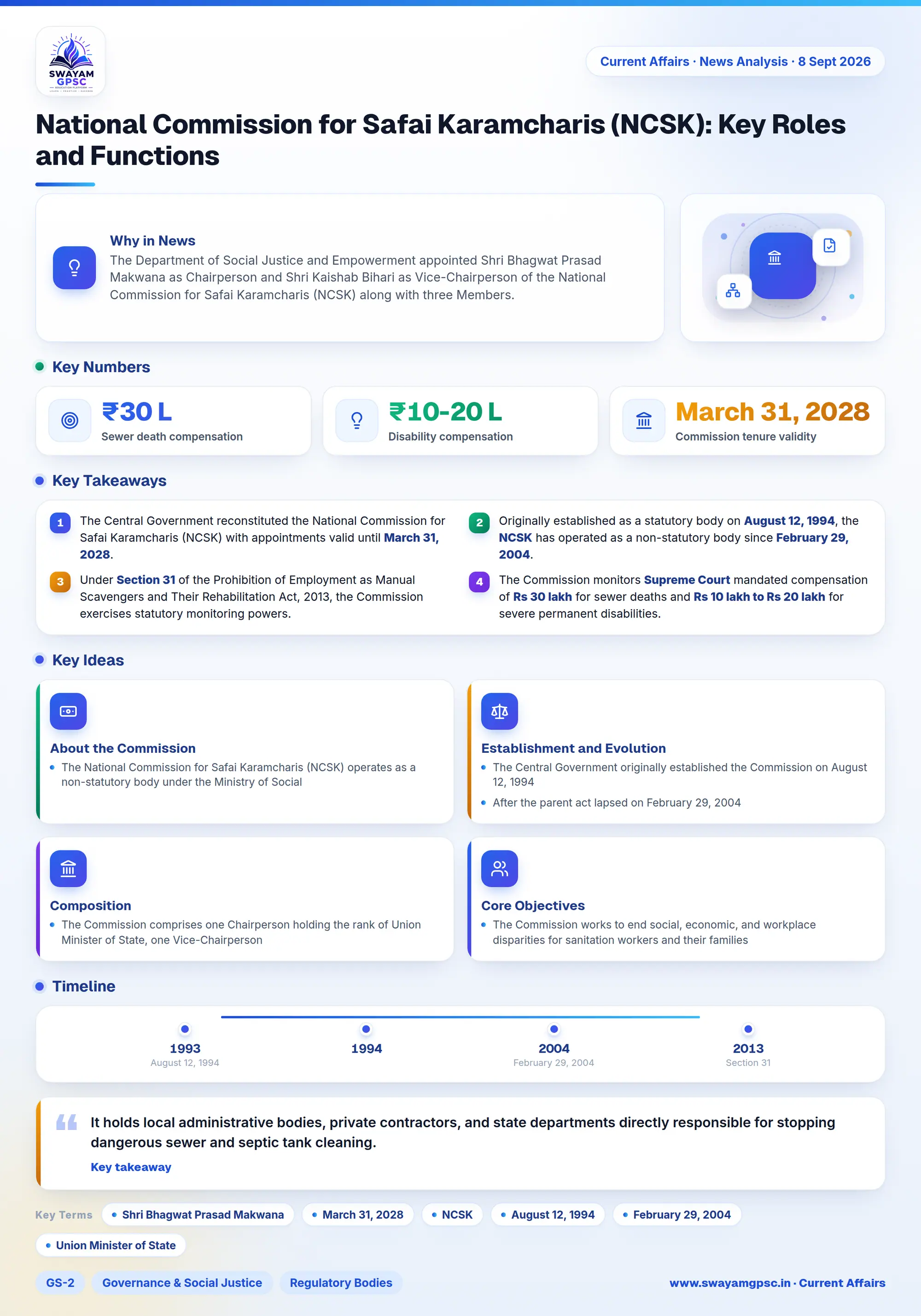
National Commission for Safai Karamcharis (NCSK): Key Roles and Functions
#GS-2 #Governance & Social Justice #Regulatory Bodies #Good Governance #Social Justice #Vulnerable Sections #Current Events #National #Prelims
Key takeaways
- The Central Government reconstituted the National Commission for Safai Karamcharis (NCSK) with appointments valid until March 31, 2028.
- Originally established as a statutory body on August 12, 1994, the NCSK has operated as a non-statutory body since February 29, 2004.
- Under Section 31 of the Prohibition of Employment as Manual Scavengers and Their Rehabilitation Act, 2013, the Commission exercises statutory monitoring powers.
- The Commission monitors Supreme Court mandated compensation of Rs 30 lakh for sewer deaths and Rs 10 lakh to Rs 20 lakh for severe permanent disabilities.
Why in News
- The Department of Social Justice and Empowerment appointed Shri Bhagwat Prasad Makwana as Chairperson and Shri Kaishab Bihari as Vice-Chairperson of the National Commission for Safai Karamcharis (NCSK) along with three Members.
- These new appointments will remain valid until March 31, 2028, completing the official tenure of the present 10th Commission.
About the Commission
- The National Commission for Safai Karamcharis (NCSK) operates as a non-statutory body under the Ministry of Social Justice and Empowerment to protect the rights, dignity, and socioeconomic welfare of sanitation workers and manual scavengers across India.
Establishment and Evolution
- The Central Government originally established the Commission on August 12, 1994, as a statutory body under the National Commission for Safai Karamcharis Act, 1993.
- After the parent act lapsed on February 29, 2004, the body has functioned as a non-statutory entity through executive resolutions, with its present tenure extended until March 31, 2028.
Composition
- The Commission comprises one Chairperson holding the rank of Union Minister of State, one Vice-Chairperson, and five Members, including at least one woman member, alongside an administrative Secretary holding the rank of Joint Secretary.
Core Objectives
- The Commission works to end social, economic, and workplace disparities for sanitation workers and their families, eliminate dangerous manual scavenging, provide protective equipment, and ensure full socioeconomic rehabilitation.
Key Functions
- It prepares policy recommendations for the Central Government to create equal opportunities for sanitation workers and evaluates ongoing rehabilitation schemes.
- It examines personal and community grievances, holding the power to initiate suo motu inquiries into administrative delays or legal violations.
- It inspects ground-level safety conditions, fair minimum wage delivery, and protective gear standards across municipal bodies, gram panchayats, and private contractors.
- It carries out oversight duties under Section 31 of the Prohibition of Employment as Manual Scavengers and Their Rehabilitation Act, 2013, advising governments and investigating violations.
- It enforces compliance with Supreme Court directives by ensuring payment of Rs 30 lakh compensation for sewer death cases and Rs 10 lakh to Rs 20 lakh for permanent sewer-related disabilities.
Significance
- It holds local administrative bodies, private contractors, and state departments directly responsible for stopping dangerous sewer and septic tank cleaning.
- It protects sanitation workers' fundamental rights, occupational health, and overall welfare through regular field inspections and direct legal interventions.