National Anti-Doping (Amendment) Act, 2025
#GS-2 #Governance & Social Justice #Regulatory Bodies #GS-3 #Current Events #National #Sports #Anti-Doping #NADA #WADA
Why in News
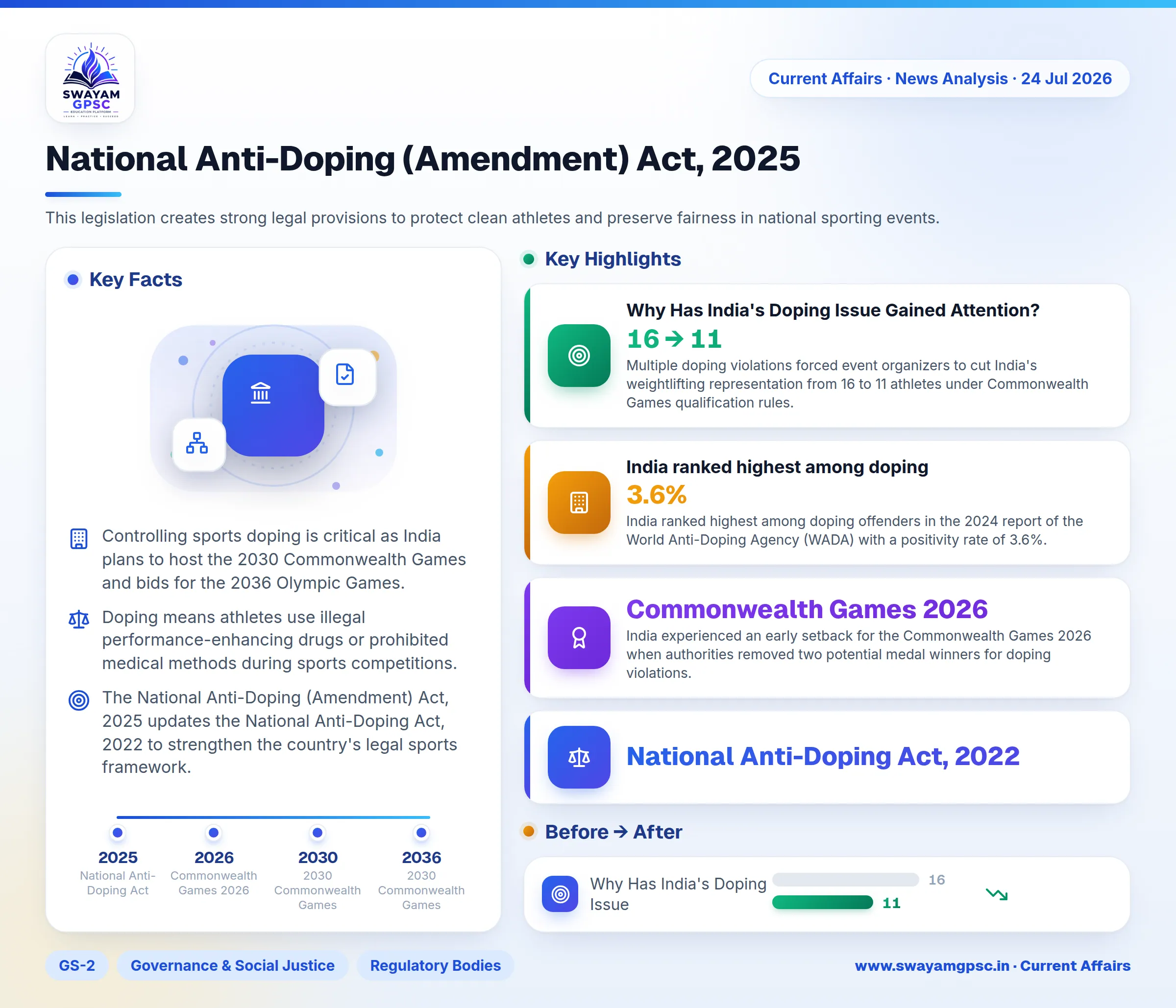
- India experienced an early setback for the Commonwealth Games 2026 when authorities removed two potential medal winners for doping violations.
- The Indian government recently notified the operational start of the National Anti-Doping Act, 2022 and the National Anti-Doping (Amendment) Act, 2025 to enforce clean sports standards.
Why Has India's Doping Issue Gained Attention?
- Multiple doping violations forced event organizers to cut India's weightlifting representation from 16 to 11 athletes under Commonwealth Games qualification rules.
- India ranked highest among doping offenders in the 2024 report of the World Anti-Doping Agency (WADA) with a positivity rate of 3.6%.
- Controlling sports doping is critical as India plans to host the 2030 Commonwealth Games and bids for the 2036 Olympic Games.
- Doping means athletes use illegal performance-enhancing drugs or prohibited medical methods during sports competitions.
Key Features of the National Anti-Doping (Amendment) Act, 2025
- The National Anti-Doping (Amendment) Act, 2025 updates the National Anti-Doping Act, 2022 to strengthen the country's legal sports framework.
- This legislation creates strong legal provisions to protect clean athletes and preserve fairness in national sporting events.
- The new rules match international standards set by the World Anti-Doping Code and the UNESCO International Convention against Doping in Sport.
- The law establishes the National Anti-Doping Agency (NADA) as the primary executive body for testing and enforcement.
- It forms the National Board for Anti-Doping in Sports to supervise NADA and advise central government authorities on policy matters.
- The legal framework provides statutory backing for sample testing, athlete education, background intelligence, and systematic investigations.
- The law authorizes the National Board to gather performance records directly from the Disciplinary Panel and the Appeal Panel.
- It clearly identifies all specific actions and circumstances that constitute anti-doping violations under sports regulations.
- This law improves institutional transparency and ensures fair hearing procedures during legal disputes.
- The updated framework gives greater independence to Indian anti-doping agencies while matching global best practices.
- These strict regulations guarantee equal competing conditions for all Indian athletes across various sports disciplines.
National Anti-Doping Agency (NADA)
- The Indian government established NADA in 2005 as an autonomous institution to control doping activities in national sports.
- NADA plans and executes nationwide drug testing while following rules established by the World Anti-Doping Agency (WADA).
- The agency manages the national Anti-Doping Program and runs awareness efforts such as the #PlayTrue Campaign for athletes.
World Anti-Doping Agency (WADA)
- The International Olympic Committee (IOC) created WADA in 1999 as an independent global regulator against sports doping.
- WADA operates through a joint governance structure funded equally by governments and international sports organizations.
- The World Anti-Doping Code functions as the main regulation document that aligns anti-doping policy across all countries.
- WADA updates its Prohibited List every year to identify all banned chemicals and unfair athletic methods worldwide.
- The rules in the Prohibited List apply to athletes during active competitions as well as off-season training periods.
Frequently Asked Questions (FAQs)
- Doping violations impacted India's Commonwealth Games 2026 participation after authorities dropped two potential medalists and slashed the weightlifting team allocation.
- Under international rules, every Anti-Doping Rule Violation (ADRV) committed by athletes or trainers reduces the official quota slots for that country.
- Authorities provisionally suspended judo competitor Arun Kumar, who represents India in the 78 kg category, ahead of upcoming competitions.
- The National Anti-Doping Act, 2022 provides statutory authority for testing procedures, sports intelligence, athlete education, and disciplinary enforcement in India.
- The National Anti-Doping (Amendment) Act, 2025 enhances board authority, guarantees due legal process, and brings national rules into agreement with international standards.