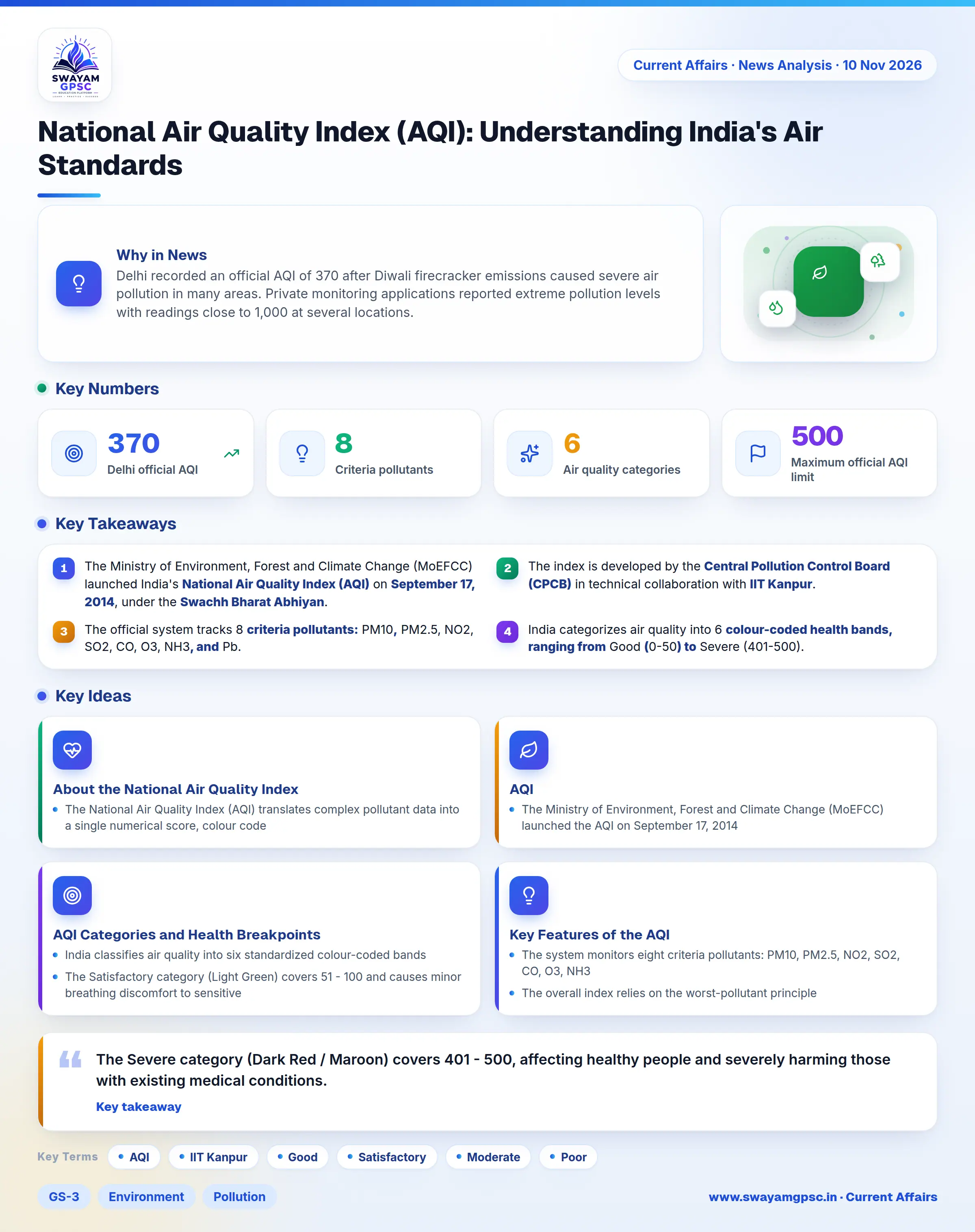
National Air Quality Index (AQI): Understanding India's Air Standards
#GS-3 #Environment #Pollution #National Air Quality Index #CPCB #Current Events #National
Key takeaways
- The Ministry of Environment, Forest and Climate Change (MoEFCC) launched India's National Air Quality Index (AQI) on September 17, 2014, under the Swachh Bharat Abhiyan.
- The index is developed by the Central Pollution Control Board (CPCB) in technical collaboration with IIT Kanpur.
- The official system tracks 8 criteria pollutants: PM10, PM2.5, NO2, SO2, CO, O3, NH3, and Pb.
- India categorizes air quality into 6 colour-coded health bands, ranging from Good (0-50) to Severe (401-500).
- India caps the official national AQI scale at 500, using the worst-pollutant principle to highlight the highest risk pollutant.
Why in News
- Delhi recorded an official AQI of 370 after Diwali firecracker emissions caused severe air pollution in many areas.
- Private monitoring applications reported extreme pollution levels with readings close to 1,000 at several locations.
About the National Air Quality Index (AQI)
- The National Air Quality Index (AQI) translates complex pollutant data into a single numerical score, colour code, and health risk category.
Background
- The Ministry of Environment, Forest and Climate Change (MoEFCC) launched the AQI on September 17, 2014, under the Swachh Bharat Abhiyan initiative.
- The Central Pollution Control Board (CPCB) formulated the index with technical support from IIT Kanpur and environmental health experts.
AQI Categories and Health Breakpoints
- India classifies air quality into six standardized colour-coded bands, starting with 0 - 50 as Good (Green) with minimal health impact.
- The Satisfactory category (Light Green) covers 51 - 100 and causes minor breathing discomfort to sensitive individuals.
- The Moderate category (Yellow) spans 101 - 200 and causes discomfort to people with heart, asthma, or lung diseases.
- The Poor category (Orange) ranges from 201 - 300 and leads to breathing trouble for most people on prolonged exposure.
- The Very Poor category (Red) spans 301 - 400 and can trigger respiratory illnesses after long exposure.
- The Severe category (Dark Red / Maroon) covers 401 - 500, affecting healthy people and severely harming those with existing medical conditions.
Key Features of the AQI
- The system monitors eight criteria pollutants: PM10, PM2.5, NO2, SO2, CO, O3, NH3, and Pb to determine ambient air quality.
- The overall index relies on the worst-pollutant principle, which uses the highest sub-index value so high individual pollutant levels are not hidden by averaging.
- Calculating the AQI requires data for at least three pollutants, which must include either PM2.5 or PM10.
- India caps its official AQI scale at 500, even if actual pollutant concentrations go above severe limits.