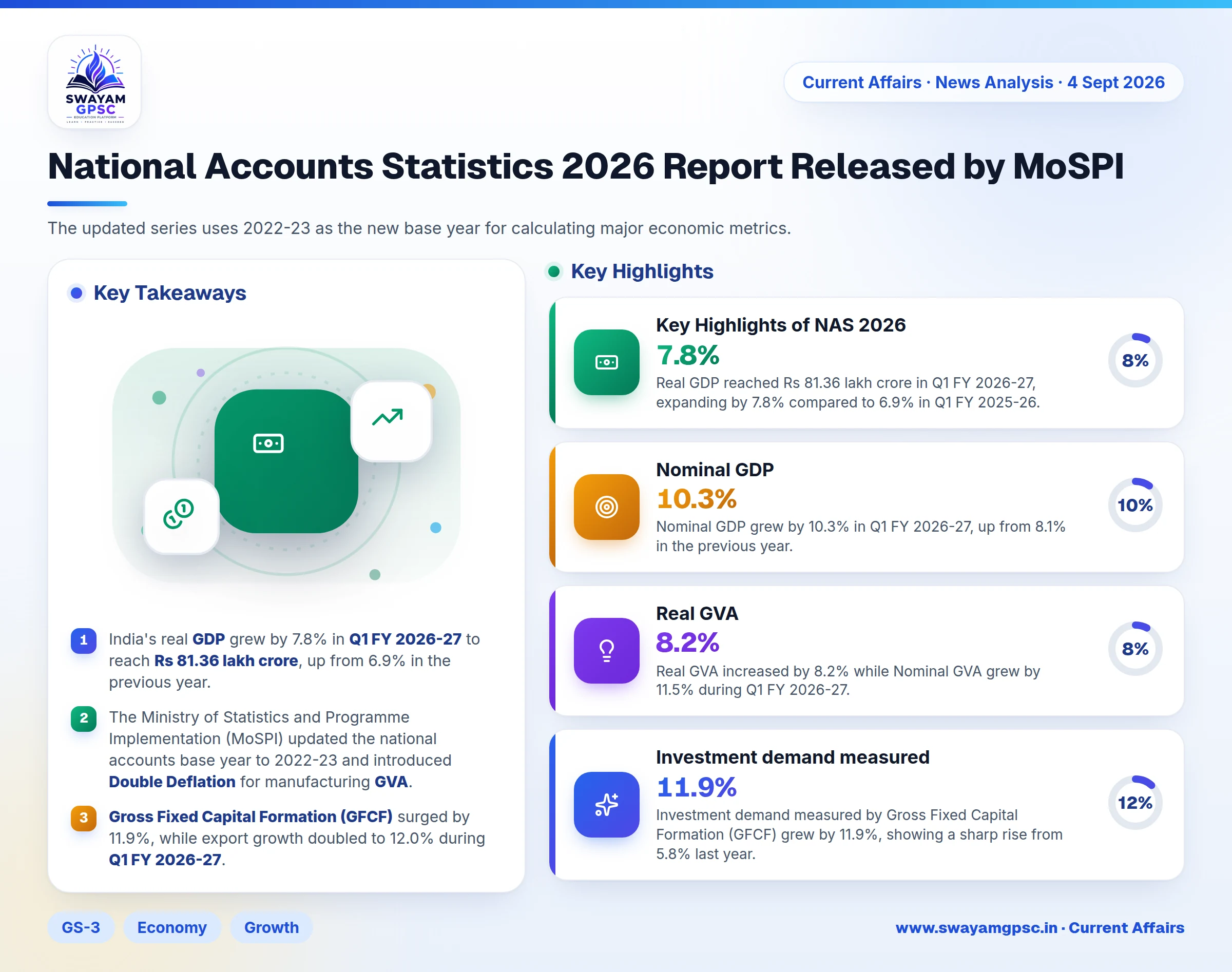
National Accounts Statistics 2026 Report Released by MoSPI
#GS-3 #Economy #Growth #Agriculture #Governance & Social Justice #Current Events #National #National Accounts Statistics #GDP #Macroeconomics
Key takeaways
- India's real GDP grew by 7.8% in Q1 FY 2026-27 to reach Rs 81.36 lakh crore, up from 6.9% in the previous year.
- The Ministry of Statistics and Programme Implementation (MoSPI) updated the national accounts base year to 2022-23 and introduced Double Deflation for manufacturing GVA.
- Gross Fixed Capital Formation (GFCF) surged by 11.9%, while export growth doubled to 12.0% during Q1 FY 2026-27.
- Major policy interventions include the Rs 12,980 crore Bharat Maritime Insurance Pool and a Rs 3.15 lakh crore funding extension for PM-KISAN through FY 2030-31.
Why in News
- The Ministry of Statistics and Programme Implementation (MoSPI) has released the National Accounts Statistics 2026 report.
- This publication introduces 2022-23 as the updated base year for tracking key macroeconomic indicators.
- It provides revised estimates for Gross Domestic Product (GDP) and national income using updated statistical datasets.
Key Highlights of NAS 2026
- The updated series uses 2022-23 as the new base year for calculating major economic metrics.
- It incorporates modern price indices including the Producer Price Index (PPI), Index of Industrial Production (IIP), and Banking Services Price Index (BkSPI).
- MoSPI adopted the Double Deflation methodology to calculate manufacturing Gross Value Added (GVA) in line with UN System of National Accounts standards.
- The previous calculation method relied on a single deflator for both raw inputs and final goods.
- The new double deflation method deflates intermediate inputs and gross output separately to measure actual value addition accurately.
- Real GDP reached Rs 81.36 lakh crore in Q1 FY 2026-27, expanding by 7.8% compared to 6.9% in Q1 FY 2025-26.
- Nominal GDP grew by 10.3% in Q1 FY 2026-27, up from 8.1% in the previous year.
- Real GVA increased by 8.2% while Nominal GVA grew by 11.5% during Q1 FY 2026-27.
- Investment demand measured by Gross Fixed Capital Formation (GFCF) grew by 11.9%, showing a sharp rise from 5.8% last year.
- Private household consumption expenditure rose by 7.1%, reflecting steady domestic demand.
- Exports of goods and services grew by 12.0%, doubling the growth rate recorded in Q1 FY 2025-26.
- The primary sector grew by 2.9%, with Agriculture and Allied Activities recording 3.6% growth.
- The secondary sector expanded by 8.6%, supported by 9.2% growth in core manufacturing.
- The services sector accelerated by 10.0%, driven by 12.1% growth in financial, real estate, and professional services.
National Accounts Statistics Overview
- National Accounts Statistics (NAS) is an annual publication produced by MoSPI to provide a complete picture of India's aggregate production and national income.
- It measures critical economic parameters such as Gross Domestic Product (GDP), Gross Value Added (GVA), savings, and investment rates.
- This report serves as the core statistical basis for the Reserve Bank of India (RBI) and policymakers to assess structural trends and shape economic planning.
Concerns Regarding India's GDP Data
- Applying double deflation when input prices rise faster than output prices can create negative deflators.
- A negative deflator can artificially inflate calculated manufacturing growth even when actual production remains weak.
- Measuring the unorganized informal sector is difficult because informal firms leave limited real-time data trails.
- Using formal corporate growth as a proxy for small unorganized firms creates a corporate bias that can overestimate actual GDP expansion.
- Analysts express concerns about the MCA-21 corporate database regarding firm misclassification and statistical extrapolation factors.
- Revising base years requires recalculating past series, which frequently triggers public debate over historical growth comparisons.
- Delays in publishing historical back-series data make long-term trend analysis difficult for independent researchers.
- Using the Wholesale Price Index (WPI) instead of a proper Producer Price Index (PPI) introduces distortions linked to international commodity prices.
High-Tech Manufacturing and Industrial Policy
- The Semicon 2.0 initiative expands domestic chip design, fabrication, and advanced packaging facilities.
- The Mobile Phone Manufacturing Scheme (2026-31) promotes local component production and export capacity.
- The BHAVYA Rasayan Scheme supports chemical manufacturing parks to lower import dependence on specialty chemicals.
- The National Investment Policy for Urea-2026 (NIPU-2026) boosts domestic fertilizer output to protect farmers against foreign price fluctuations.
Energy Security and Green Infrastructure
- The Samudra Manthan project expands offshore oil and gas exploration to enhance domestic energy supplies.
- The Surface Coal/Lignite Gasification Scheme targets 100 million tonnes of capacity by 2030 to lower synthetic fuel imports.
- The GOBARdhan (2023-35) scheme promotes compressed biogas production from agricultural waste to build a circular economy.
- The PM Surya Sarovar Yojana (2026-31) targets 5,000 MW of floating solar power paired with Battery Energy Storage Systems (BESS).
Trade and Capital Market Initiatives
- The India-UK CETA offers zero-duty access for nearly 99% of Indian export categories, supporting textiles and engineering goods.
- The India-Israel Bilateral Investment Agreement (2026) provides a clear legal framework to attract cross-border direct investment.
- Expanding the Fully Accessible Route (FAR) enables higher foreign portfolio investment in government securities.
- The Bharat Maritime Insurance Pool (BMIP, 2026) offers Rs 12,980 crore in sovereign guarantees to shield shipping trade from geopolitical disruptions.
MSME and Rural Support Measures
- The Emergency Credit Line Guarantee Scheme (ECLGS) 5.0 provides credit guarantees to ease business liquidity needs.
- The MSME Development (Amendment) Act, 2026 simplifies regulatory compliance to encourage formal business growth.
- The PM-KISAN Extension delivers Rs 3.15 lakh crore through Direct Benefit Transfer (DBT) through FY 2030-31 to support rural incomes.
- Higher Minimum Support Price (MSP) settings for 14 Kharif crops incentivize domestic cultivation of oilseeds and pulses.
- The Kapas Kanti mission invests Rs 5,659 crore to improve cotton yields and strengthen the textile supply chain.
Way Forward
- The government must maintain regular base-year updates and publish detailed historical back-series data without delay.
- Using real-time GST filing data and digital transaction records can significantly improve informal sector estimation.
- Publishing comprehensive methodology documents will increase transparency and build public confidence in official economic statistics.