National Academic Depository: Digital Management of Academic Records
#GS-2 #Governance & Social Justice #Education #Digital Education #National Academic Depository #DigiLocker
Key takeaways
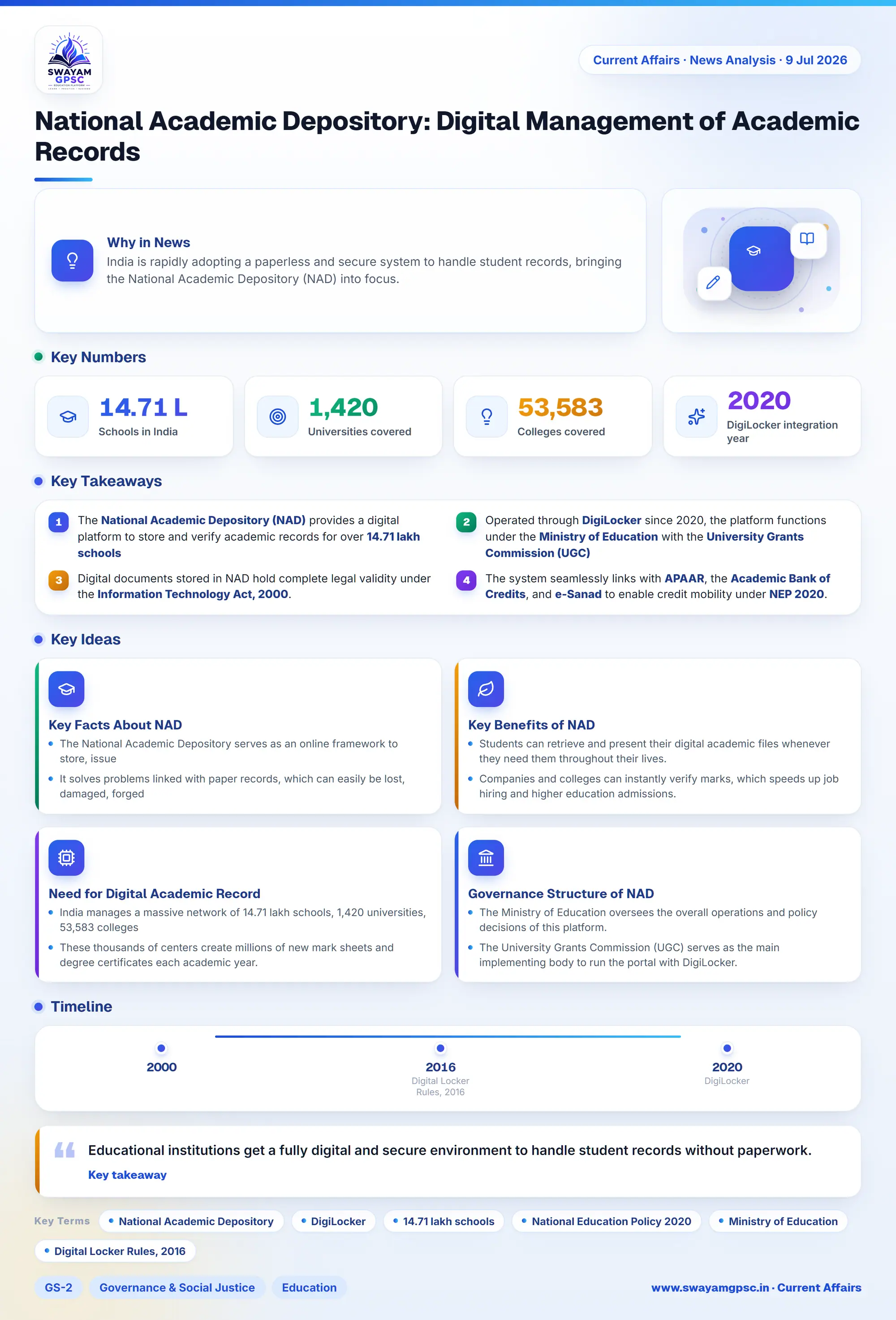
- The National Academic Depository (NAD) provides a digital platform to store and verify academic records for over 14.71 lakh schools and 1,420 universities in India.
- Operated through DigiLocker since 2020, the platform functions under the Ministry of Education with the University Grants Commission (UGC) as the nodal agency.
- Digital documents stored in NAD hold complete legal validity under the Information Technology Act, 2000.
- The system seamlessly links with APAAR, the Academic Bank of Credits, and e-Sanad to enable credit mobility under NEP 2020.
Why in News
- India is rapidly adopting a paperless and secure system to handle student records, bringing the National Academic Depository (NAD) into focus.
Key Facts About NAD
- The National Academic Depository serves as an online framework to store, issue, and verify student records like degrees and certificates.
- It solves problems linked with paper records, which can easily be lost, damaged, forged, or delayed during manual verification.
- The main goal is giving students lifetime access to their verified digital degrees from anywhere at any time.
- Since 2020, the government has run NAD through the DigiLocker platform to issue and share credentials securely.
- This system connects universities, school boards, students, employers, banks, and government agencies on a single network.
- The platform connects with DigiLocker, APAAR, the Academic Bank of Credits, and the e-Sanad portal for easy credit transfer and verification.
Key Benefits of NAD
- Educational institutions get a fully digital and secure environment to handle student records without paperwork.
- Students can retrieve and present their digital academic files whenever they need them throughout their lives.
- Companies and colleges can instantly verify marks, which speeds up job hiring and higher education admissions.
- Digital validation completely removes the scope for fake degrees and document alteration.
- The digital record process makes service delivery and administration much more transparent across institutions.
- This modern approach aligns the Indian education system with international standards of credential management.
Need for Digital Academic Record Management
- India manages a massive network of 14.71 lakh schools, 1,420 universities, 53,583 colleges, and 280 research institutes.
- These thousands of centers create millions of new mark sheets and degree certificates each academic year.
- Physical documents waste resources, take too long to check manually, and create bottlenecks for job seekers and banks.
- The National Education Policy 2020 introduces flexible learning choices like multiple entry and exit points for students.
- With students shifting between different colleges, India needs a unified digital system to transfer academic credits smoothly.
Governance Structure of NAD
- The Ministry of Education oversees the overall operations and policy decisions of this platform.
- The University Grants Commission (UGC) serves as the main implementing body to run the portal with DigiLocker.
- Institutions upload authenticated records to the system so students can view and share them with verifiers easily.
- Electronic certificates issued here carry equal legal standing to paper documents under the Information Technology Act, 2000.
Legal and Regulatory Framework
- The Information Technology Act, 2000 grants official legal approval to digital certificates and electronic signatures.
- The Digital Locker Rules, 2016 mandate that no third party can view documents without the student's clear permission.
- The National e-Authentication Framework sets up strong security measures to verify user identities safely.
Frequently Asked Questions
- The National Academic Depository is a digital storehouse to issue and verify degrees, mark sheets, and diplomas.
- The government uses the DigiLocker platform to run and manage the depository.
- The Ministry of Education controls the overall governance and functioning of this initiative.
- The University Grants Commission (UGC) acts as the nodal agency executing this project through DigiLocker.
- Yes, digital documents stored here have full legal equality with paper records under the Information Technology Act, 2000.