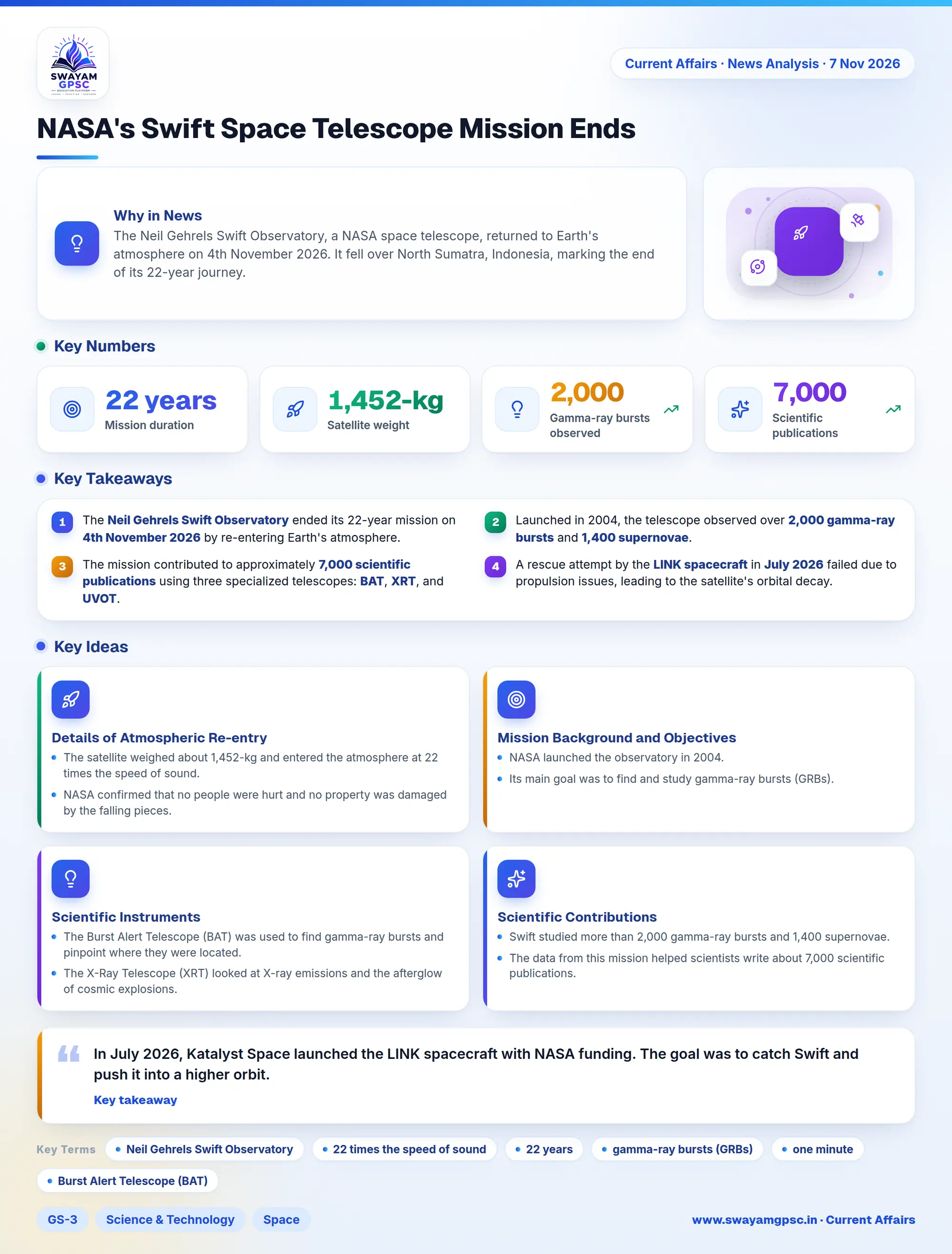
NASA's Swift Space Telescope Mission Ends
#GS-3 #Science & Technology #Space #Current Events #National #International
Key takeaways
- The Neil Gehrels Swift Observatory ended its 22-year mission on 4th November 2026 by re-entering Earth's atmosphere.
- Launched in 2004, the telescope observed over 2,000 gamma-ray bursts and 1,400 supernovae.
- The mission contributed to approximately 7,000 scientific publications using three specialized telescopes: BAT, XRT, and UVOT.
- A rescue attempt by the LINK spacecraft in July 2026 failed due to propulsion issues, leading to the satellite's orbital decay.
Why in News
- The Neil Gehrels Swift Observatory, a NASA space telescope, returned to Earth's atmosphere on 4th November 2026. It fell over North Sumatra, Indonesia, marking the end of its 22-year journey.
Details of Atmospheric Re-entry
- The satellite weighed about 1,452-kg and entered the atmosphere at 22 times the speed of sound. Most of the telescope likely burned up because of the intense heat.
- NASA confirmed that no people were hurt and no property was damaged by the falling pieces.
Mission Background and Objectives
- NASA launched the observatory in 2004. While it was originally meant to work for only two years, it stayed active for nearly 22 years and stopped its science work on 20th October 2026.
- Its main goal was to find and study gamma-ray bursts (GRBs). These are some of the most powerful explosions in the universe.
- The telescope was special because it could turn and point its instruments toward a burst in about one minute to catch the fading light.
Scientific Instruments
- The Burst Alert Telescope (BAT) was used to find gamma-ray bursts and pinpoint where they were located.
- The X-Ray Telescope (XRT) looked at X-ray emissions and the afterglow of cosmic explosions.
- The Ultraviolet/Optical Telescope (UVOT) studied light from astronomical sources in ultraviolet and visible ranges.
Scientific Contributions
- Swift studied more than 2,000 gamma-ray bursts and 1,400 supernovae. It also observed black holes, asteroids, comets, and stellar X-ray flares.
- The data from this mission helped scientists write about 7,000 scientific publications.
Failed Rescue Attempt and Cause of Re-entry
- In July 2026, Katalyst Space launched the LINK spacecraft with NASA funding. The goal was to catch Swift and push it into a higher orbit.
- This attempt failed because the LINK spacecraft had problems with its propulsion and attitude-control systems.
- Swift eventually fell back to Earth because it had no own engine to fight the atmospheric drag that slowly pulled it down.