Myanmar President Visit to India
#GS-2 #Governance & Social Justice #Current Events #International #Bilateral Groupings & Agreements #Groupings & Agreements Involving India and/or Affecting India's Interests #Effect of Policies & Politics of Countries on India's Interests #International Treaties & Agreements
Key takeaways
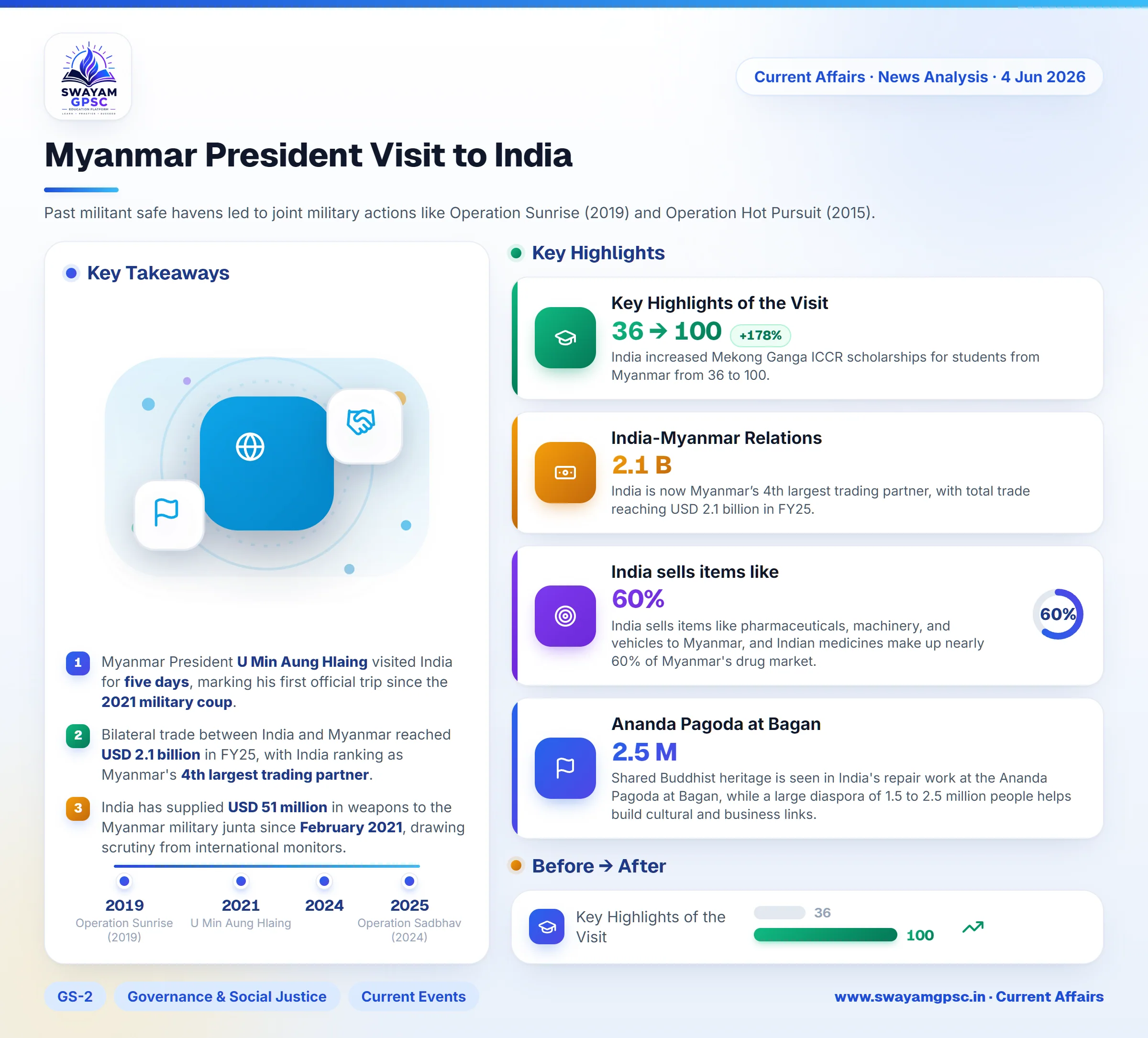
- Myanmar President U Min Aung Hlaing visited India for five days, marking his first official trip since the 2021 military coup.
- Bilateral trade between India and Myanmar reached USD 2.1 billion in FY25, with India ranking as Myanmar's 4th largest trading partner.
- India has supplied USD 51 million in weapons to the Myanmar military junta since February 2021, drawing scrutiny from international monitors.
- The two nations share a land border spanning 1,643 km across four northeastern states alongside a vital maritime boundary in the Bay of Bengal.
Why in News
- The President of Myanmar, U Min Aung Hlaing, visited India for five days, marking his first official trip since the 2021 military coup.
- Talks between the Indian Prime Minister and the National Security Advisor (NSA) focused heavily on border security and protecting shared regional interests.
Summary
- Myanmar is a key partner for India under the Act East, Neighbourhood First, and Indo-Pacific policies.
- The visit boosted cooperation in security, trade, connectivity, and critical minerals while advancing projects like the Kaladan Project, IMT Trilateral Highway, and the Rupee-Kyat trade mechanism.
Key Highlights of the Visit
- Myanmar promised that its land will not serve as a base for anti-India rebel groups like NSCN-K (National Socialist Council of Nagaland-Khaplang) and ULFA (United Liberation Front of Asom).
- Past militant safe havens led to joint military actions like Operation Sunrise (2019) and Operation Hot Pursuit (2015).
- Both governments agreed to grow trade using the Rupee-Kyat settlement mechanism, which started in 2024, and to invest more in agriculture, energy, and mining.
- Leaders reaffirmed their dedication to finishing the Kaladan Multi-Modal Transit Transport Project and the India-Myanmar-Thailand (IMT) Trilateral Highway.
- India highlighted Myanmar's vital role in its Neighbourhood First, Act East, and MAHASAGAR strategic frameworks.
- India increased Mekong Ganga ICCR scholarships for students from Myanmar from 36 to 100.
- Both nations decided to cooperate closely on critical minerals and rare earths because of their growing value in modern technology.
India-Myanmar Relations
- India is now Myanmar’s 4th largest trading partner, with total trade reaching USD 2.1 billion in FY25.
- India sells items like pharmaceuticals, machinery, and vehicles to Myanmar, and Indian medicines make up nearly 60% of Myanmar's drug market.
- Myanmar exports items like pulses and wood products, which help support India's food needs.
- Banks in Myanmar have set up Special Rupee Vostro Accounts (SRVA) to allow direct trade payments using Indian Rupees.
- The Rupee-Kyat Settlement Mechanism makes direct two-way trade much easier.
- India is building the Kaladan Multimodal Transit Transport Project, running Sittwe Port, and constructing parts of the Trilateral Highway.
- India funds local welfare work through the Border Area Development Programme (BADP) and Rakhine State Development Programme (RSDP).
- India proved its role as a regional helper by sending relief supplies during crises through Operation Sadbhav (2024) and Operation Brahma (2025).
- Shared Buddhist heritage is seen in India's repair work at the Ananda Pagoda at Bagan, while a large diaspora of 1.5 to 2.5 million people helps build cultural and business links.
Strategic Importance of Myanmar
- Myanmar is India's only ASEAN neighbour that shares both a land border of 1,643 km and a maritime boundary in the Bay of Bengal.
- Managing border security requires close teamwork between the Indian Army and the Tatmadaw to stop rebel groups and stop smuggling from the Golden Triangle.
- China is expanding its footprint through the China-Myanmar Economic Corridor (CMEC) and the Kyaukpyu deep-sea port, posing a strategic challenge to India.
- Working with Myanmar helps India access vital heavy rare earth elements in Kachin state, which are needed for green energy and electronics.
- Myanmar's Coco Islands sit very close to India's Andaman and Nicobar Islands, making regional diplomacy essential for security.
- India needs stability in Myanmar to connect economically with the rest of Southeast Asia.
Challenges in Bilateral Relations
- India has to balance its democratic values with real-world security needs while dealing with Myanmar's military rulers.
- India suspended the Free Movement Regime (FMR) due to concerns over illegal entry and drug smuggling, though local border tribes view the fence as a divider of families.
- Projects like the Kaladan corridor face severe delays and high cost overruns because of rough terrain and fighting involving Ethnic Armed Organizations (EAOs) like the Arakan Army.
- Fighting inside Myanmar has pushed thousands of refugees into Mizoram and Manipur, putting pressure on local administration.
- Reports that India sold USD 51 million in weapons to the junta since February 2021 have drawn international criticism.
- Some global groups have called these arms sales a death trade, which hurts India's diplomatic reputation.
Way Forward
- India must use smart security steps and talk with local groups to protect projects like the Kaladan transit corridor.
- The government should speed up the installation of the Comprehensive Integrated Border Management System (CIBMS) to stop illegal cross-border crime.
- India needs to turn routine security talks into a permanent framework for sharing real-time intelligence on rebel movements.
- India can expand its cultural influence by focusing on heritage sites like the Mahabodhi Temple in Bodh Gaya and by helping with local health and education.
Conclusion
- India's approach to Myanmar relies on practical diplomacy, balancing immediate security needs with regional stability and humanitarian support.