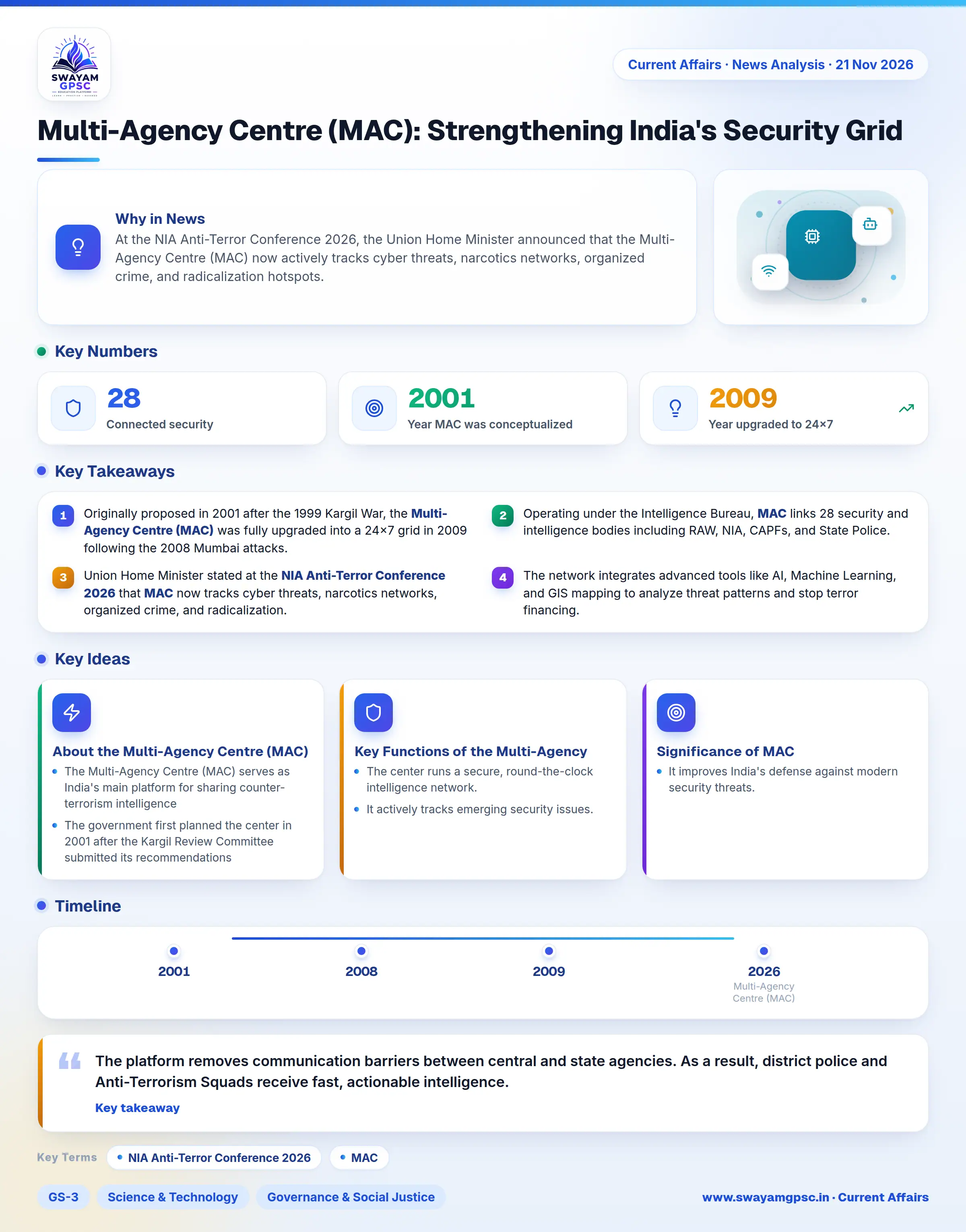
Multi-Agency Centre (MAC): Strengthening India's Security Grid
#GS-3 #Science & Technology #Governance & Social Justice #Current Events #Cyber Security #National #Internal Security #Multi-Agency Centre
Key takeaways
- Originally proposed in 2001 after the 1999 Kargil War, the Multi-Agency Centre (MAC) was fully upgraded into a 24x7 grid in 2009 following the 2008 Mumbai attacks.
- Operating under the Intelligence Bureau, MAC links 28 security and intelligence bodies including RAW, NIA, CAPFs, and State Police.
- Union Home Minister stated at the NIA Anti-Terror Conference 2026 that MAC now tracks cyber threats, narcotics networks, organized crime, and radicalization.
- The network integrates advanced tools like AI, Machine Learning, and GIS mapping to analyze threat patterns and stop terror financing.
Why in News
- At the NIA Anti-Terror Conference 2026, the Union Home Minister announced that the Multi-Agency Centre (MAC) now actively tracks cyber threats, narcotics networks, organized crime, and radicalization hotspots.
About the Multi-Agency Centre (MAC)
- The Multi-Agency Centre (MAC) serves as India's main platform for sharing counter-terrorism intelligence and maintaining a real-time security grid.
- The government first planned the center in 2001 after the Kargil Review Committee submitted its recommendations following the 1999 Kargil War. Later, authorities upgraded it into a round-the-clock operational system in 2009 after the 2008 Mumbai terror attacks.
- The center operates under the Intelligence Bureau within the Ministry of Home Affairs. It links 28 security and intelligence agencies across India, including RAW, NIA, CAPFs, and State Police through Subsidiary Multi-Agency Centres.
- The main objective is to speed up real-time intelligence sharing between central and state agencies. This helps security forces detect, analyze, and stop terror activities and new security risks early.
Key Functions of the Multi-Agency Centre (MAC)
- The center runs a secure, round-the-clock intelligence network. This system connects 28 security agencies with state police departments and district units to swap information quickly.
- It actively tracks emerging security issues. These include terrorism, Left-Wing Extremism, cyber attacks, narco-terrorism, syndicate crime, and areas vulnerable to radicalization.
- The platform uses modern tools like Artificial Intelligence, Machine Learning, and GIS mapping. These technologies help analysts spot high-risk zones and predict future threats.
- It connects local police stations with central agencies. This two-way communication channel helps district police forces participate directly in counter-terrorism operations.
- The system combines multiple security databases and intelligence records. This unified dataset helps officers uncover terror funding channels, monitor suspicious movements, and prevent planned attacks.
Significance of MAC
- The platform removes communication barriers between central and state agencies. As a result, district police and Anti-Terrorism Squads receive fast, actionable intelligence.
- It improves India's defense against modern security threats. Early alerts allow coordinated responses against cyber crimes, online radicalization, drone threats, and cross-border terror funding.