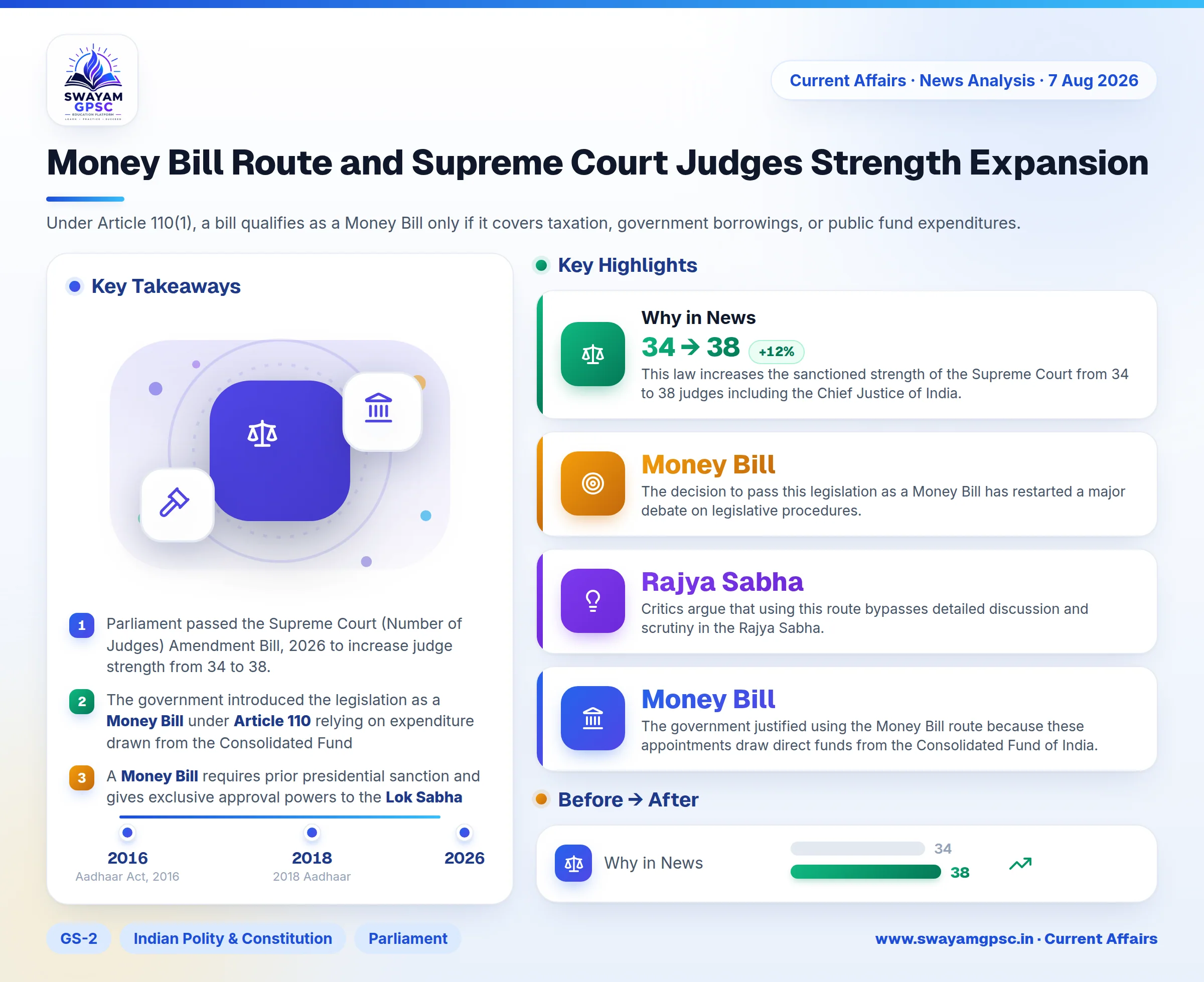
Money Bill Route and Supreme Court Judges Strength Expansion
#GS-2 #Indian Polity & Constitution #Parliament #Judiciary #Constitution #Current Events #National
Key takeaways
- Parliament passed the Supreme Court (Number of Judges) Amendment Bill, 2026 to increase judge strength from 34 to 38.
- The government introduced the legislation as a Money Bill under Article 110 relying on expenditure drawn from the Consolidated Fund of India.
- A Money Bill requires prior presidential sanction and gives exclusive approval powers to the Lok Sabha, leaving the Rajya Sabha only 14 days for advisory review.
- The scope of the Lok Sabha Speaker's sole certification power is currently under review by a 7-judge Constitution Bench of the Supreme Court.
Why in News
- Parliament recently passed the Supreme Court (Number of Judges) Amendment Bill, 2026 to expand judicial capacity.
- This law increases the sanctioned strength of the Supreme Court from 34 to 38 judges including the Chief Justice of India.
- The decision to pass this legislation as a Money Bill has restarted a major debate on legislative procedures.
- Critics argue that using this route bypasses detailed discussion and scrutiny in the Rajya Sabha.
Key Provisions of the Amendment Bill
- The new law creates four additional judicial posts to tackle the mounting burden of pending cases in the top court.
- Appointing four new judges requires extra expenditure on supporting administrative staff, official quarters, transport, and security arrangements.
- The government justified using the Money Bill route because these appointments draw direct funds from the Consolidated Fund of India.
Constitutional Provisions on Money Bills
- Under Article 110(1), a bill qualifies as a Money Bill only if it covers taxation, government borrowings, or public fund expenditures.
- Clause Article 110(1)(g) also allows matters incidental to main financial subjects to be included in a Money Bill.
- Under Article 110(3), the decision of the Lok Sabha Speaker on whether a proposal is a Money Bill remains final.
- Article 109 sets out the special parliamentary procedure for passing financial proposals in Parliament.
Procedure and Special Rules for Money Bills
- A Money Bill can only start in the Lok Sabha and needs the prior approval of the President of India.
- When sending the bill to the Rajya Sabha, the Lok Sabha Speaker must attach a formal endorsement certificate.
- The Rajya Sabha cannot alter or reject a Money Bill and must return it within 14 days with suggestions.
- The Lok Sabha holds full power to accept or reject any changes suggested by the Rajya Sabha.
- If the Rajya Sabha does not act within 14 days, Parliament considers the bill passed in its original form.
- Unlike ordinary legislation, the Constitution does not allow a joint sitting under Article 108 for a Money Bill.
Challenges
- Opposition parties argue that governments misuse Article 110(1)(g) to bypass the Rajya Sabha on non-financial policies.
- Legal experts note that Article 110 requires a bill to contain exclusively financial topics rather than general regulatory rules.
- Adding minor budget costs like judicial salaries to ordinary bills stretches the constitutional definition beyond its original intent.
- Previous laws passed through this route include the Aadhaar Act, 2016, PMLA amendments, and tribunal reform laws.
- In the 2018 Aadhaar case, Justice D.Y. Chandrachud called using the Money Bill route a fraud on the Constitution.
Way Forward
- A 7-judge Constitution Bench of the Supreme Court is currently reviewing the scope of the Speaker's certifying powers.
- The top court needs to set clear standards so that governments do not avoid legislative checks in the Upper House.
- Parliament should reserve the Money Bill route strictly for core financial legislation to protect healthy democratic debates.