Modified UDAN Scheme: Expanding Regional Aviation in India
#GS-2 #GS-3 #Governance & Social Justice #Economy #Infrastructure #Current Events #National #Government Policies
Why in News
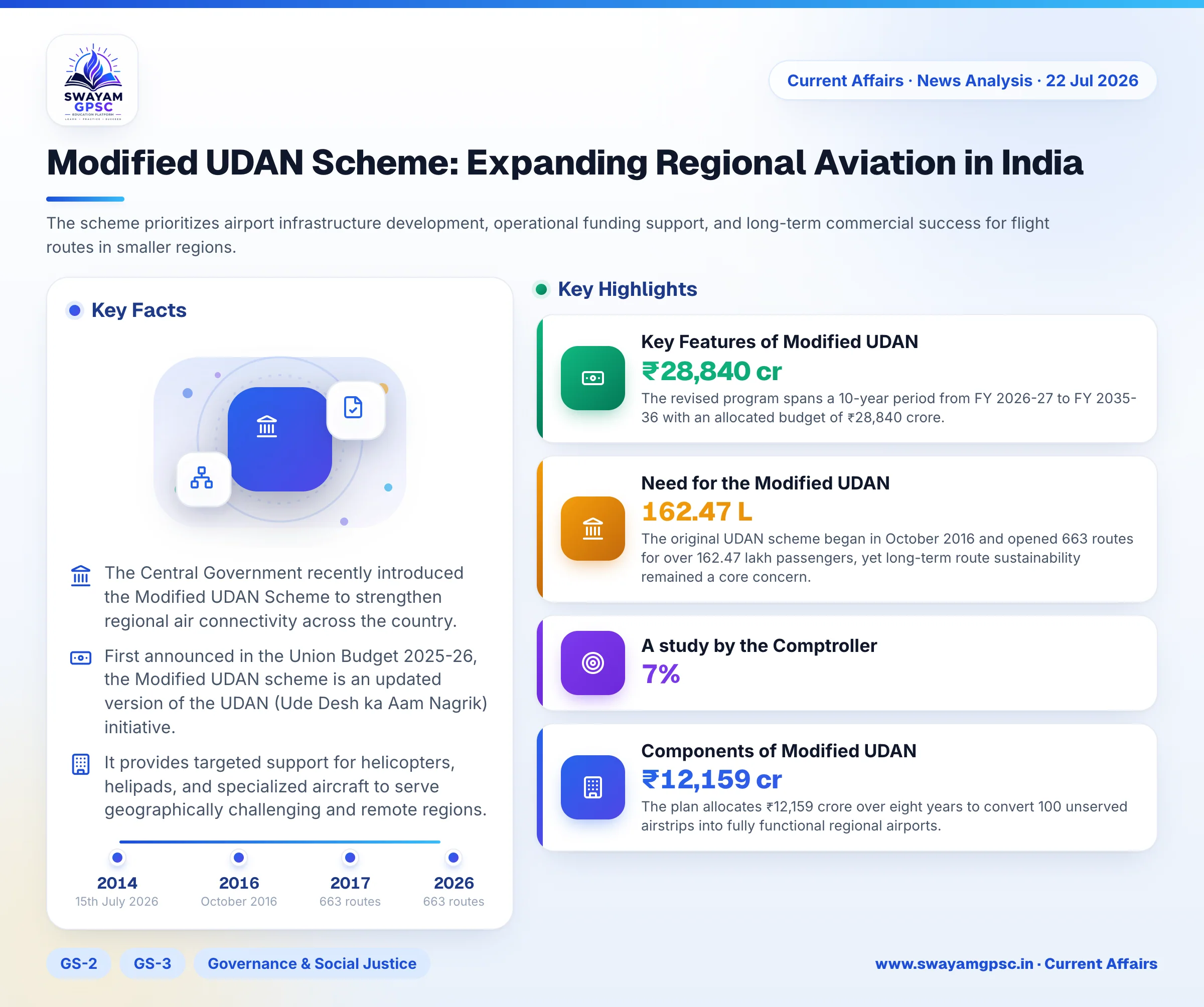
- The Central Government recently introduced the Modified UDAN Scheme to strengthen regional air connectivity across the country. This new phase builds directly upon the groundwork laid by the original UDAN programme.
Key Features of Modified UDAN
- First announced in the Union Budget 2025-26, the Modified UDAN scheme is an updated version of the UDAN (Ude Desh ka Aam Nagrik) initiative. It focuses on affordable air travel, connecting Tier-2 and Tier-3 towns, and maintaining financial viability for airlines.
- The revised program spans a 10-year period from FY 2026-27 to FY 2035-36 with an allocated budget of ₹28,840 crore.
- The scheme prioritizes airport infrastructure development, operational funding support, and long-term commercial success for flight routes in smaller regions.
- It provides targeted support for helicopters, helipads, and specialized aircraft to serve geographically challenging and remote regions.
Need for the Modified UDAN
- The original UDAN scheme began in October 2016 and opened 663 routes for over 162.47 lakh passengers, yet long-term route sustainability remained a core concern.
- A study by the Comptroller and Auditor General of India revealed that only 7% to 10% of operational routes stayed financially independent after their initial subsidy period ended.
- The previous three-year cap on financial subsidies proved too short for airlines to build stable passenger bases in smaller regional markets.
- Out of the 663 routes launched since 2017, around 327 routes became inactive by February 2026.
- Additionally, 15 of the 95 airports reactivated under the early phase of the scheme eventually stopped operating flights.
Components of Modified UDAN
- The plan allocates ₹12,159 crore over eight years to convert 100 unserved airstrips into fully functional regional airports.
- Airports working under the Regional Connectivity Scheme (RCS) with low revenue will receive Operation and Maintenance (O&M) funding for three years. This support is capped at ₹3.06 crore per year for airports and ₹0.90 crore per year for helipads or water aerodromes.
- The total budget for Operation and Maintenance stands at ₹2,577 crore, covering roughly 441 airports, heliports, and water aerodromes.
- To serve regions unsuitable for regular airports, the scheme commits ₹3,661 crore over eight years to build 200 modern helipads, costing ₹15 crore per unit.
- The government set aside ₹10,043 crore over ten years for Viability Gap Funding (VGF) to compensate airlines flying low-demand regional routes.
- To promote local manufacturing, the scheme deploys two Hindustan Aeronautics Limited (HAL) Dhruv helicopters with Pawan Hans and two HAL Dornier aircraft with Alliance Air.
Key Achievements of UDAN Scheme
- The government started the Regional Connectivity Scheme - UDAN in October 2016 to offer affordable and accessible flight options to common citizens.
- India expanded its operational airports from 74 in 2014 to 165 by 15th July 2026, making the nation the world's third-largest domestic aviation market.
- The scheme operationalized 679 routes across 95 airports, heliports, and water aerodromes, managing over 3.58 lakh flights and serving 1.68 crore passengers.
- Remote and island locations like Tezpur, Pasighat, Diu, Pithoragarh, and Rourkela received regular flight connections through this program.
- The project shortened overall travel times, boosted local tourism, expanded business activities, and enabled fast transport during medical emergencies.
- Passenger services expanded through added facilities such as UDAN Yatri Cafés, free reading materials via Flybrary, and complimentary Wi-Fi access.
Conclusion
- The Modified UDAN program represents a crucial advancement in India's regional flight connectivity by building infrastructure and encouraging indigenous manufacturing.
- This strategic initiative will improve nationwide mobility, stimulate local economic activity, and bring air transport benefits to every corner of India.