Mobile Phone Manufacturing Scheme Approved to Boost Electronics Sector
#GS-2 #GS-3 #Governance & Social Justice #Economy #Infrastructure #Employment #Science & Technology #National
Why in News
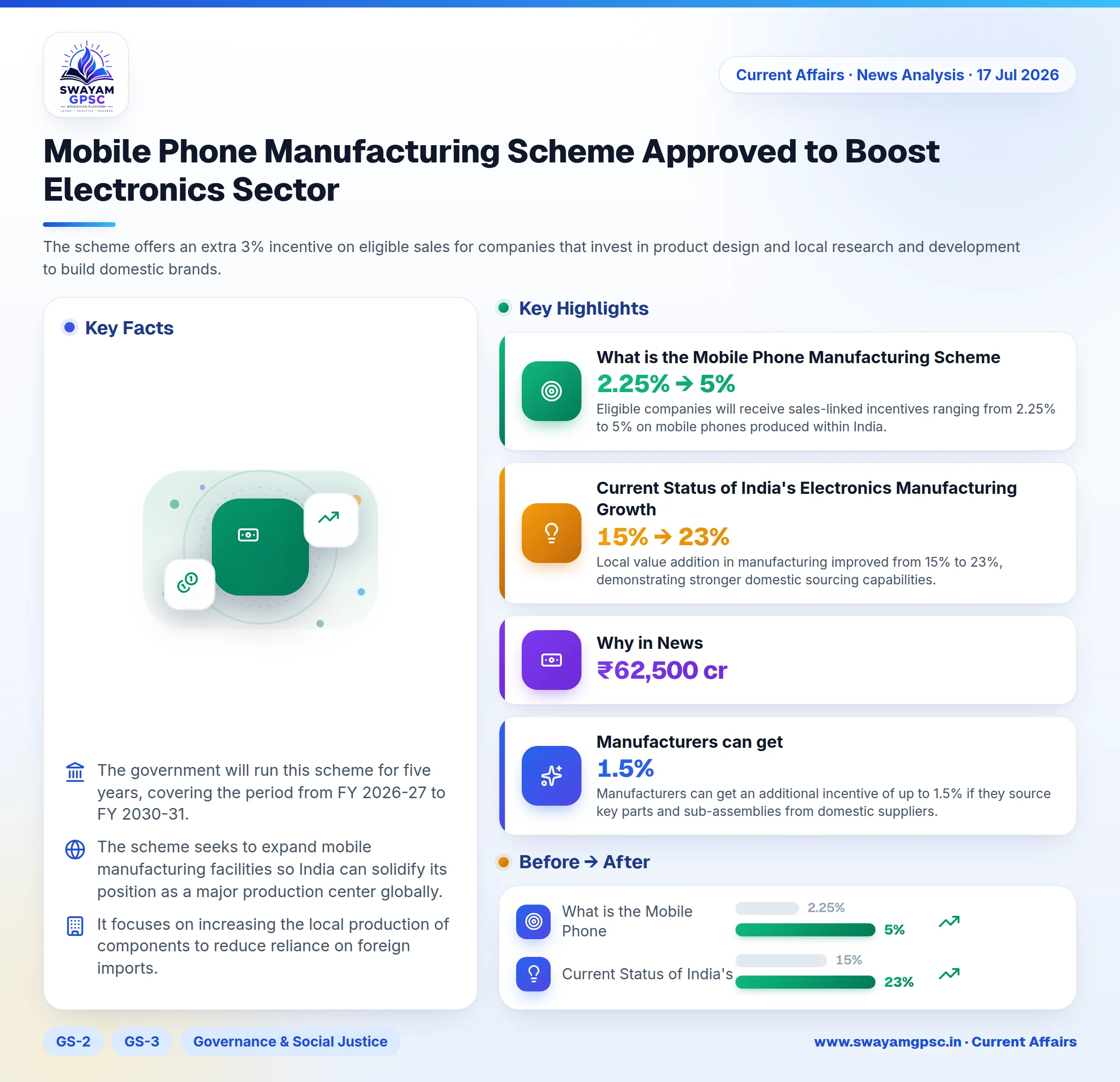
- The Union Cabinet has approved the Mobile Phone Manufacturing Scheme (MPMS) with a total financial allocation of ₹62,500 crore to strengthen the country's mobile production ecosystem.
What is the Mobile Phone Manufacturing Scheme
- The Mobile Phone Manufacturing Scheme (MPMS) aims to increase mobile production, boost local component sourcing, build strong supply chains, and make Indian manufacturing globally competitive.
- The government will run this scheme for five years, covering the period from FY 2026-27 to FY 2030-31.
- Eligible companies will receive sales-linked incentives ranging from 2.25% to 5% on mobile phones produced within India.
- Manufacturers can get an additional incentive of up to 1.5% if they source key parts and sub-assemblies from domestic suppliers.
- The scheme offers an extra 3% incentive on eligible sales for companies that invest in product design and local research and development to build domestic brands.
Objectives of MPMS
- The scheme seeks to expand mobile manufacturing facilities so India can solidify its position as a major production center globally.
- It focuses on increasing the local production of components to reduce reliance on foreign imports.
- The policy aims to build resilient and competitive domestic supply chains for the electronics sector.
- It supports homegrown phone brands so Indian companies can earn higher profits from original designs, patents, and technology.
- The scheme promotes long-term technological independence by encouraging local design, innovation, and intellectual property creation.
Expected Outcomes
- Total mobile phone production under this scheme is expected to reach approximately ₹39 lakh crore over the five-year period.
- The initiative aims to boost phone exports significantly and integrate Indian manufacturing deeper into global supply networks.
- The scheme is projected to generate nearly 60,000 direct jobs, expanding employment in the industrial sector.
- It will reinforce India's standing as a primary global destination for mobile manufacturing and international exports.
Current Status of India's Electronics Manufacturing Growth
- This scheme replaces the Production Linked Incentive Scheme for Large Scale Electronics Manufacturing (PLI-LSEM), which ended on 31st March 2026 after transforming India into a mobile production hub.
- India's total electronics production grew almost seven-fold, rising from ₹1.90 lakh crore in 2014-15 to an estimated ₹13.11 lakh crore in 2025-26.
- Exports of electronic products expanded eleven-fold during this period, increasing from ₹38,263 crore to ₹4.24 lakh crore.
- Electronic goods became India's third-largest export category, reaching USD 47.96 billion in FY 2025-26.
- Local value addition in manufacturing improved from 15% to 23%, demonstrating stronger domestic sourcing capabilities.
- More than 40 major component manufacturers have expanded operations in India, supported by a growing network of smaller local suppliers.
Mobile Manufacturing as Growth Anchor
- Mobile production acts as the primary driving force behind the overall growth and exports of India's electronics sector.
- India is the world's second-largest mobile phone manufacturer by volume, with 99.2% of domestically used phones made locally.
- Mobile phone production expanded 33-fold, climbing from ₹18,900 crore in 2014-15 to ₹6.27 lakh crore in 2025-26.
- Exports of mobile phones grew 165-fold, increasing from ₹1,566 crore to ₹2.60 lakh crore over the same timeframe.
- Mobile phones jumped from being India's 153rd-largest export item in FY 2014-15 to becoming its largest single export product in FY 2025-26.
- Smartphones became India's top exported product category in 2025, overtaking traditional export items like diesel fuel and polished diamonds.
Women's Participation in Electronic Sector
- Women represent nearly 30% of the entire workforce created in the electronics manufacturing industry over the past decade.
- In mobile phone factories, women make up almost 70% of the direct assembly line workforce.
- The previous PLI scheme for large-scale electronics created employment opportunities for around 90,000 women.
- The sector provides safe and skilled factory work, helping women achieve financial independence and social empowerment.
Conclusion
- The new scheme marks the next growth phase for electronics manufacturing following the success of the PLI program. By encouraging local component sourcing, design, and job creation, it strengthens India's global manufacturing standing and supports the vision of Viksit Bharat.