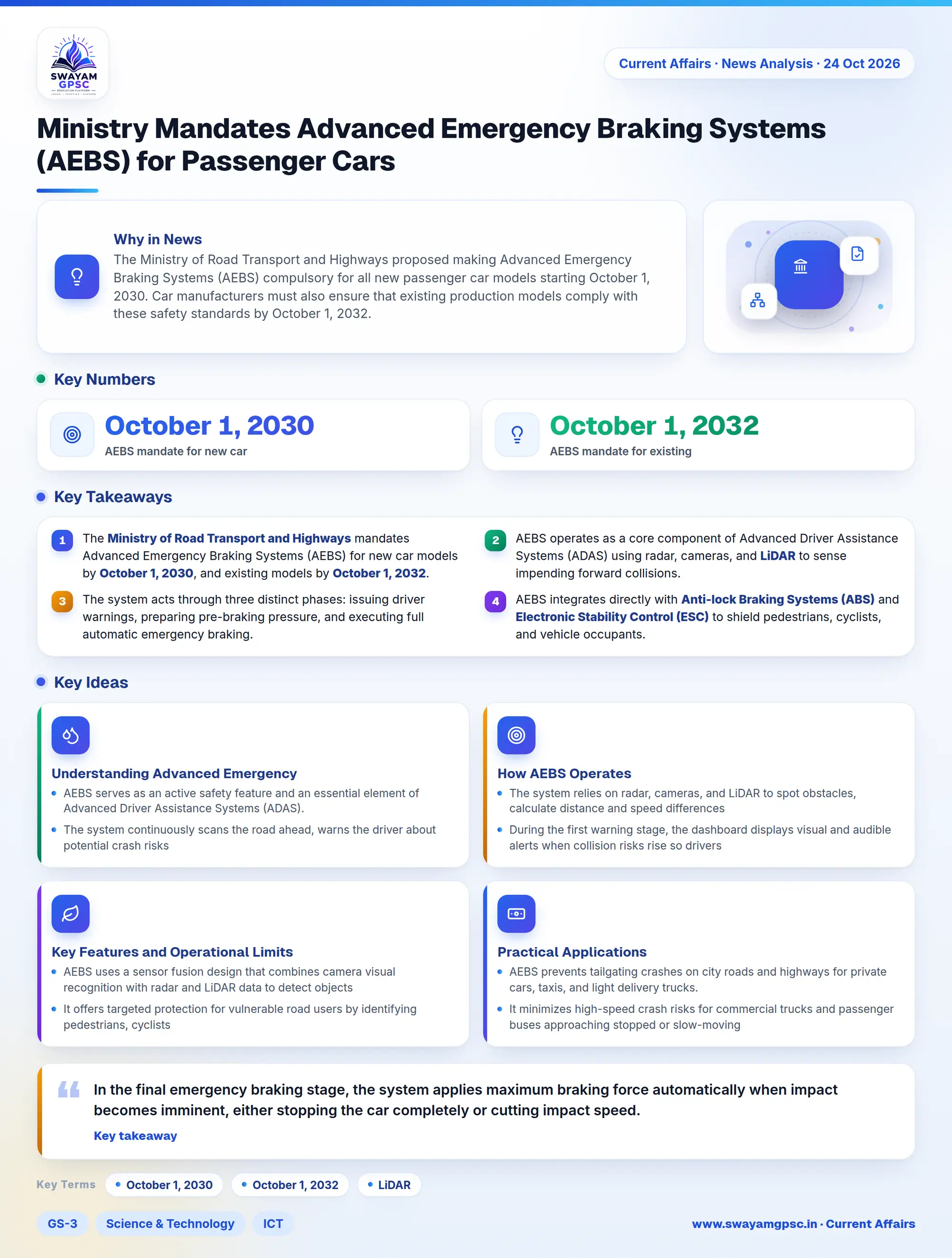
Ministry Mandates Advanced Emergency Braking Systems (AEBS) for Passenger Cars
#GS-3 #Science & Technology #ICT #Infrastructure #Governance & Social Justice #Road Safety #Automotive Regulations
Key takeaways
- The Ministry of Road Transport and Highways mandates Advanced Emergency Braking Systems (AEBS) for new car models by October 1, 2030, and existing models by October 1, 2032.
- AEBS operates as a core component of Advanced Driver Assistance Systems (ADAS) using radar, cameras, and LiDAR to sense impending forward collisions.
- The system acts through three distinct phases: issuing driver warnings, preparing pre-braking pressure, and executing full automatic emergency braking.
- AEBS integrates directly with Anti-lock Braking Systems (ABS) and Electronic Stability Control (ESC) to shield pedestrians, cyclists, and vehicle occupants.
Why in News
- The Ministry of Road Transport and Highways proposed making Advanced Emergency Braking Systems (AEBS) compulsory for all new passenger car models starting October 1, 2030.
- Car manufacturers must also ensure that existing production models comply with these safety standards by October 1, 2032.
Understanding Advanced Emergency Braking Systems (AEBS)
- AEBS serves as an active safety feature and an essential element of Advanced Driver Assistance Systems (ADAS).
- The system continuously scans the road ahead, warns the driver about potential crash risks, and automatically applies brakes if the driver fails to act promptly.
- This technology aims to avoid rear-end crashes, protect pedestrians and cyclists, eliminate driver reaction delays, and drastically decrease road deaths.
How AEBS Operates
- The system relies on radar, cameras, and LiDAR to spot obstacles, calculate distance and speed differences, and determine the precise time-to-collision.
- During the first warning stage, the dashboard displays visual and audible alerts when collision risks rise so drivers can brake manually.
- If the driver does not react, the pre-braking stage builds up brake pressure, increases braking assistance, and begins slowing down the vehicle.
- In the final emergency braking stage, the system applies maximum braking force automatically when impact becomes imminent, either stopping the car completely or cutting impact speed.
Key Features and Operational Limits
- AEBS uses a sensor fusion design that combines camera visual recognition with radar and LiDAR data to detect objects accurately in varied driving environments.
- It offers targeted protection for vulnerable road users by identifying pedestrians, cyclists, and two-wheeler riders in the driving path and intervening automatically.
- The technology works together with Anti-lock Braking Systems (ABS) and Electronic Stability Control (ESC) to keep the car stable and avoid wheel lockup during hard braking.
- It provides automated collision reduction by stopping low-speed city crashes and lowering the force of high-speed highway accidents.
- System effectiveness can decrease during severe rain, thick fog, poor lighting, sensor blockage, sharp road turns, or false system triggers.
Practical Applications
- AEBS prevents tailgating crashes on city roads and highways for private cars, taxis, and light delivery trucks.
- It minimizes high-speed crash risks for commercial trucks and passenger buses approaching stopped or slow-moving highway traffic.
- The feature increases safety across electric buses, driverless shuttles, and semi-autonomous transport fleets operating in busy urban settings.