Microfinance Sector in India: RBI Regulation and Challenges
#GS-3 #Economy #Banking #Poverty #Governance & Social Justice #Vulnerable Sections #Women
Key takeaways
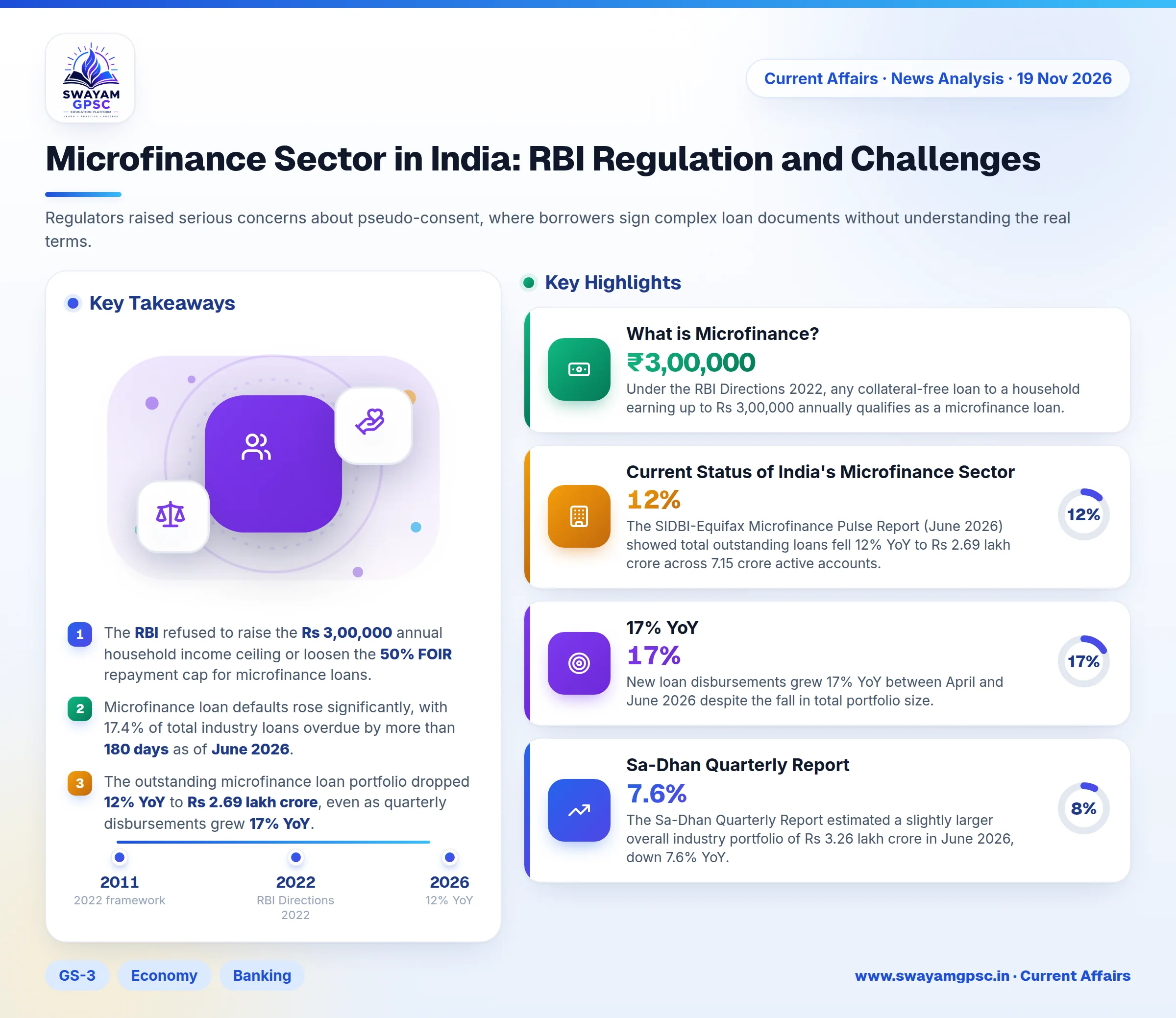
- The RBI refused to raise the Rs 3,00,000 annual household income ceiling or loosen the 50% FOIR repayment cap for microfinance loans.
- Microfinance loan defaults rose significantly, with 17.4% of total industry loans overdue by more than 180 days as of June 2026.
- The outstanding microfinance loan portfolio dropped 12% YoY to Rs 2.69 lakh crore, even as quarterly disbursements grew 17% YoY.
- NBFC-MFIs accounted for 47% of the microfinance market, while commercial banks held a 25% share.
Why in News
- The Reserve Bank of India (RBI) recently reaffirmed its strict regulatory stance on the microfinance industry.
- The central bank rejected requests from lenders to relax borrower income limits and loan repayment caps.
- The RBI emphasized the need for responsible lending practices to prevent lower-income households from falling into severe debt traps.
- Regulators raised serious concerns about pseudo-consent, where borrowers sign complex loan documents without understanding the real terms.
Summary of RBI's Stance
- The RBI aims to strike a balance between promoting financial inclusion and maintaining financial stability.
- The central bank plans to stop multiple loans to single households by enforcing stricter lending standards.
- Improving financial literacy among poor borrowers is crucial for building long-term household financial strength.
- Lenders must adopt transparent practices and use digital tools to assess credit safety while protecting borrowers.
What is Microfinance?
- Microfinance provides small collateral-free loans, micro-insurance, and basic savings options to low-income families.
- Under the RBI Directions 2022, any collateral-free loan to a household earning up to Rs 3,00,000 annually qualifies as a microfinance loan.
- This income limit of Rs 3,00,000 applies equally to households located in both rural and urban areas.
- The 2022 framework replaced the entity-based model from the 2011 Malegam Committee with an activity-based model.
- This activity-based regulatory system covers commercial banks, Small Finance Banks (SFBs), co-operative banks, and NBFC-MFIs.
- Microfinance bridges the credit gap for poor households by offering formal loans and replacing high-cost informal moneylenders.
- Most microfinance borrowers in India are women, which boosts female entrepreneurship and financial decision-making power.
- Microfinance supports small businesses, farming-related activities, and informal shops, keeping the rural economy active.
Current Status of India's Microfinance Sector
- The SIDBI-Equifax Microfinance Pulse Report (June 2026) showed total outstanding loans fell 12% YoY to Rs 2.69 lakh crore across 7.15 crore active accounts.
- New loan disbursements grew 17% YoY between April and June 2026 despite the fall in total portfolio size.
- The Sa-Dhan Quarterly Report estimated a slightly larger overall industry portfolio of Rs 3.26 lakh crore in June 2026, down 7.6% YoY.
- Commercial banks held 25% of all microfinance loans, but this accounted for less than 0.4% of overall bank credit according to MFIN.
- NBFC-MFIs remained the largest single lender group in the market, holding 47% of total outstanding loans.
- Around 17.4% of all microfinance loans were overdue by more than 180 days, indicating severe repayment distress among vulnerable families.
- The microfinance sector contributed 2.03% to India's Gross Value Added (GVA) in 2018-19, with projections reaching 2.7% by 2025-26.
Key Demands of the Microfinance Industry
- Lenders want the Rs 3,00,000 annual household income ceiling raised to reflect wage growth and inflation, but the RBI made any change conditional on better income verification and credit reporting.
- Industry bodies asked to relax the 50% Fixed-Obligation-to-Income Ratio (FOIR) cap to accommodate regional living costs, but the RBI kept the 50% limit as an absolute upper ceiling.
- Lenders requested counting only interest payments when calculating household repayment caps, but the RBI rejected excluding principal payments to avoid hiding actual debt loads.
- The central bank highlighted a study showing microfinance borrowers spend 18.7% of household income on loan repayments while spending nearly two-thirds on basic daily living.
- The industry demanded uniform loan reporting in Credit Information Company (CIC) databases, and the RBI agreed that frequent, standardized reporting is necessary to curb multiple lending.
Key Challenges in the Microfinance Sector
- Low financial literacy leads to pseudo-consent, where borrowers sign loan contracts without understanding interest rates or hidden fees.
- Rising digital lending apps and quick personal loan offers threaten to expand this pseudo-consent issue across the broader banking sector.
- High fuel prices, food inflation, and climate shocks reduce household savings, turning small loans into deep debt traps.
- Strict repayment schedules during non-farming seasons force poor families to take high-interest short-term loans to pay off original loan EMIs.
- Lenders and Direct Selling Agents (DSAs) aggressively bundle unwanted insurance policies and increase loan sizes to boost profits rather than help borrowers.
- Self-Regulatory Organizations like MFIN and Sa-Dhan face conflicts of interest because their member institutions are the entities they must supervise.
- Inconsistent updates to credit bureaus hide real borrower debt levels, while rising market interest rates make micro-loans increasingly expensive.
Measures Needed to Ensure Responsible Microfinance
- Field agents must explain the local-language Key Fact Statement clearly to borrowers before releasing loan money.
- Lenders must offer flexible repayment schedules linked to seasonal farm cash flows instead of enforcing rigid monthly payments.
- Banks should use the Account Aggregator (AA) network to inspect real bank cash flows before approving new loans.
- Institutions should implement the Grameen Credit Score from Union Budget 2025-26 to evaluate rural creditworthiness accurately.
- Regulators must crack down on harsh loan recovery tactics and strengthen oversight over self-regulatory bodies to eliminate industry conflicts of interest.
Conclusion
- The RBI must maintain strict prudential oversight while keeping formal credit accessible to poor households.
- Protecting vulnerable borrowers and promoting responsible lending are essential for long-term financial stability in rural India.