The Mekedatu Reservoir Project: Issues and Significance
#GS-2 #Indian Polity & Constitution #Federalism #GS-3 #Environment #Biodiversity #Mekedatu Project #Cauvery River #Inter-State Water Dispute
Key takeaways
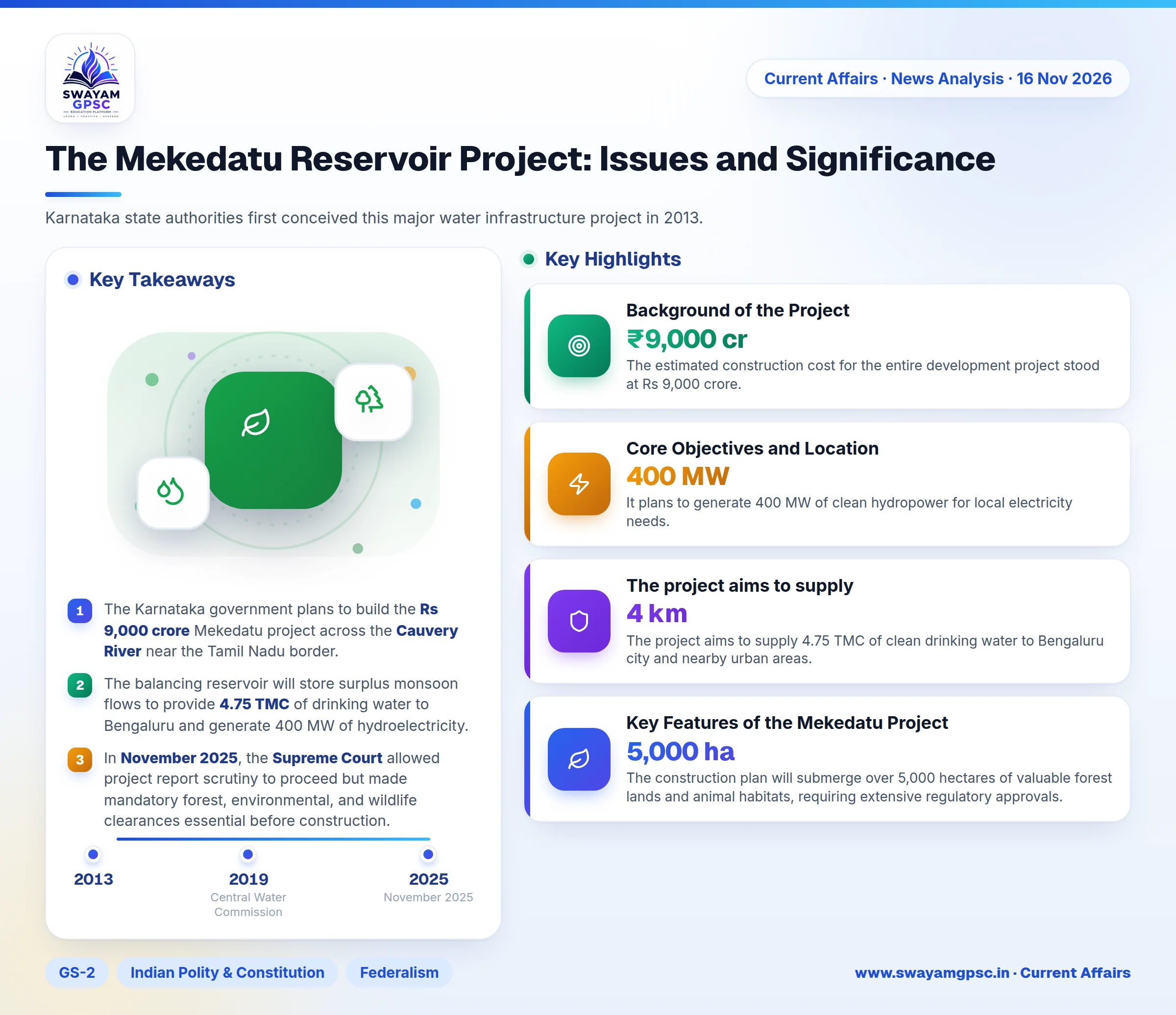
- The Karnataka government plans to build the Rs 9,000 crore Mekedatu project across the Cauvery River near the Tamil Nadu border.
- The balancing reservoir will store surplus monsoon flows to provide 4.75 TMC of drinking water to Bengaluru and generate 400 MW of hydroelectricity.
- In November 2025, the Supreme Court allowed project report scrutiny to proceed but made mandatory forest, environmental, and wildlife clearances essential before construction.
- The planned reservoir will submerge over 5,000 hectares of forest land within the Cauvery Wildlife Sanctuary, raising severe ecological concerns.
- Tamil Nadu strongly opposes the dam, fearing that upstream storage could disrupt timely irrigation water deliveries to delta farmers while Karnataka assures it will honor the 177.25 TMC water allocation.
Why in News
- The Karnataka government recently repeated its strong commitment to complete the Mekedatu reservoir project.
- State leaders asserted that Karnataka holds full legal rights to build this dam structure.
- They also assured Tamil Nadu that its legal share of 177.25 TMC of Cauvery water will remain fully protected.
Background of the Project
- Karnataka state authorities first conceived this major water infrastructure project in 2013.
- The state agency Cauvery Neeravari Nigam Limited submitted the Detailed Project Report to the Central Water Commission (CWC) in 2019.
- The estimated construction cost for the entire development project stood at Rs 9,000 crore.
- In November 2025, the Supreme Court rejected a petition from Tamil Nadu that challenged the official scrutiny of this project report.
- The court highlighted that Karnataka must secure mandatory forest, environmental, and wildlife permissions before starting actual construction.
Core Objectives and Location
- The project aims to supply 4.75 TMC of clean drinking water to Bengaluru city and nearby urban areas.
- It plans to generate 400 MW of clean hydropower for local electricity needs.
- It seeks to regulate downstream river flows to help Karnataka fulfill its legally bound water releases to Tamil Nadu.
- Engineers planned the dam across the Cauvery River near a rocky gorge named Mekedatu near Kanakapura.
- The site lies downstream of Sangama, where the Arkavathi River joins the Cauvery, just 4 km upstream from the Tamil Nadu border.
Key Features of the Mekedatu Project
- The plan features a concrete gravity dam designed with 16 TMC gross storage and 59.46 TMC live storage to save excess monsoon water.
- It sets aside 4.75 TMC of water to solve growing urban drinking needs in Bengaluru and lower groundwater over-extraction.
- It incorporates a 400 MW hydropower facility to produce green power and support energy stability during peak demand hours.
- It operates as a balancing reservoir to smooth out seasonal river flows and keep water releases to Tamil Nadu steady.
- The construction plan will submerge over 5,000 hectares of valuable forest lands and animal habitats, requiring extensive regulatory approvals.
Challenges and Implications
- The project worsens long-standing inter-state friction because Tamil Nadu worries upstream storage will delay irrigation releases to its delta farmers.
- It risks damaging delicate wildlife habitats within the Cauvery Wildlife Sanctuary, including critical elephant corridors.
- The resulting flooding threatens local river ecosystems and endangered aquatic species like the hump-backed mahseer.