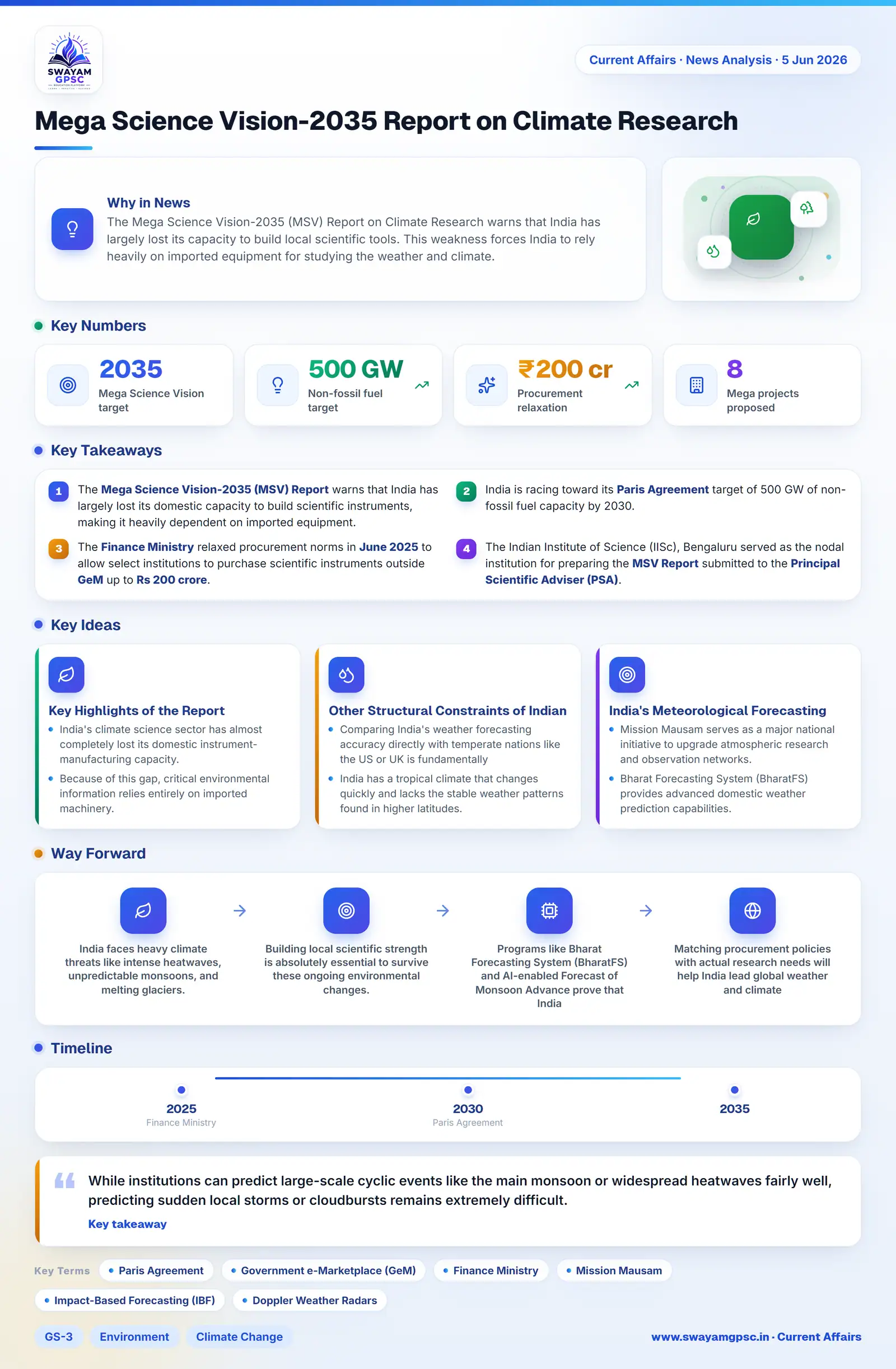
Mega Science Vision-2035 Report on Climate Research
#GS-3 #Environment #Climate Change #Pollution #Sustainable Development #Infrastructure #Economy #Quick Facts For Prelims
Key takeaways
- The Mega Science Vision-2035 (MSV) Report warns that India has largely lost its domestic capacity to build scientific instruments, making it heavily dependent on imported equipment.
- India is racing toward its Paris Agreement target of 500 GW of non-fossil fuel capacity by 2030.
- The Finance Ministry relaxed procurement norms in June 2025 to allow select institutions to purchase scientific instruments outside GeM up to Rs 200 crore.
- The Indian Institute of Science (IISc), Bengaluru served as the nodal institution for preparing the MSV Report submitted to the Principal Scientific Adviser (PSA).
Why in News
- The Mega Science Vision-2035 (MSV) Report on Climate Research warns that India has largely lost its capacity to build local scientific tools.
- This weakness forces India to rely heavily on imported equipment for studying the weather and climate.
- These foreign instruments often run without proper calibration for years, which seriously harms the quality of Indian climate data.
Key Highlights of the Report
- India's climate science sector has almost completely lost its domestic instrument-manufacturing capacity.
- Because of this gap, critical environmental information relies entirely on imported machinery.
- Imported devices often operate without proper calibration for years, leading to incorrect data reports in national and international journals.
- This situation raises serious global doubts about the credibility of Indian scientific output.
- India is racing toward its Paris Agreement goal of 500 GW of non-fossil fuel capacity by 2030.
- However, the report cautions that the long-term environmental effects of massive solar and wind projects remain poorly understood and need careful monitoring.
- India currently relies on foreign models from the US and Europe for Earth System Models, which combine land, ocean, and air data.
- These foreign systems struggle with regional inputs they were never built to handle, making them poor fits for India's unique climate.
- The mandatory use of the Government e-Marketplace (GeM) portal created major hurdles for research institutions because low-bidding vendors failed to supply specialized scientific gear.
- Although global tenders offered another path, long bureaucratic delays often slowed down purchases.
- To fix this problem, the Finance Ministry relaxed procurement rules in June 2025 to let select institutions buy scientific tools outside GeM for purchases up to Rs 200 crore.
- The report also points out other major gaps, such as weak research on carbon capture and storage technologies.
- It notes poor connection between environmental monitoring records and public health databases.
- Finally, it highlights the lack of a clear framework to include climate concerns in broader government policies.
Other Structural Constraints of Indian Meteorological Forecasting
- Comparing India's weather forecasting accuracy directly with temperate nations like the US or UK is fundamentally flawed.
- India has a tropical climate that changes quickly and lacks the stable weather patterns found in higher latitudes.
- The ongoing climate crisis is constantly breaking traditional weather patterns.
- This systemic change makes old predictive models much less reliable because future weather events behave very differently from past records.
- Forecasting accuracy depends heavily on the geographic scale of the study area.
- While institutions can predict large-scale cyclic events like the main monsoon or widespread heatwaves fairly well, predicting sudden local storms or cloudbursts remains extremely difficult.
India's Meteorological Forecasting Initiatives
- Mission Mausam serves as a major national initiative to upgrade atmospheric research and observation networks.
- Bharat Forecasting System (BharatFS) provides advanced domestic weather prediction capabilities.
- Impact-Based Forecasting (IBF) helps authorities prepare for specific weather damage rather than just predicting temperatures.
- AI-Enabled Forecast of Monsoon Advance uses modern technology to track seasonal rains more accurately.
- Doppler Weather Radars scan the skies continuously to track heavy rainfall and storms in real time.
- The SkyCast System was created by the Ministry of Earth Sciences (MoES) under the Mission Mausam initiative to monitor aviation weather.
- This system combines real-time data on fog, dust, turbulence, and visibility to build a fog-free aviation framework that keeps passengers safe.
Mega Science Vision-2035 Report
- The report serves as a detailed roadmap prepared by the Indian climate research community.
- The Indian Institute of Science (IISc), Bengaluru acted as the nodal institution for this project.
- The team submitted the finished report to the Office of the Principal Scientific Adviser (PSA) to the Union government.
- Its main goal is to map out future priorities, funding needs, and goals for Indian climate science while pointing out major gaps.
Recommendations of the MSV Report
- The report suggests eight mega projects featuring advanced observatories, dedicated satellites, and local sensor development up to 2035.
- India must build an indigenous Earth System Model from scratch using Artificial Intelligence and Machine Learning to match local geography.
- The country needs targeted investments to revive domestic manufacturing of scientific instruments and reduce reliance on foreign imports.
- Authorities must expand surface weather stations, ocean buoys, and greenhouse gas sensors to remove geographic blind spots.
- The report urges experts to calculate the Social Cost of Carbon and apply a strict polluter pays rule to stop companies from treating the air like a trash dump.
Way Forward
- India faces heavy climate threats like intense heatwaves, unpredictable monsoons, and melting glaciers.
- Building local scientific strength is absolutely essential to survive these ongoing environmental changes.
- Programs like Bharat Forecasting System (BharatFS) and AI-enabled Forecast of Monsoon Advance prove that India must become self-reliant in climate science.
- Matching procurement policies with actual research needs will help India lead global weather and climate forecasting efforts.