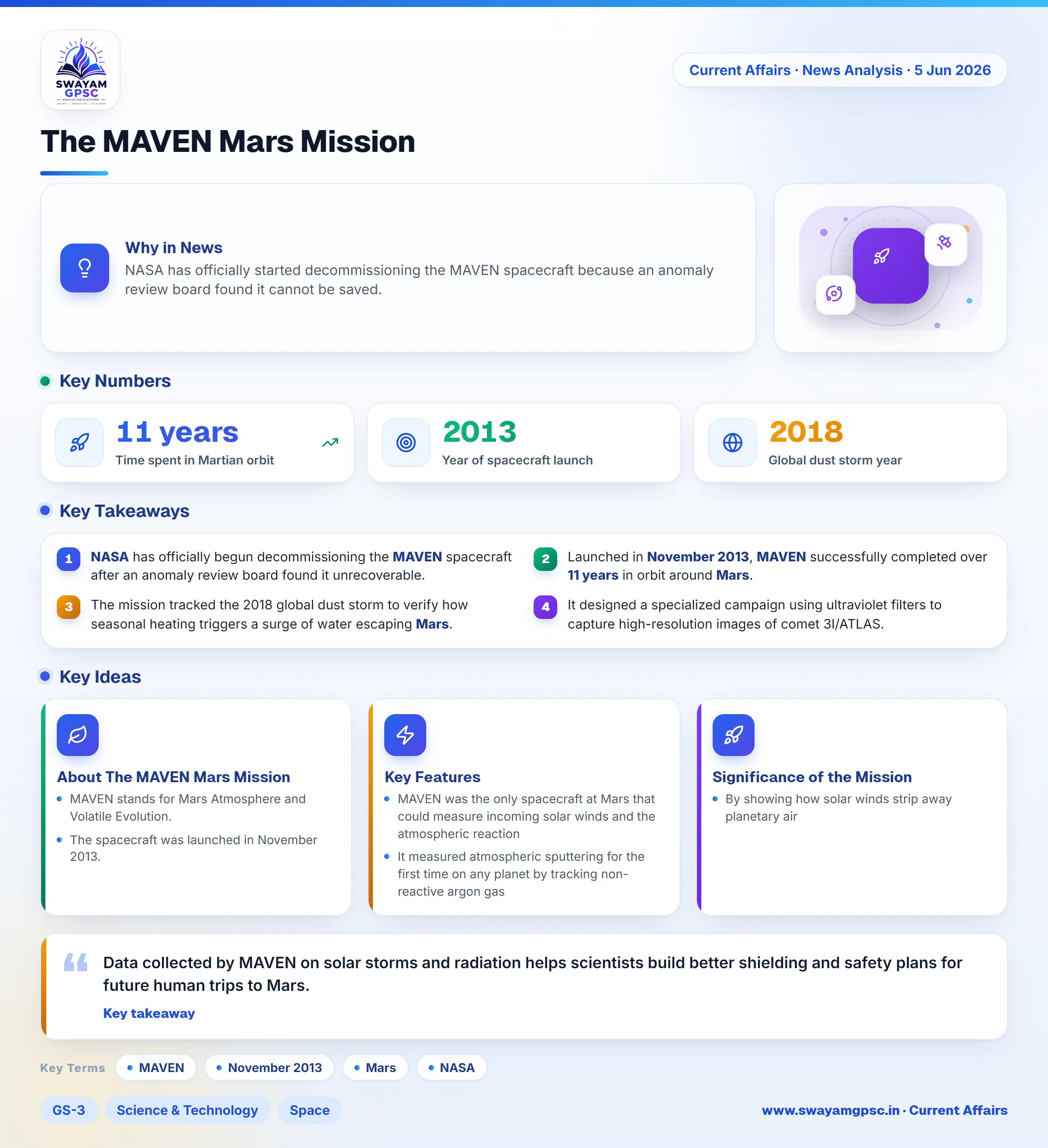
The MAVEN Mars Mission
#GS-3 #Science & Technology #Space #Current Events #National
Key takeaways
- NASA has officially begun decommissioning the MAVEN spacecraft after an anomaly review board found it unrecoverable.
- Launched in November 2013, MAVEN successfully completed over 11 years in orbit around Mars.
- The mission tracked the 2018 global dust storm to verify how seasonal heating triggers a surge of water escaping Mars.
- It designed a specialized campaign using ultraviolet filters to capture high-resolution images of comet 3I/ATLAS.
Why in News
- NASA has officially started decommissioning the MAVEN spacecraft because an anomaly review board found it cannot be saved.
About The MAVEN Mars Mission
- MAVEN stands for Mars Atmosphere and Volatile Evolution. It was the first robotic space probe from NASA created to study the upper atmosphere, ionosphere, and climate history of Mars.
- The spacecraft was launched in November 2013. It completed more than 11 years in orbit, lasting a full decade longer than its planned one-year primary mission.
- The primary goal was to understand how Mars lost its upper atmosphere and volatile compounds into space over billions of years.
- By measuring how fast the atmosphere escapes today, the mission helped scientists understand how the planet changed from a warm, wet world into a cold, dry desert.
Key Features
- MAVEN was the only spacecraft at Mars that could measure incoming solar winds and the atmospheric reaction at the exact same time.
- It measured atmospheric sputtering for the first time on any planet by tracking non-reactive argon gas, showing how fast ions push gas molecules into deep space.
- The spacecraft discovered global proton auroras. These light shows happen across the entire surface of Mars rather than just near the poles like on Earth.
- It tracked the 2018 global dust storm and proved that seasonal heating pushes water molecules high into the atmosphere, causing a sudden loss of water.
- It used ultraviolet and multi-wavelength filters to take clear images of comet 3I/ATLAS and study its atomic hydrogen composition.
- It acted as a vital communication relay for NASA. It sent data from surface rovers back to Earth and set a record for the most data relayed from another planet in one day.
Significance of the Mission
- Data collected by MAVEN on solar storms and radiation helps scientists build better shielding and safety plans for future human trips to Mars.
- By showing how solar winds strip away planetary air, MAVEN helps researchers understand why some planets stay habitable while others do not, which aids the search for alien life.