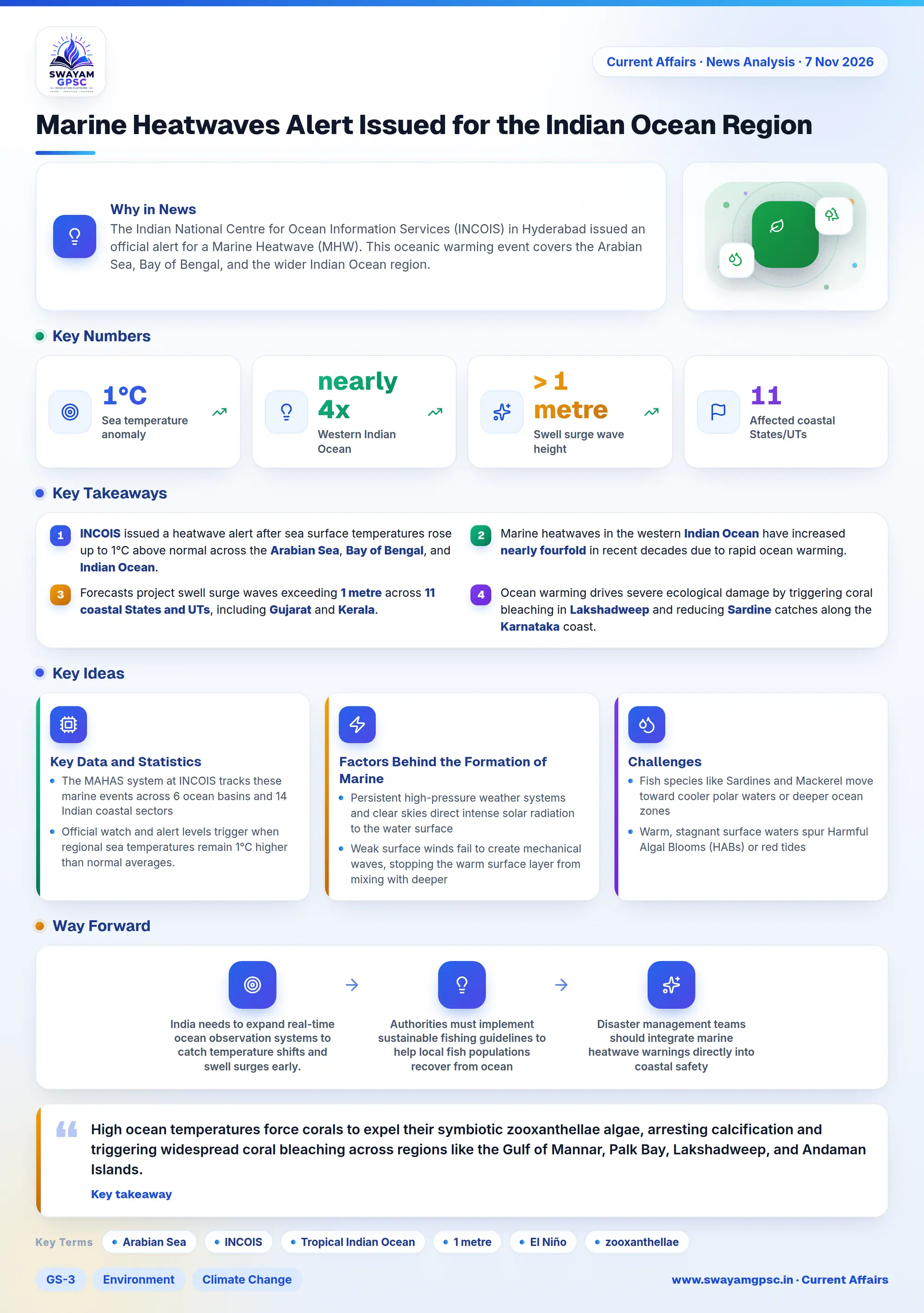
Marine Heatwaves Alert Issued for the Indian Ocean Region
#GS-3 #Environment #Climate Change #Biodiversity #Disaster Management #Disaster Preparedness #Science & Technology #Current Events #National
Key takeaways
- INCOIS issued a heatwave alert after sea surface temperatures rose up to 1°C above normal across the Arabian Sea, Bay of Bengal, and Indian Ocean.
- Marine heatwaves in the western Indian Ocean have increased nearly fourfold in recent decades due to rapid ocean warming.
- Forecasts project swell surge waves exceeding 1 metre across 11 coastal States and UTs, including Gujarat and Kerala.
- Ocean warming drives severe ecological damage by triggering coral bleaching in Lakshadweep and reducing Sardine catches along the Karnataka coast.
Why in News
- The Indian National Centre for Ocean Information Services (INCOIS) in Hyderabad issued an official alert for a Marine Heatwave (MHW).
- This oceanic warming event covers the Arabian Sea, Bay of Bengal, and the wider Indian Ocean region.
- Sea surface temperatures across these areas have risen up to 1°C above normal levels.
Key Data and Statistics
- The MAHAS system at INCOIS tracks these marine events across 6 ocean basins and 14 Indian coastal sectors, including the Red Sea, Persian Gulf, and South China Sea.
- Official watch and alert levels trigger when regional sea temperatures remain 1°C higher than normal averages.
- The Tropical Indian Ocean is warming fast, causing marine heatwaves in the western region to rise nearly fourfold over recent decades.
- Forecasts show swell surge waves higher than 1 metre impacting 11 coastal States and UTs, such as Gujarat, Kerala, Odisha, Tamil Nadu, and Andaman & Nicobar Islands.
Factors Behind the Formation of Marine Heatwaves
- Persistent high-pressure weather systems and clear skies direct intense solar radiation to the water surface, creating strong atmospheric heating without clouds to reflect sunlight.
- Weak surface winds fail to create mechanical waves, stopping the warm surface layer from mixing with deeper, cooler ocean waters.
- Warm water stays trapped in a thin upper layer, concentrating thermal energy and driving surface temperatures up quickly.
- Shifts in ocean currents push warm equatorial waters into mid-latitude or coastal zones, raising localized surface temperatures.
- Global climate change raises baseline ocean temperatures, while climate patterns like El Niño or a positive Indian Ocean Dipole (IOD) reduce upwelling and build up heat.
Challenges
- High ocean temperatures force corals to expel their symbiotic zooxanthellae algae, arresting calcification and triggering widespread coral bleaching across regions like the Gulf of Mannar, Palk Bay, Lakshadweep, and Andaman Islands.
- Fish species like Sardines and Mackerel move toward cooler polar waters or deeper ocean zones, causing local catches to collapse along the Kerala and Karnataka coasts.
- Warm, stagnant surface waters spur Harmful Algal Blooms (HABs) or red tides, which drain dissolved oxygen and produce toxins that harm marine life and aquaculture.
- Thermal stress destroys underwater Halophila and Enhalus seagrass beds, lowering ocean carbon capture and starving endangered species like dugongs and sea turtles.
- Warm upper ocean waters feed passing weather systems, turning simple low-pressure areas over the Arabian Sea and Bay of Bengal into severe tropical cyclones.
Way Forward
- India needs to expand real-time ocean observation systems to catch temperature shifts and swell surges early.
- Authorities must implement sustainable fishing guidelines to help local fish populations recover from ocean warming events.
- Disaster management teams should integrate marine heatwave warnings directly into coastal safety and preparedness plans.