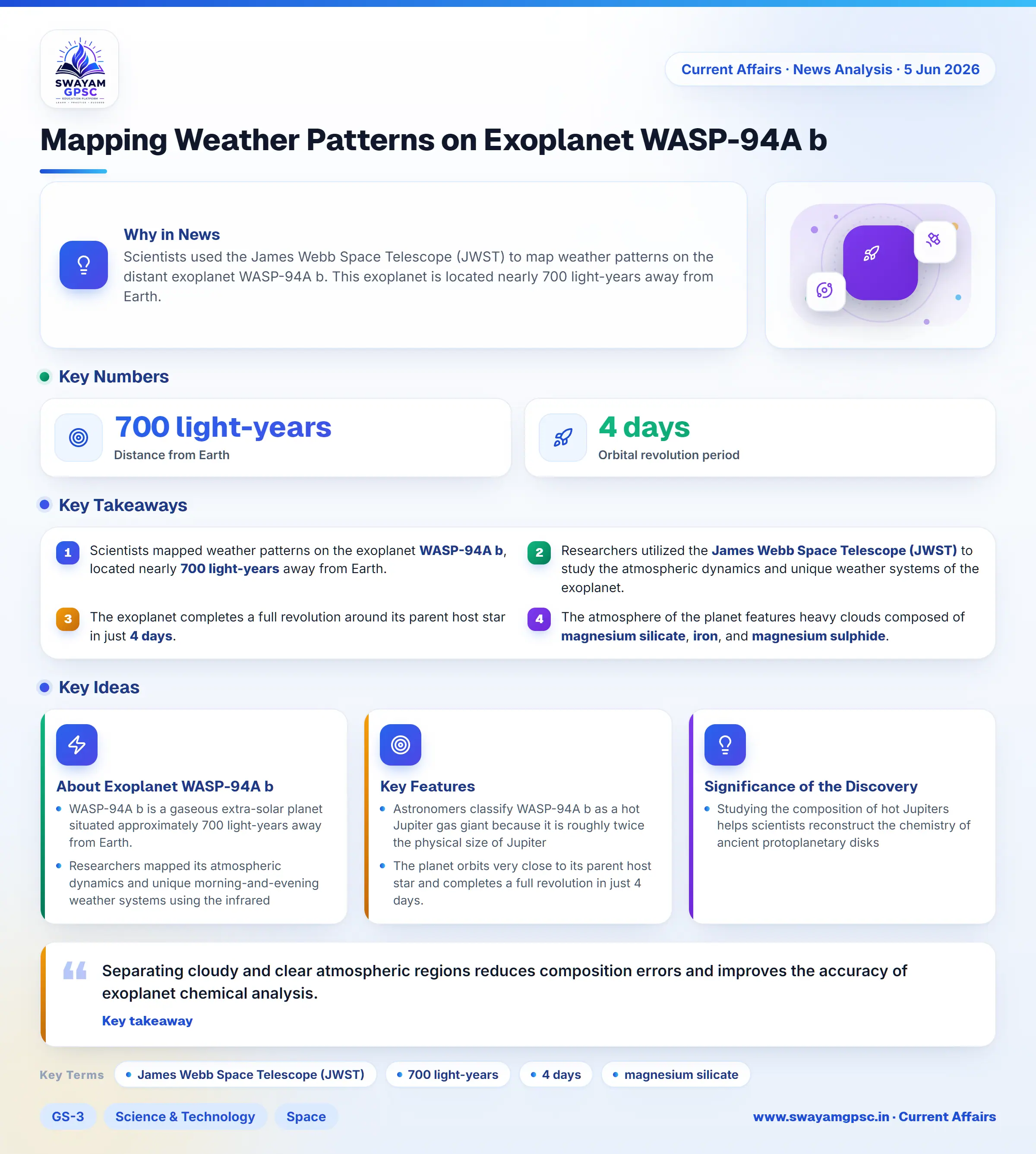
Mapping Weather Patterns on Exoplanet WASP-94A b
#GS-3 #Science & Technology #Space #Economy #Current Events #National
Key takeaways
- Scientists mapped weather patterns on the exoplanet WASP-94A b, located nearly 700 light-years away from Earth.
- Researchers utilized the James Webb Space Telescope (JWST) to study the atmospheric dynamics and unique weather systems of the exoplanet.
- The exoplanet completes a full revolution around its parent host star in just 4 days.
- The atmosphere of the planet features heavy clouds composed of magnesium silicate, iron, and magnesium sulphide.
Why in News
- Scientists used the James Webb Space Telescope (JWST) to map weather patterns on the distant exoplanet WASP-94A b.
- This exoplanet is located nearly 700 light-years away from Earth.
About Exoplanet WASP-94A b
- WASP-94A b is a gaseous extra-solar planet situated approximately 700 light-years away from Earth.
- Researchers mapped its atmospheric dynamics and unique morning-and-evening weather systems using the infrared sensitivity of the James Webb Space Telescope (JWST).
Key Features
- Astronomers classify WASP-94A b as a hot Jupiter gas giant because it is roughly twice the physical size of Jupiter but contains only half of its absolute mass.
- The planet orbits very close to its parent host star and completes a full revolution in just 4 days.
- This extreme proximity leaves the planet tidally locked, which synchronizes its rotation with its revolution.
- One side of the planet perennially faces the star as a scorching desert hot enough to melt rock.
- The perennially dark nightside of the planet drops close to absolute zero.
- The atmosphere is starkly divided with heavy clouds composed of magnesium silicate, iron, and magnesium sulphide blanketing its mornings.
- The early evenings on the planet sport completely clear skies.
- Clouds continuously form on the cooler nightside and are swept across the globe by ferocious winds.
- These clouds promptly dissipate and vaporize upon entering the blistering dayside.
- Astronomers isolated the atmospheric signature from the host star using the slow transit spectroscopy method.
- By split-scanning the light at different wavelengths during a slow transit, scientists mapped variations between morning and evening horizons.
Significance of the Discovery
- Separating cloudy and clear atmospheric regions reduces composition errors and improves the accuracy of exoplanet chemical analysis.
- Studying the composition of hot Jupiters helps scientists reconstruct the chemistry of ancient protoplanetary disks and the evolution of planetary systems.