Mangrove Forests Versus Seawalls for Coastal Protection
#GS-3 #Environment #Climate Change #Infrastructure #Sustainable Development #Economy
Key takeaways
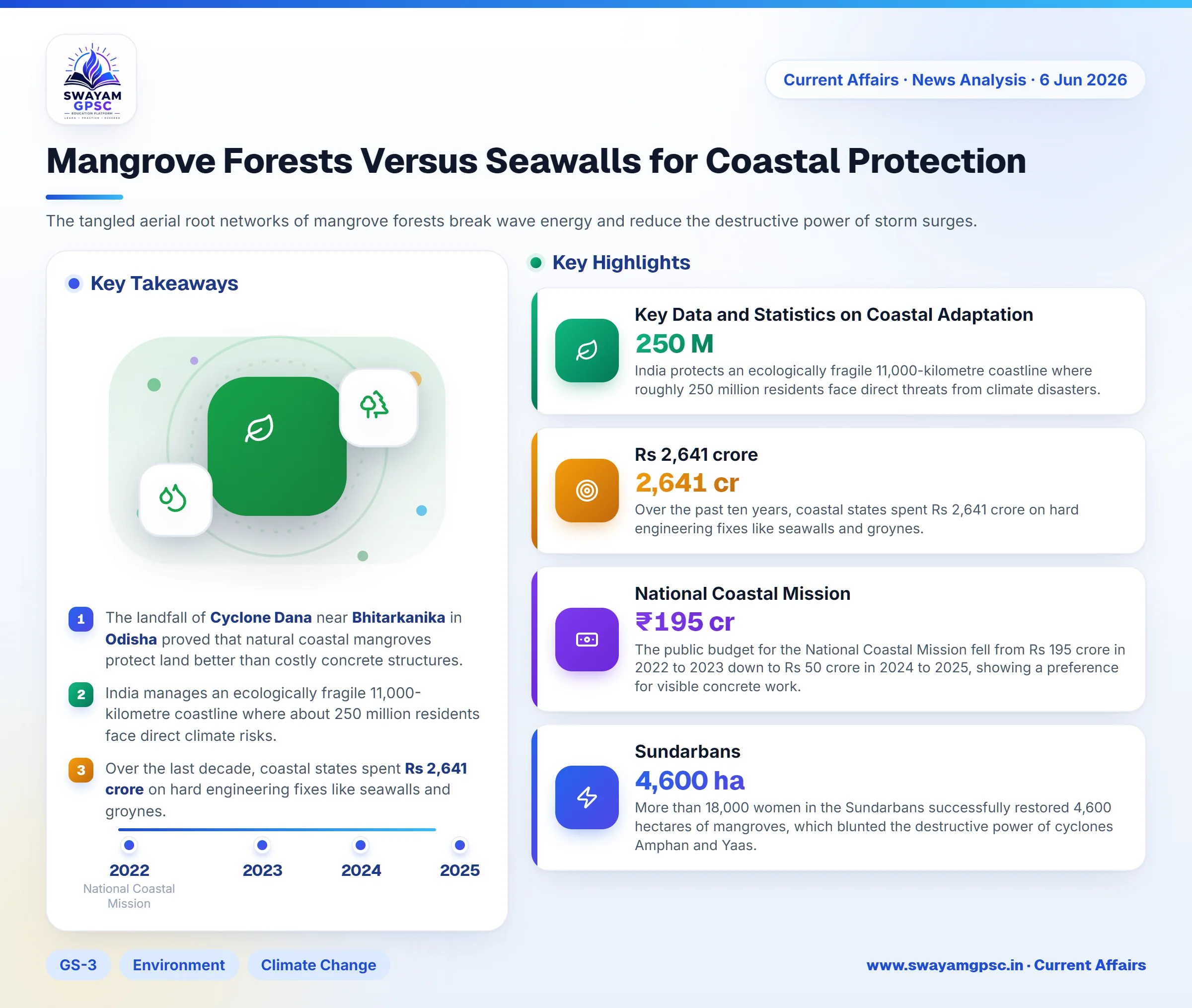
- The landfall of Cyclone Dana near Bhitarkanika in Odisha proved that natural coastal mangroves protect land better than costly concrete structures.
- India manages an ecologically fragile 11,000-kilometre coastline where about 250 million residents face direct climate risks.
- Over the last decade, coastal states spent Rs 2,641 crore on hard engineering fixes like seawalls and groynes.
- More than 18,000 women in the Sundarbans successfully restored 4,600 hectares of mangroves to fight tropical cyclones.
Why in News
- The landfall of Cyclone Dana near Bhitarkanika on the coast of Odisha shows how natural coastal mangroves protect land better than costly concrete barriers.
About Ecosystem-based Adaptation
- Ecosystem-based Adaptation is a nature-focused strategy that uses biodiversity to help local communities deal with climate change impacts.
- Unlike man-made grey infrastructure, this approach uses natural habitats like mangroves, seagrass meadows, and coral reefs as self-repairing shields.
Key Data and Statistics on Coastal Adaptation
- India protects an ecologically fragile 11,000-kilometre coastline where roughly 250 million residents face direct threats from climate disasters.
- Over the past ten years, coastal states spent Rs 2,641 crore on hard engineering fixes like seawalls and groynes.
- The public budget for the National Coastal Mission fell from Rs 195 crore in 2022 to 2023 down to Rs 50 crore in 2024 to 2025, showing a preference for visible concrete work.
- More than 18,000 women in the Sundarbans successfully restored 4,600 hectares of mangroves, which blunted the destructive power of cyclones Amphan and Yaas.
Key Features of Mangroves as Climate Shields
- The tangled aerial root networks of mangrove forests break wave energy and reduce the destructive power of storm surges.
- Mangroves trap organic sediment within their roots, which helps build up soil elevation as sea levels rise.
- Research names India a global hotspot for coastal adaptation, showing that mangroves protect more people per hectare than almost any other country.
- Mangrove systems work as superior blue carbon sinks that lock away carbon dioxide much faster than land-based tropical rainforests.
- Unlike concrete blocks that crack and demand constant repairs, mangrove ecosystems are self-healing and grow stronger over time.
Challenges Associated with Coastal Policy
- Hard concrete structures often push wave energy elsewhere rather than absorbing it, which speeds up erosion in unprotected neighboring areas.
- Policy makers use confusing overlapping terms like Nature-based Solutions, Eco-DRR, and EbCA, which makes it hard to define standard adaptation actions.
- Many adaptation projects get buried inside general forestry or development plans so their actual climate benefits go unrecorded.
- Coastal management suffers from split duties and weak monitoring, which favors visible concrete construction over natural projects.
- Flagship programs like MISHTI, which targets 540 sq. km of mangrove restoration, are framed as conservation efforts rather than core climate strategies.
Way Forward
- The government should create clear legal definitions to identify, track, and fund ecosystem adaptation projects separately from standard forestry.
- Policy makers must move away from isolated projects and build a national strategy that puts mangrove restoration into state disaster laws.
- Public funds should shift away from high-maintenance seawalls to restore the financial strength of the National Coastal Mission.
- Authorities should back self-help groups and women cooperatives financially to lead local restoration, following the successful Sundarbans model.
- Officials must build strong monitoring networks to track the protective value of natural ecosystems and secure international climate funds.