Malus and Clawback Mechanisms in Executive Remuneration
#GS-2 #GS-3 #Governance & Social Justice #Economy #Regulatory Bodies #Banking #Corporate Governance #Reserve Bank of India #Financial Sector Reforms
Key takeaways
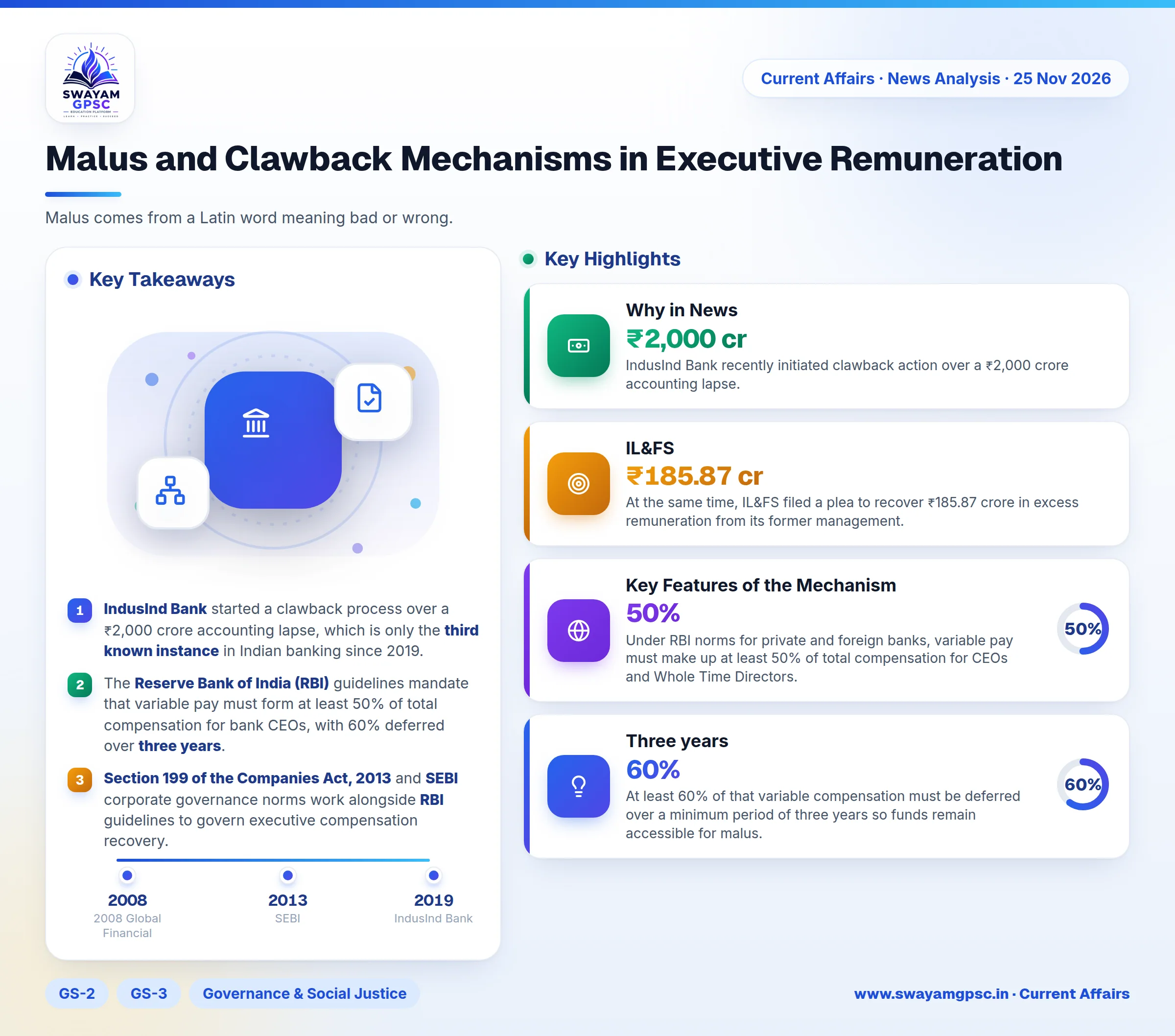
- IndusInd Bank started a clawback process over a ₹2,000 crore accounting lapse, which is only the third known instance in Indian banking since 2019.
- The Reserve Bank of India (RBI) guidelines mandate that variable pay must form at least 50% of total compensation for bank CEOs, with 60% deferred over three years.
- Section 199 of the Companies Act, 2013 and SEBI corporate governance norms work alongside RBI guidelines to govern executive compensation recovery.
- While Malus withholds unvested bonuses before disbursement without court intervention, Clawback legally recovers money already paid after financial misstatements or fraud are established.
Why in News
- IndusInd Bank recently initiated clawback action over a ₹2,000 crore accounting lapse.
- At the same time, IL&FS filed a plea to recover ₹185.87 crore in excess remuneration from its former management.
- These high-profile legal moves have renewed public and regulatory scrutiny of malus and clawback provisions in India.
- The action by IndusInd Bank represents only the third known instance of a clawback in Indian banking since the Reserve Bank of India (RBI) introduced the framework in 2019.
About Malus and Clawback Mechanisms
- These are contractual and regulatory compensation-governance tools used by institutions.
- Malus comes from a Latin word meaning bad or wrong.
- It allows companies to withhold unpaid variable pay from senior executives.
- Clawback allows institutions to recover bonuses and incentives that were already paid out.
- Institutions invoke these tools when later investigations reveal executive misconduct, governance failures, or financial misreporting.
Aim of the Mechanism
- The primary goal is to align executive risk-taking with the long-term stability of the institution.
- It ensures top management cannot keep windfall bonuses earned through flawed accounting, excessive risk, or compliance failures.
History and Regulatory Evolution
- These tools gained global prominence after the 2008 Global Financial Crisis.
- The Financial Stability Board recommended them to curb short-term and reckless risk-taking by bankers.
- The Reserve Bank of India (RBI) formally introduced the regulatory framework in November 2019.
- This rollout was part of the RBI Guidelines on Compensation of Whole Time Directors, CEOs, and Material Risk Takers.
- Section 199 of the Companies Act, 2013 and SEBI corporate governance norms also support these clawback requirements.
Key Features of the Mechanism
- Malus operates as a pre-payout withholding tool by canceling, reducing, or withholding deferred variable pay like cash bonuses or stock options before disbursement.
- Because funds have not been distributed yet, malus is administratively easier to execute without needing court intervention.
- Clawback works as a post-payout recovery tool that legally forces executives to return already paid incentives once fraud or financial misstatements are proven.
- Under RBI norms for private and foreign banks, variable pay must make up at least 50% of total compensation for CEOs and Whole Time Directors.
- At least 60% of that variable compensation must be deferred over a minimum period of three years so funds remain accessible for malus.
- Specific trigger events include negative financial performance, account restatements, gross negligence, fraud, integrity breaches, or regulatory penalties.
- The RBI mandates that banks disclose every instance of invoking malus or clawback in their annual financial statements.
Significance and Challenges
- Linking executive pay to sustainable performance discourages artificial profit inflation and excessive risk-taking.
- However, clawback attempts often run into prolonged litigation, complex tax issues, and reluctance from corporate boards.
- These hurdles highlight the urgent need for stronger regulatory enforcement and better corporate accountability.