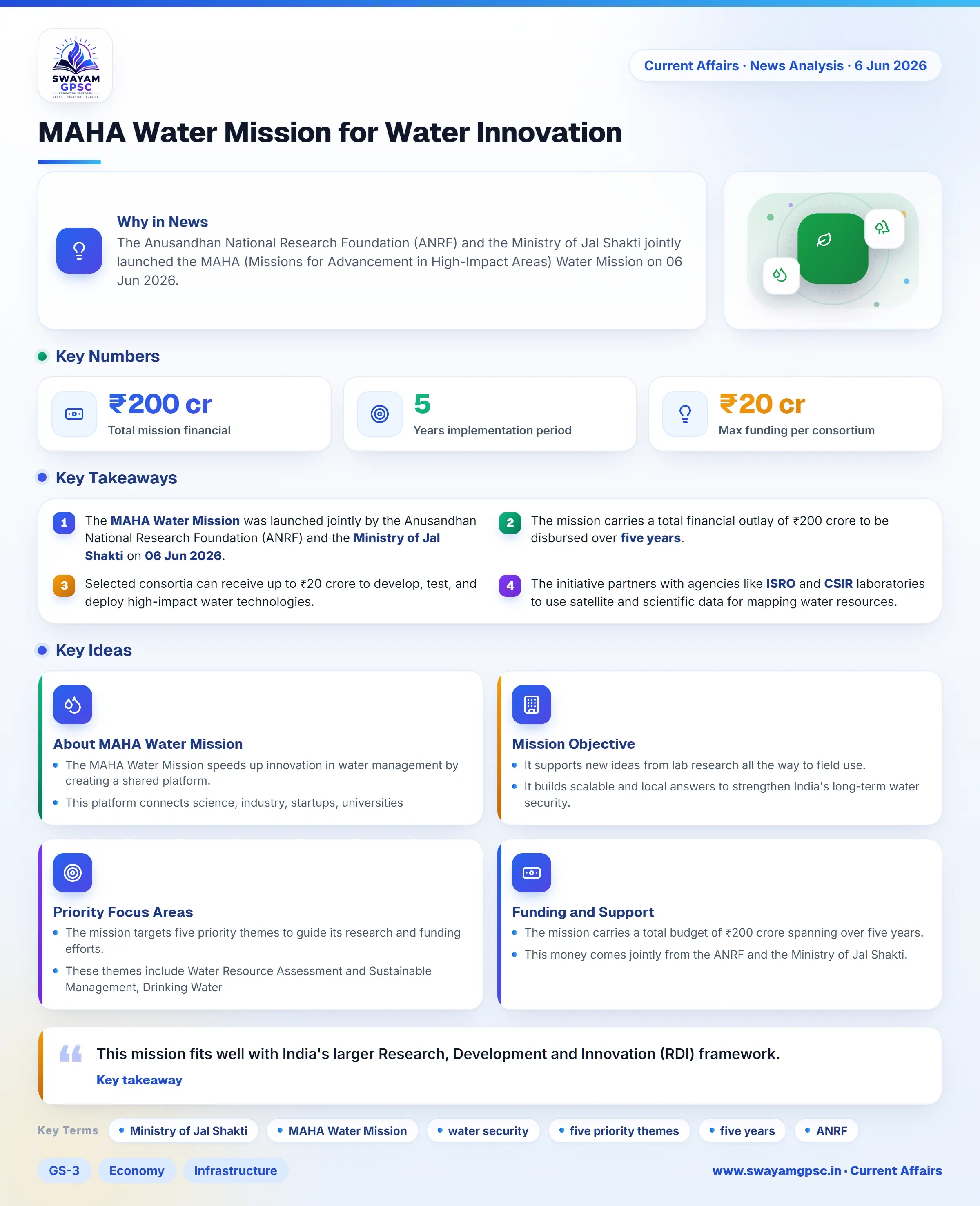
MAHA Water Mission for Water Innovation
#GS-3 #Economy #Infrastructure #Science & Technology #Environment #Rapid Fire CA #Quick Facts For Prelims
Key takeaways
- The MAHA Water Mission was launched jointly by the Anusandhan National Research Foundation (ANRF) and the Ministry of Jal Shakti on 06 Jun 2026.
- The mission carries a total financial outlay of ₹200 crore to be disbursed over five years.
- Selected consortia can receive up to ₹20 crore to develop, test, and deploy high-impact water technologies.
- The initiative partners with agencies like ISRO and CSIR laboratories to use satellite and scientific data for mapping water resources.
Why in News
- The Anusandhan National Research Foundation (ANRF) and the Ministry of Jal Shakti jointly launched the MAHA (Missions for Advancement in High-Impact Areas) Water Mission on 06 Jun 2026.
- This mission supports startups, MSMEs, universities, and innovators in the water sector by opening up research funding beyond traditional institutions.
About MAHA Water Mission
- The MAHA Water Mission speeds up innovation in water management by creating a shared platform.
- This platform connects science, industry, startups, universities, and grassroots workers to build scalable and sustainable water solutions.
Mission Objective
- It supports new ideas from lab research all the way to field use.
- It builds scalable and local answers to strengthen India's long-term water security.
Priority Focus Areas
- The mission targets five priority themes to guide its research and funding efforts.
- These themes include Water Resource Assessment and Sustainable Management, Drinking Water, Water Quality and Ecological Health, Water Use Efficiency and Circular Economy, and Climate Resilience and Adaptation.
Funding and Support
- The mission carries a total budget of ₹200 crore spanning over five years.
- This money comes jointly from the ANRF and the Ministry of Jal Shakti.
- Each selected group can receive up to ₹20 crore for building, testing, and launching high-impact technologies.
Collaborative Framework
- The mission relies on teamwork across different sectors to solve complex water problems.
- It partners with the Indian Space Research Organisation (ISRO), the Department of Space, CSIR laboratories, and Earth Sciences institutions.
- These partnerships use satellite, geospatial, and scientific data for water mapping, irrigation planning, and checking groundwater levels.
Significance
- This mission fits well with India's larger Research, Development and Innovation (RDI) framework.
- It helps new water technologies reach the market while supporting long-term water security, sustainable growth, and local community needs.