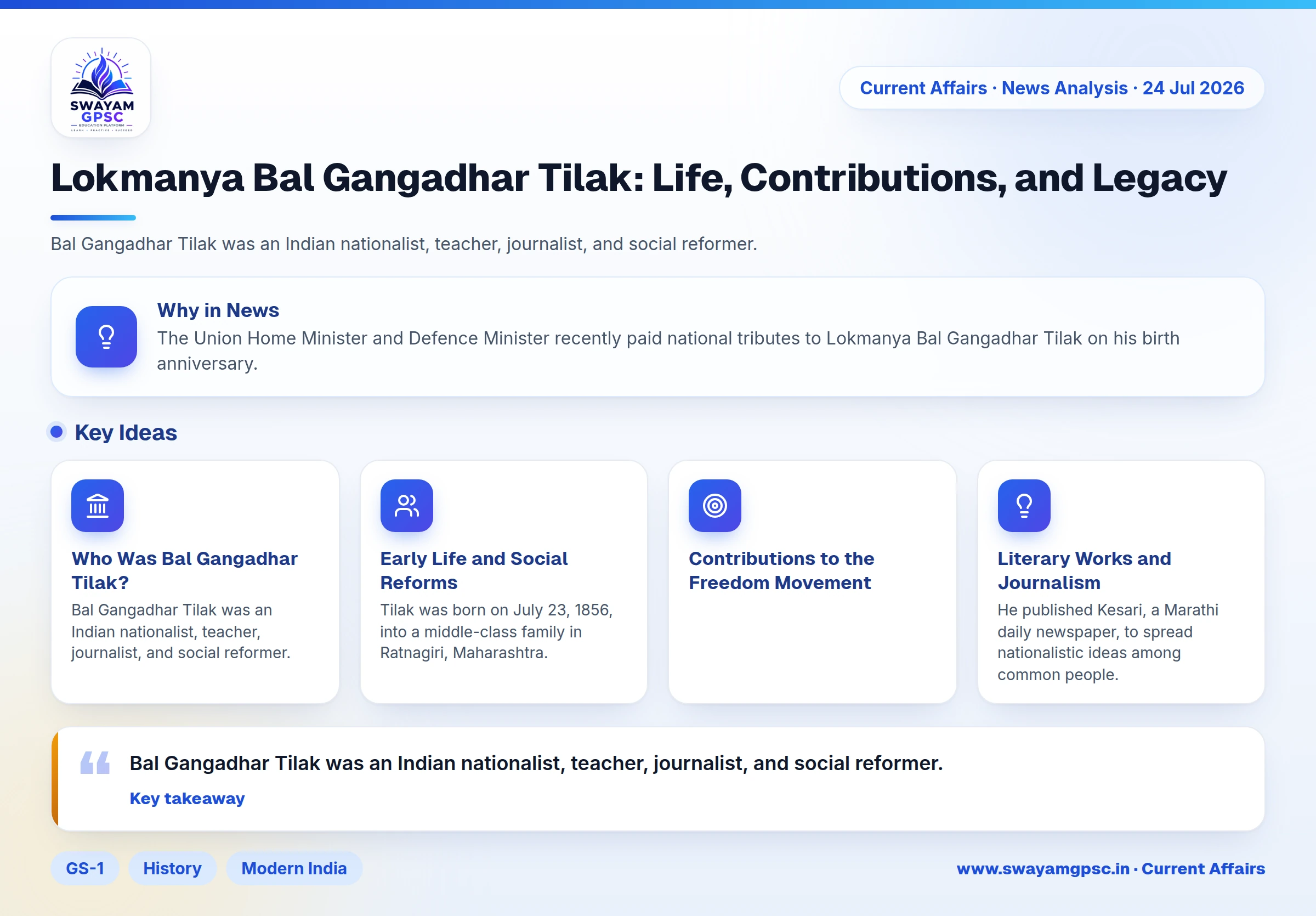
Lokmanya Bal Gangadhar Tilak: Life, Contributions, and Legacy
#GS-1 #History #Modern India #Freedom Struggle #Bal Gangadhar Tilak #Lokmanya Tilak
Why in News
- The Union Home Minister and Defence Minister recently paid national tributes to Lokmanya Bal Gangadhar Tilak on his birth anniversary.
Who Was Bal Gangadhar Tilak?
- Bal Gangadhar Tilak was an Indian nationalist, teacher, journalist, and social reformer. The British called him the Father of the Indian Unrest, while Jawaharlal Nehru described him as the Father of India's Revolution for leading the radical wing of the Indian National Congress before the arrival of Gandhi.
Early Life and Social Reforms
- Tilak was born on July 23, 1856, into a middle-class family in Ratnagiri, Maharashtra.
- To spread nationalist education among youth, he co-founded the Deccan Education Society in 1884, which later set up Fergusson College in Pune.
- He strongly opposed untouchability and declared that he would not accept even God if God sanctioned social discrimination.
Contributions to the Freedom Movement
- He mobilized the masses with his famous slogan, Swaraj is my birthright, and I shall have it!, leading the Lal-Bal-Pal nationalist group after the 1905 Partition of Bengal.
- In 1897, British authorities arrested and convicted him of sedition because of his revolutionary writings in Kesari.
- Between 1908 and 1914, he served six years of imprisonment in Mandalay Prison in Burma, where he spent time writing scholarly books.
- He established the Indian Home Rule League in 1916 at Pune and helped sign the historic Lucknow Pact in 1916 to bring the Congress and Muslim League together.
Literary Works and Journalism
- He published Kesari, a Marathi daily newspaper, to spread nationalistic ideas among common people.
- He also edited Mahratta, an English weekly newspaper, to criticize British policies.
- In 1915, while serving time in prison, he wrote Gita Rahasya, a commentary on the Bhagavad Gita that emphasizes selfless action.
- In 1903, he wrote The Arctic Home in the Vedas, offering a new theory about the original home of Aryan ancestors.
Key Organizations and Cultural Initiatives
- He co-founded the Deccan Education Society in 1884 to promote patriotic education across Maharashtra.
- He joined the Indian National Congress in 1889 and soon emerged as the prominent leader of its radical nationalist wing.
- He formed the Indian Home Rule League in 1916 to demand self-governance across Maharashtra, Karnataka, Central Provinces, and Berar.
- He transformed Sarvajanik Ganeshotsav and Shivaji Jayanti into public community festivals to unite people and bypass British bans on political gatherings.
Last Days and Legacy
- He passed away on August 1, 1920, in Mumbai at the age of 64.
- His death occurred on the exact day Mahatma Gandhi launched the Non-Cooperation Movement, marking the transition from the Tilak era to the Gandhian era in India's freedom struggle.