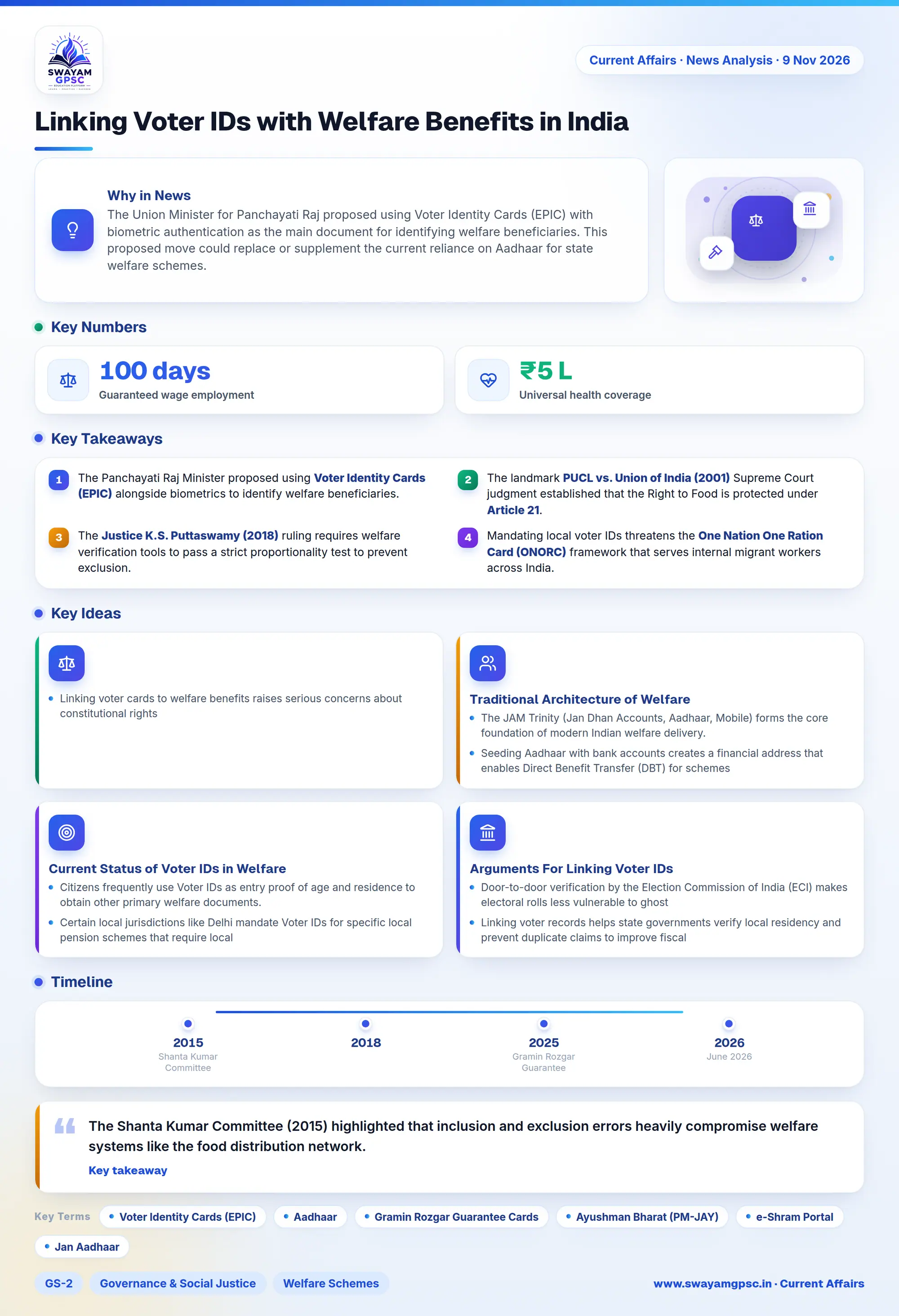
Linking Voter IDs with Welfare Benefits in India
#GS-2 #Governance & Social Justice #Welfare Schemes #Indian Polity & Constitution #Constitution #Current Events #National #Government Policies & Interventions
Key takeaways
- The Panchayati Raj Minister proposed using Voter Identity Cards (EPIC) alongside biometrics to identify welfare beneficiaries.
- The landmark PUCL vs. Union of India (2001) Supreme Court judgment established that the Right to Food is protected under Article 21.
- The Justice K.S. Puttaswamy (2018) ruling requires welfare verification tools to pass a strict proportionality test to prevent exclusion.
- Mandating local voter IDs threatens the One Nation One Ration Card (ONORC) framework that serves internal migrant workers across India.
- The Shanta Kumar Committee (2015) highlighted major inclusion and exclusion errors in existing welfare distribution networks.
Why in News
- The Union Minister for Panchayati Raj proposed using Voter Identity Cards (EPIC) with biometric authentication as the main document for identifying welfare beneficiaries.
- This proposed move could replace or supplement the current reliance on Aadhaar for state welfare schemes.
- The proposal has started a intense national debate about beneficiary exclusion, administrative feasibility, and constitutional rights.
Summary
- Linking voter cards to welfare benefits raises serious concerns about constitutional rights, exclusion of vulnerable groups, and migrant welfare access.
- Welfare reforms should focus on modern technology, dynamic social registries, and stronger direct cash transfers without harming the right to food.
Traditional Architecture of Welfare Delivery in India
- The JAM Trinity (Jan Dhan Accounts, Aadhaar, Mobile) forms the core foundation of modern Indian welfare delivery.
- Seeding Aadhaar with bank accounts creates a financial address that enables Direct Benefit Transfer (DBT) for schemes like PM-KISAN without middlemen.
- Digitizing the Public Distribution System into the One Nation One Ration Card (ONORC) lets citizens claim food grains anywhere using Aadhaar authentication.
- Gramin Rozgar Guarantee Cards under the VB-G RAM G Act 2025 (formerly MGNREGA) guarantee 100 days of wage employment at the local Panchayat level.
- Ayushman Bharat (PM-JAY) cards provide families with universal health coverage up to Rs 5 lakh.
- The e-Shram Portal maintains a national database of unorganized workers to deliver social security benefits efficiently.
- States like Rajasthan (Jan Aadhaar), Madhya Pradesh (Samagra), and Haryana (Parivar Pehchan Patra) use household cards for family-centric welfare.
Current Status of Voter IDs in Welfare Delivery
- Citizens frequently use Voter IDs as entry proof of age and residence to obtain other primary welfare documents.
- Certain local jurisdictions like Delhi mandate Voter IDs for specific local pension schemes that require local lawmaker approval.
- Central welfare schemes have never used Voter IDs as their primary financial verification tool because they lack integration with banking systems.
Arguments For Linking Voter IDs with Welfare Benefits
- The Shanta Kumar Committee (2015) highlighted that inclusion and exclusion errors heavily compromise welfare systems like the food distribution network.
- Door-to-door verification by the Election Commission of India (ECI) makes electoral rolls less vulnerable to ghost beneficiaries than Aadhaar.
- Linking voter records helps state governments verify local residency and prevent duplicate claims to improve fiscal efficiency.
- This connection prevents individuals from illegally claiming state-specific welfare benefits like pensions across multiple states at the same time.
Arguments Against Linking Voter IDs with Welfare Benefits
- The Supreme Court ruled in the PUCL vs. Union of India (2001) case that the Right to Food is essential to Article 21.
- The PUCL (2001) ruling mandates that lacking identity documents like a Voter ID cannot justify denying food to starving people.
- Denying welfare based on electoral status violates fundamental rights under Article 14 and Article 19 regarding free movement across India.
- The Justice K.S. Puttaswamy vs. Union of India (2018) judgment required identity systems to pass a strict proportionality test to avoid excluding citizens.
- Linking welfare to voter lists creates double exclusion risks where people removed during electoral revisions lose vital welfare access.
- In June 2026, West Bengal checked food welfare lists against voter rolls, though pending electoral appeals provisionally protected beneficiary entitlements.
- Mandating local Voter IDs breaks welfare portability for internal migrant workers, undermining the main goal of the ONORC scheme.
- The Nandan Nilekani Task Force (2011) designed the JAM Trinity around Aadhaar and the NPCI mapper, which Voter IDs lack completely.
Measures Needed for Effective Welfare Delivery
- Scaling up digital solutions like e-RUPI digital vouchers and central bank digital currency can eliminate leakages without complex local documents.
- India should establish a National Social Registry to update socio-economic data in real time, as recommended by the Hashim Committee (2012).
- Upgrading Aadhaar with iris scanning, facial recognition, and OTP fallbacks will stop technical failures from denying legitimate benefits.
- Full implementation of ONORC integrated with the e-Shram portal will ensure internal migrants access benefits across state borders.
- Moving toward universal access for basic needs allows local Gram Sabhas to conduct transparent community social audits.
- Establishing independent beneficiary verification ensures that voters facing election roll disputes do not lose their essential welfare safety net.
Conclusion
- Welfare reforms must balance administrative efficiency with social inclusivity and basic constitutional rights.
- Technology should strengthen benefit delivery while keeping welfare as a fundamental right rather than a privilege tied to voting status.