Life and Legacy of Maulana Barkatullah Bhopali
#GS-1 #GS-2 #Modern India #Freedom Struggle #National #Economy
Key takeaways
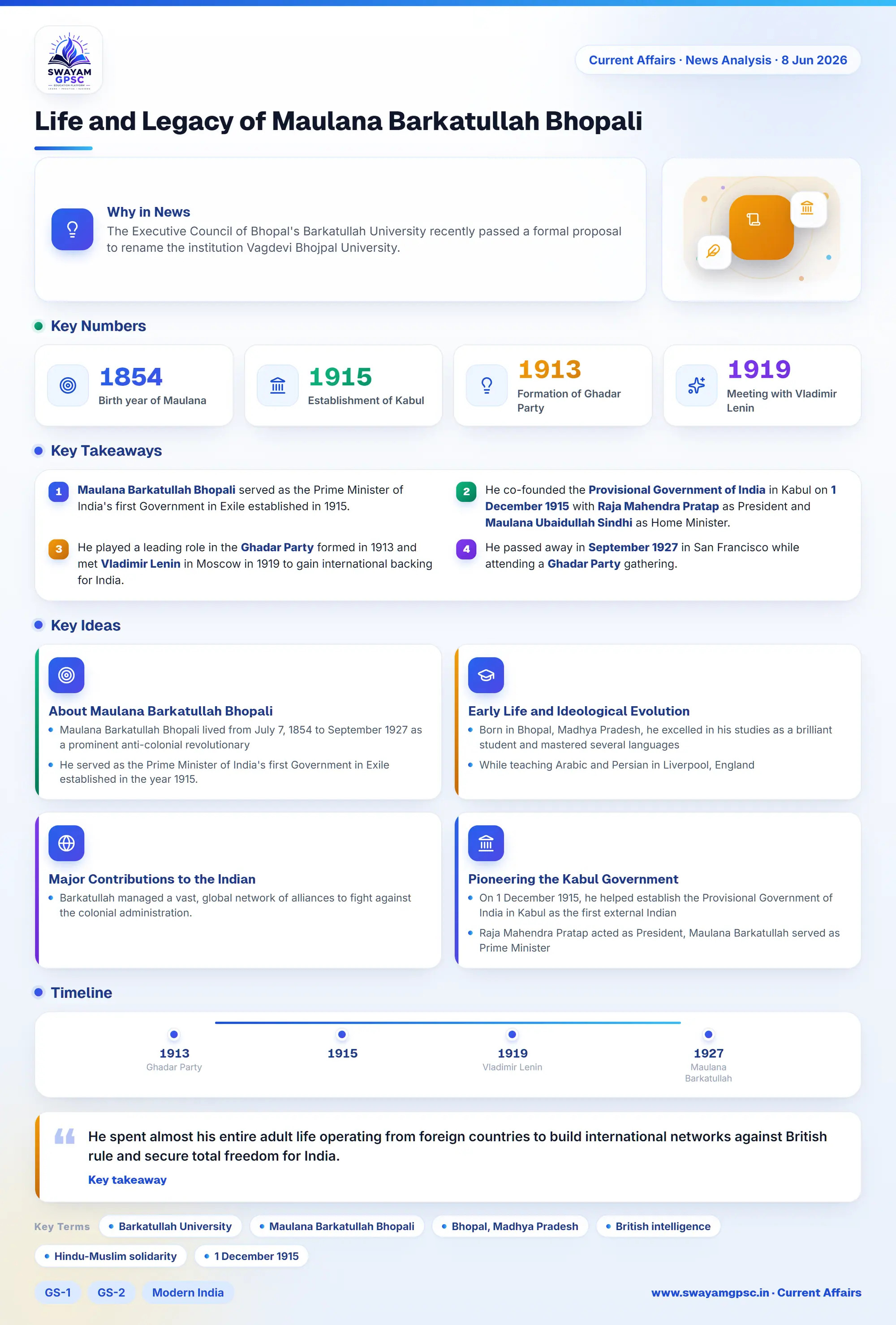
- Maulana Barkatullah Bhopali served as the Prime Minister of India's first Government in Exile established in 1915.
- He co-founded the Provisional Government of India in Kabul on 1 December 1915 with Raja Mahendra Pratap as President and Maulana Ubaidullah Sindhi as Home Minister.
- He played a leading role in the Ghadar Party formed in 1913 and met Vladimir Lenin in Moscow in 1919 to gain international backing for India.
- He passed away in September 1927 in San Francisco while attending a Ghadar Party gathering.
Why in News
- The Executive Council of Bhopal's Barkatullah University recently passed a formal proposal to rename the institution Vagdevi Bhojpal University.
About Maulana Barkatullah Bhopali
- Maulana Barkatullah Bhopali lived from July 7, 1854 to September 1927 as a prominent anti-colonial revolutionary, scholar, and fierce journalist.
- He served as the Prime Minister of India's first Government in Exile established in the year 1915.
- He spent almost his entire adult life operating from foreign countries to build international networks against British rule and secure total freedom for India.
Early Life and Ideological Evolution
- Born in Bhopal, Madhya Pradesh, he excelled in his studies as a brilliant student and mastered several languages before moving to Bombay and then London for higher education.
- While teaching Arabic and Persian in Liverpool, England, he met Indian revolutionaries and wrote anti-British articles that made him a primary target of British intelligence, forcing him to flee to the United States in 1899.
- He strongly believed in complete Hindu-Muslim solidarity and argued in letters to Maulana Hasrat Mohani that British-led famines harmed all communities equally, meaning India could only win freedom through united struggle against divide-and-rule tactics.
Major Contributions to the Indian Freedom Movement
- Barkatullah managed a vast, global network of alliances to fight against the colonial administration.
Pioneering the Kabul Government in Exile
- On 1 December 1915, he helped establish the Provisional Government of India in Kabul as the first external Indian administration seeking global backing for freedom.
- Raja Mahendra Pratap acted as President, Maulana Barkatullah served as Prime Minister, and Maulana Ubaidullah Sindhi took charge as Home Minister to represent a united nationalist front.
Role in the Ghadar Party
- He became a major leader of the Ghadar Party founded in 1913, which favored armed revolution over peaceful constitutional methods.
- The party planned to spark a massive mutiny within the British Indian Army to launch a countrywide uprising.
The German Axis Plan during World War I
- During World War I, he collaborated with Germany because he saw British adversaries as useful allies for India's liberation.
- He visited Indian POW camps across Europe to persuade captured soldiers to join a revolutionary army against British imperialism.
Meeting with Vladimir Lenin
- In 1919, he traveled to Moscow and met Vladimir Lenin to ask for assistance in India's anti-colonial struggle.
Last Days and Demise
- Even with poor health and constant watch by British intelligence, he continued his revolutionary work overseas.
- He passed away in September 1927 during a Ghadar Party meeting in San Francisco and found his final resting place in California.
Core Achievements
- As Prime Minister of the Kabul administration, he led diplomatic efforts to gain worldwide recognition for a free India.
- He took India's freedom struggle global by spreading revolutionary activities across Asia, Europe, and North America.
- His groundwork inspired future leaders like Netaji Subhas Chandra Bose and helped pave the way for the Indian National Army.