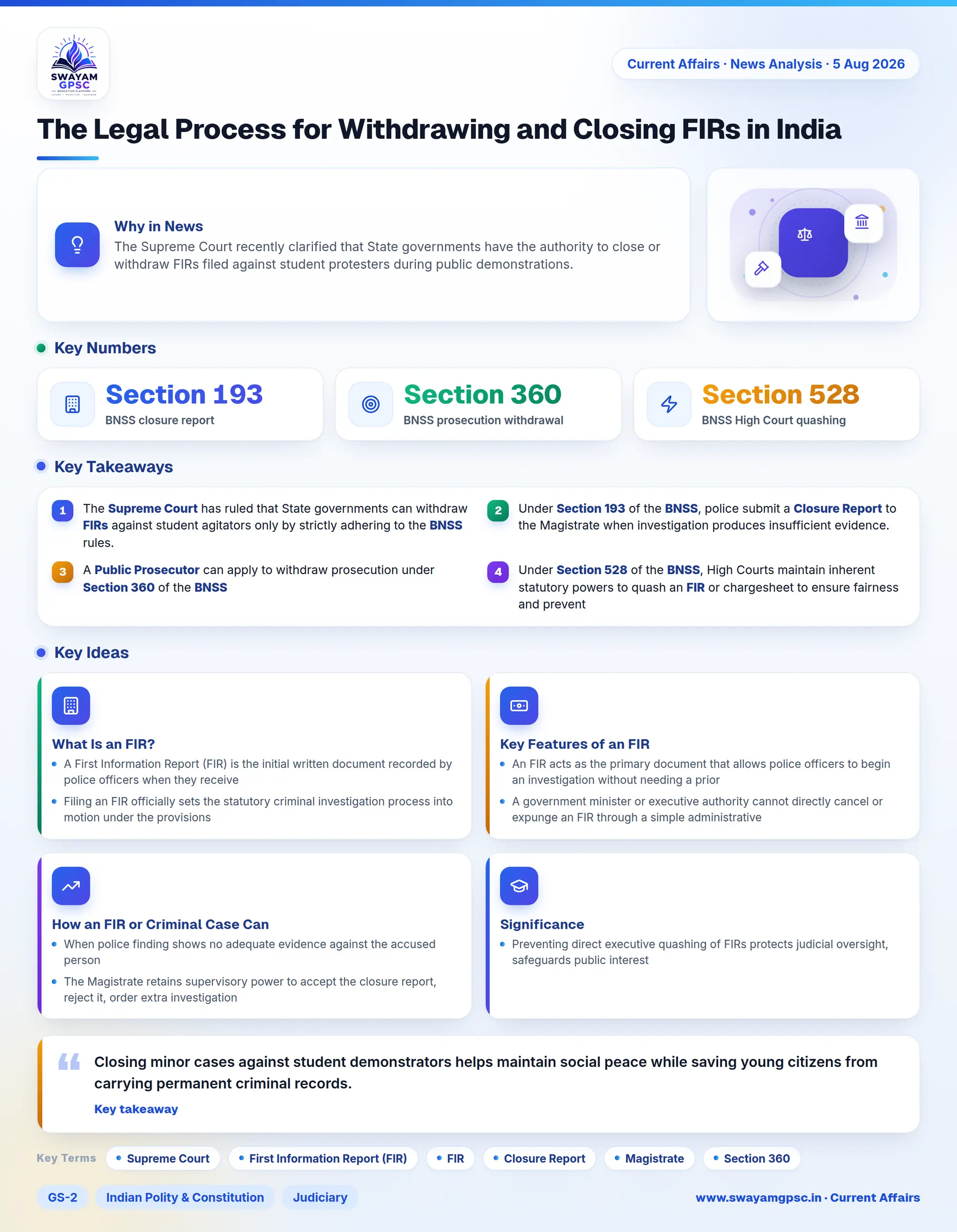
The Legal Process for Withdrawing and Closing FIRs in India
#GS-2 #Indian Polity & Constitution #Judiciary #Executive #Governance & Social Justice #Good Governance #Current Events #National
Key takeaways
- The Supreme Court has ruled that State governments can withdraw FIRs against student agitators only by strictly adhering to the BNSS rules.
- Under Section 193 of the BNSS, police submit a Closure Report to the Magistrate when investigation produces insufficient evidence.
- A Public Prosecutor can apply to withdraw prosecution under Section 360 of the BNSS, provided it reflects independent judgment and judicial consent as required in Sheonandan Paswan v. State of Bihar (1986).
- Under Section 528 of the BNSS, High Courts maintain inherent statutory powers to quash an FIR or chargesheet to ensure fairness and prevent legal abuse.
Why in News
- The Supreme Court recently clarified that State governments have the authority to close or withdraw FIRs filed against student protesters during public demonstrations.
- State governments can only execute this withdrawal if they strictly follow the statutory steps listed under the Bharatiya Nagarik Suraksha Sanhita (BNSS).
What Is an FIR?
- A First Information Report (FIR) is the initial written document recorded by police officers when they receive information about a cognizable offence.
- Filing an FIR officially sets the statutory criminal investigation process into motion under the provisions of the BNSS.
Key Features of an FIR
- An FIR acts as the primary document that allows police officers to begin an investigation without needing a prior warrant from a court.
- A government minister or executive authority cannot directly cancel or expunge an FIR through a simple administrative order.
- After police register an FIR, closing or ending the resulting legal proceedings requires formal court filings or explicit judicial approval.
- An FIR serves only as an initial report of an alleged crime and does not count as final proof until confirmed in court.
How an FIR or Criminal Case Can Be Withdrawn or Closed
- When police finding shows no adequate evidence against the accused person, the investigating officer files a Closure Report under Section 193 of the BNSS.
- The Magistrate retains supervisory power to accept the closure report, reject it, order extra investigation, or take cognisance directly, as upheld in Palaniswamy Veeraraja v. State of Karnataka (2026).
- Under Section 360 of the BNSS, a Public Prosecutor can apply to the trial court to withdraw from prosecuting a case before the final judgment.
- The decision to withdraw from a criminal case must come from the prosecutor's own independent evaluation rather than executive orders.
- The trial court must grant clear consent for withdrawal after verifying that the step serves the public interest, as established in Sheonandan Paswan v. State of Bihar (1986).
- Courts must give crime victims a fair opportunity to present their views before granting permission to withdraw prosecution.
- Under Section 528 of the BNSS, High Courts hold inherent powers to quash an FIR or chargesheet to stop the abuse of legal processes.
- High Courts can quash cases if no preliminary case exists against the accused or if parties resolve non-heinous disputes peacefully.
Significance
- Closing minor cases against student demonstrators helps maintain social peace while saving young citizens from carrying permanent criminal records.
- Preventing direct executive quashing of FIRs protects judicial oversight, safeguards public interest, and secures victim rights.