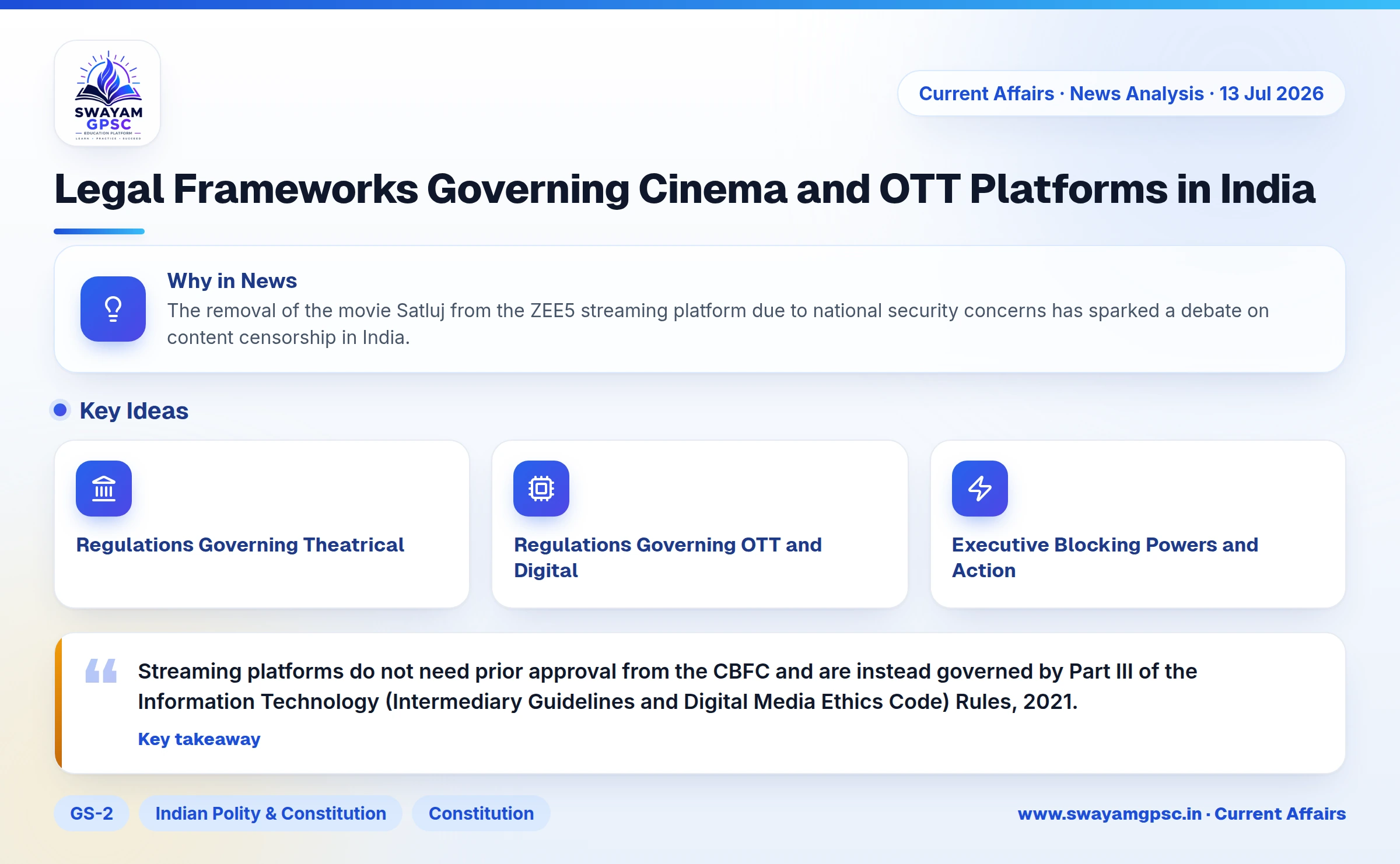
Legal Frameworks Governing Cinema and OTT Platforms in India
#GS-2 #Indian Polity & Constitution #Constitution #Governance & Social Justice #Regulatory Bodies #Government Policies & Interventions #Cinema and OTT Regulation
Why in News
- The removal of the movie Satluj from the ZEE5 streaming platform due to national security concerns has sparked a debate on content censorship in India.
- The film was originally named Punjab '95, but the Central Board of Film Certification (CBFC) ordered 127 structural cuts, leading the producers to release the uncut movie directly on OTT.
- This case highlights the legal differences between traditional cinema regulated under the Cinematograph Act, 1952 and online platforms governed by the Information Technology Rules, 2021.
Regulations Governing Theatrical Movies
- Public movie screenings in cinema halls require mandatory prior certification from the CBFC, which operates as a statutory body under the Ministry of Information and Broadcasting.
- The CBFC can demand cuts or refuse certification based on grounds like national sovereignty, state security, public order, and decency under Article 19(2) of the Constitution.
- The Cinematograph (Amendment) Act, 2023 introduced age classifications like UA 7+, UA 13+, and UA 16+, while making certificates valid permanently instead of the previous 10-year limit.
- In 2021, the government abolished the Film Certification Appellate Tribunal (FCAT), forcing filmmakers to take grievances straight to High Courts, which takes time and money.
Regulations Governing OTT and Digital Platforms
- Streaming platforms do not need prior approval from the CBFC and are instead governed by Part III of the Information Technology (Intermediary Guidelines and Digital Media Ethics Code) Rules, 2021.
- The IT Rules, 2021 create a three-tier grievance framework consisting of publisher self-regulation, industry body self-regulation, and central government oversight.
- The central government oversight mechanism faces legal challenges, with key provisions currently stayed by the Bombay High Court and Madras High Court.
Executive Blocking Powers and Action on Satluj
- Under Section 69A of the IT Act, 2000 and the IT Rules, 2009, the central government can block public access to online content after providing written reasons and subject to review.
- In the Satluj case, the Ministry of Information and Broadcasting formed an Inter-Departmental Committee under Rule 14 of the IT Rules, 2021 to review the content.
- This committee can recommend measures such as warnings, disclaimers, content editing, age reclassification, or complete blocking under Section 69A.