Lab-Grown Diamonds: India's Push for Sustainable Gemstones
#GS-1 #Geography #Resources #Industries #GS-2 #Governance & Social Justice #GS-3 #Economy #Science & Technology #Environment #Sustainable Development #Current Events #National #Lab-Grown Diamonds #Kimberley Process
Key takeaways
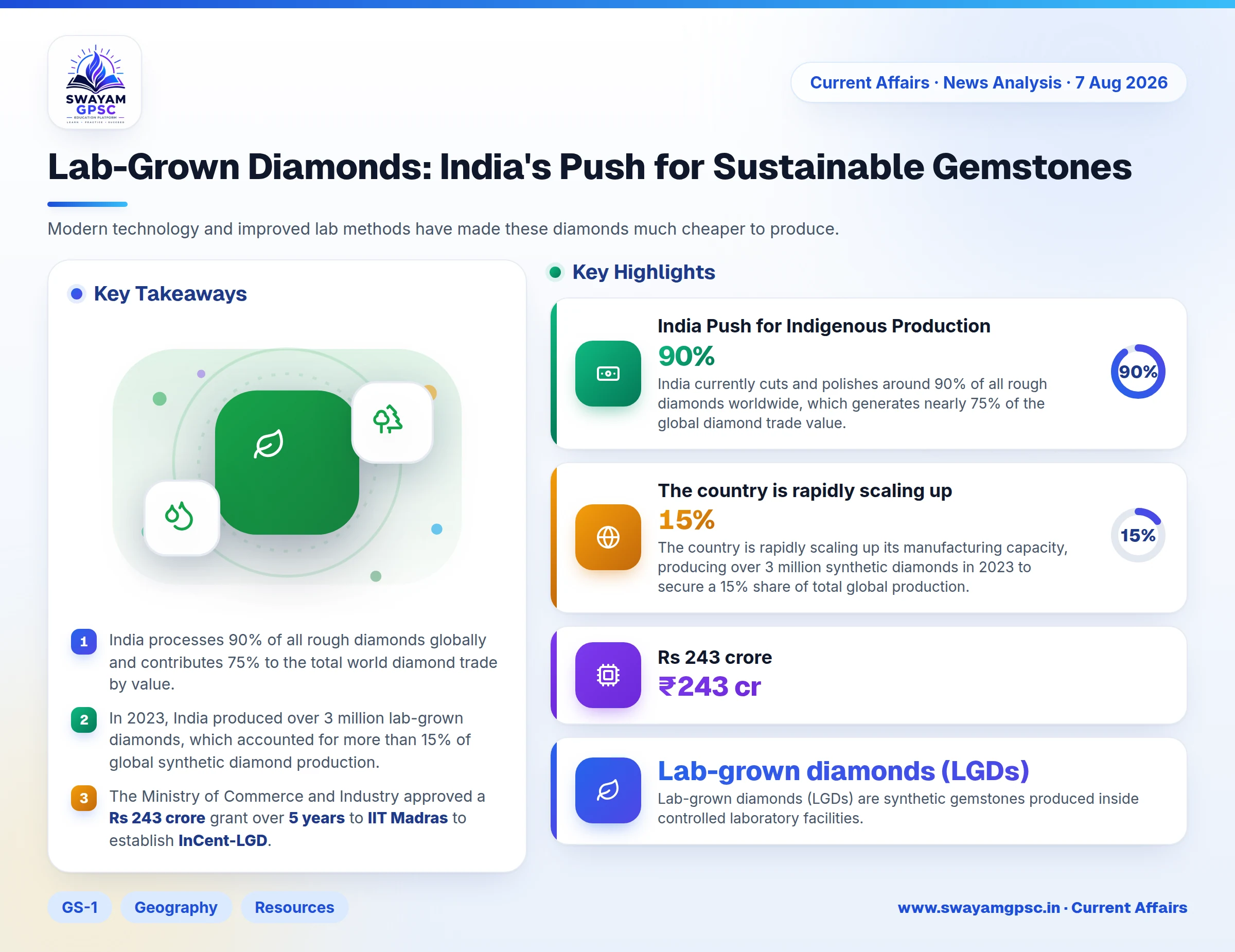
- India processes 90% of all rough diamonds globally and contributes 75% to the total world diamond trade by value.
- In 2023, India produced over 3 million lab-grown diamonds, which accounted for more than 15% of global synthetic diamond production.
- The Ministry of Commerce and Industry approved a Rs 243 crore grant over 5 years to IIT Madras to establish InCent-LGD.
- Global diamond mines that currently account for 90% of natural diamond production have a remaining operational life of less than 50 years.
- The Majhgawan Diamond Mine in Panna, Madhya Pradesh, operated by NMDC, is India's only active mechanized commercial diamond mine.
Why in News
- Lab-grown diamonds are gaining worldwide interest as an eco-friendly option to mined diamonds because natural reserves are shrinking, and mining creates major environmental and ethical problems.
- To support this green trend, India is actively helping its local lab-grown diamond industry grow through scientific research and technological innovation.
What are Lab-Grown Diamonds (LGDs)?
- Lab-grown diamonds (LGDs) are synthetic gemstones produced inside controlled laboratory facilities. They match natural diamonds completely in chemical composition, physical strength, and optical appearance, as both feature the same carbon crystal structure.
- These manufactured gems exhibit the exact same brilliance, sparkle, rarity, and durability as stones dug out of the ground.
- Natural mining often leads to environmental harm, human rights abuses, and funding for armed conflicts, known as blood diamonds. In contrast, lab-grown diamonds guarantee clear traceability across the entire supply chain.
- Modern technology and improved lab methods have made these diamonds much cheaper to produce. Consequently, retail prices have dropped, offering buyers a budget-friendly option.
- Producing lab-created diamonds mainly involves two specialized technical methods that encourage carbon atoms to crystallize properly.
- First developed in 1954, the High Pressure High Temperature (HPHT) technique reproduces the intense heat and crushingly high pressure found deep inside the Earth's mantle.
- Under these extreme conditions, carbon materials compress and transform directly into pure diamond crystals.
- Created in 1962, the Chemical Vapour Deposition (CVD) method places a thin diamond seed into a sealed chamber filled with carbon gases such as methane.
- The equipment ionizes these gases into plasma, breaking down the chemical bonds so pure carbon settles onto the seed layer by layer.
- Traditional diamond mining causes widespread tree clearing, soil damage, heavy water use, and wildlife displacement. Lab production completely avoids these environmental damages.
- When factories run on clean solar or wind power rather than coal electricity, their emissions drop sharply. This supports the UN Sustainable Development Goals (SDGs) and clean circular economy rules.
- Thanks to their exceptional hardness and heat conduction, these diamonds serve important uses outside jewelry.
- They play critical roles in heavy industrial cutting tools, high-speed computer chips, quantum computing devices, and ultra-durable protective gear coatings.
India Push for Indigenous Production
- Recognizing the economic value and environmental benefits of synthetic diamonds, the Indian government introduced strong supporting policies in the Union Budget 2023-24 to boost local research in HPHT and CVD technologies.
- India currently cuts and polishes around 90% of all rough diamonds worldwide, which generates nearly 75% of the global diamond trade value.
- The country is rapidly scaling up its manufacturing capacity, producing over 3 million synthetic diamonds in 2023 to secure a 15% share of total global production.
- To drive technology forward, the Ministry of Commerce and Industry granted Rs 243 crore over five years to IIT Madras to create the India Centre for Lab-Grown Diamond (InCent-LGD).
- This research hub focuses on making diamond-making machines locally, refining techniques, and creating raw seed crystals so India becomes a world leader in sustainable diamond making.
Concerns Regarding Natural Diamond Mining
- Famous diamond mines like Argyle in Australia and Diavik in Canada are running dry. Industry estimates indicate that mines supplying 90% of the world's natural diamonds will close within 50 years.
- Diamond mine workers suffer severe health hazards due to asbestos dust exposure, which triggers serious respiratory illnesses like asbestosis, pleural plaques, and mesothelioma.
- Unlawful mining sales frequently fund local warlords and brutal military actions. Even with the international Kimberley Process, illegal smuggling through regulatory loopholes continues.
- India assumed the Leadership Chair of the Kimberley Process (KP) for 2026. As a founding member of the Kimberley Process Certification Scheme (KPCS), India is leading worldwide actions to eliminate conflict diamond trading and build clean trade systems.
Diamond Resources in India
- India was among the world's earliest diamond sources, with mining traditions starting as far back as the 5th century BC.
- During the 16th and 17th centuries, Golconda in Andhra Pradesh functioned as the premier global trading hub for precious diamonds.
- India yielded world-renowned historic gems like the Kohinoor, Great Moghul, Hope, Nizam, Pitt (Regent), Orloff, and Darya-i-Noor before major Brazilian mines opened around 1726.
- Today, the Majhgawan Diamond Mine in Panna, Madhya Pradesh, managed by the state-run National Mineral Development Corporation (NMDC), stands as India's only operating mechanized commercial mine.
- India's historically significant diamond belts comprise the Panna Diamond Belt in Madhya Pradesh, the Krishna River gravels in Andhra Pradesh, the Mahanadi River gravels in Odisha, and the Wairagarh Conglomerates in Maharashtra.
- Prominent kimberlite rock formations containing raw diamond pipes include the Majhgawan Pipe in Madhya Pradesh and the Wajrakarur Pipe in Andhra Pradesh.