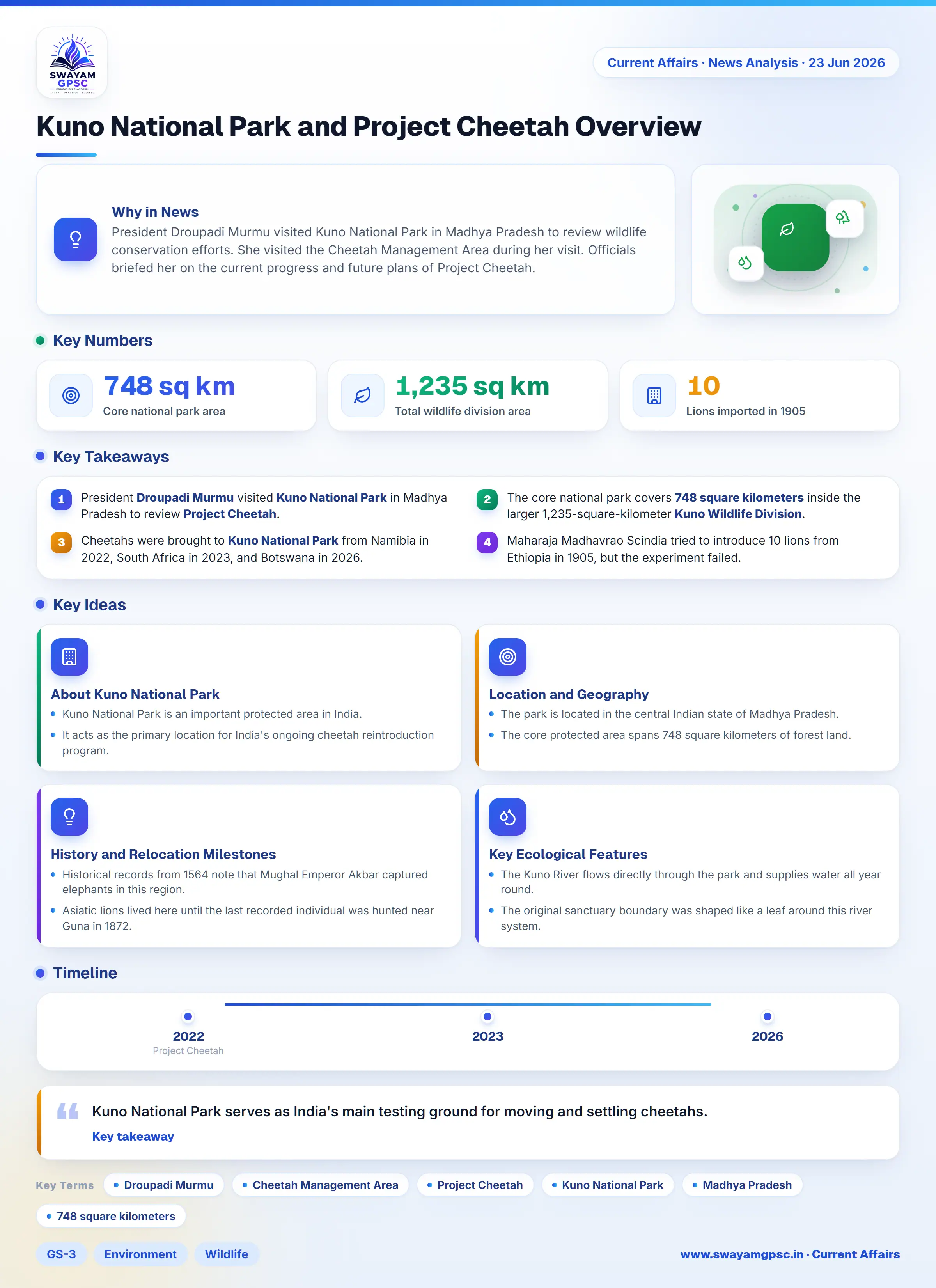
Kuno National Park and Project Cheetah Overview
#GS-3 #Environment #Wildlife #Biodiversity #Current Events #National #Gujarat
Key takeaways
- President Droupadi Murmu visited Kuno National Park in Madhya Pradesh to review Project Cheetah.
- The core national park covers 748 square kilometers inside the larger 1,235-square-kilometer Kuno Wildlife Division.
- Cheetahs were brought to Kuno National Park from Namibia in 2022, South Africa in 2023, and Botswana in 2026.
- Maharaja Madhavrao Scindia tried to introduce 10 lions from Ethiopia in 1905, but the experiment failed.
Why in News
- President Droupadi Murmu visited Kuno National Park in Madhya Pradesh to review wildlife conservation efforts.
- She visited the Cheetah Management Area during her visit.
- Officials briefed her on the current progress and future plans of Project Cheetah.
About Kuno National Park
- Kuno National Park is an important protected area in India.
- It acts as the primary location for India's ongoing cheetah reintroduction program.
- The park plays a major role in global efforts to restore lost biodiversity.
Location and Geography
- The park is located in the central Indian state of Madhya Pradesh.
- The core protected area spans 748 square kilometers of forest land.
- It is surrounded by a larger 1,235-square-kilometer territory known as the Kuno Wildlife Division.
History and Relocation Milestones
- Historical records from 1564 note that Mughal Emperor Akbar captured elephants in this region.
- Asiatic lions lived here until the last recorded individual was hunted near Guna in 1872.
- Maharaja Madhavrao Scindia brought 10 lions from Ethiopia in 1905, but the project failed because some turned man-eaters.
- Project Cheetah brought animals from Namibia in 2022, South Africa in 2023, and Botswana in 2026.
Key Ecological Features
- The Kuno River flows directly through the park and supplies water all year round.
- The original sanctuary boundary was shaped like a leaf around this river system.
- Open grasslands and savannas create ideal hunting grounds for fast predators.
- Dry deciduous forests filled with Kardhai, Khair, and Salai trees can easily survive long dry spells.
Significance
- Kuno National Park serves as India's main testing ground for moving and settling cheetahs.
- The park was originally prepared to become a second home for Asiatic Lions.
- It remains a vital location for future big cat conservation projects in India.