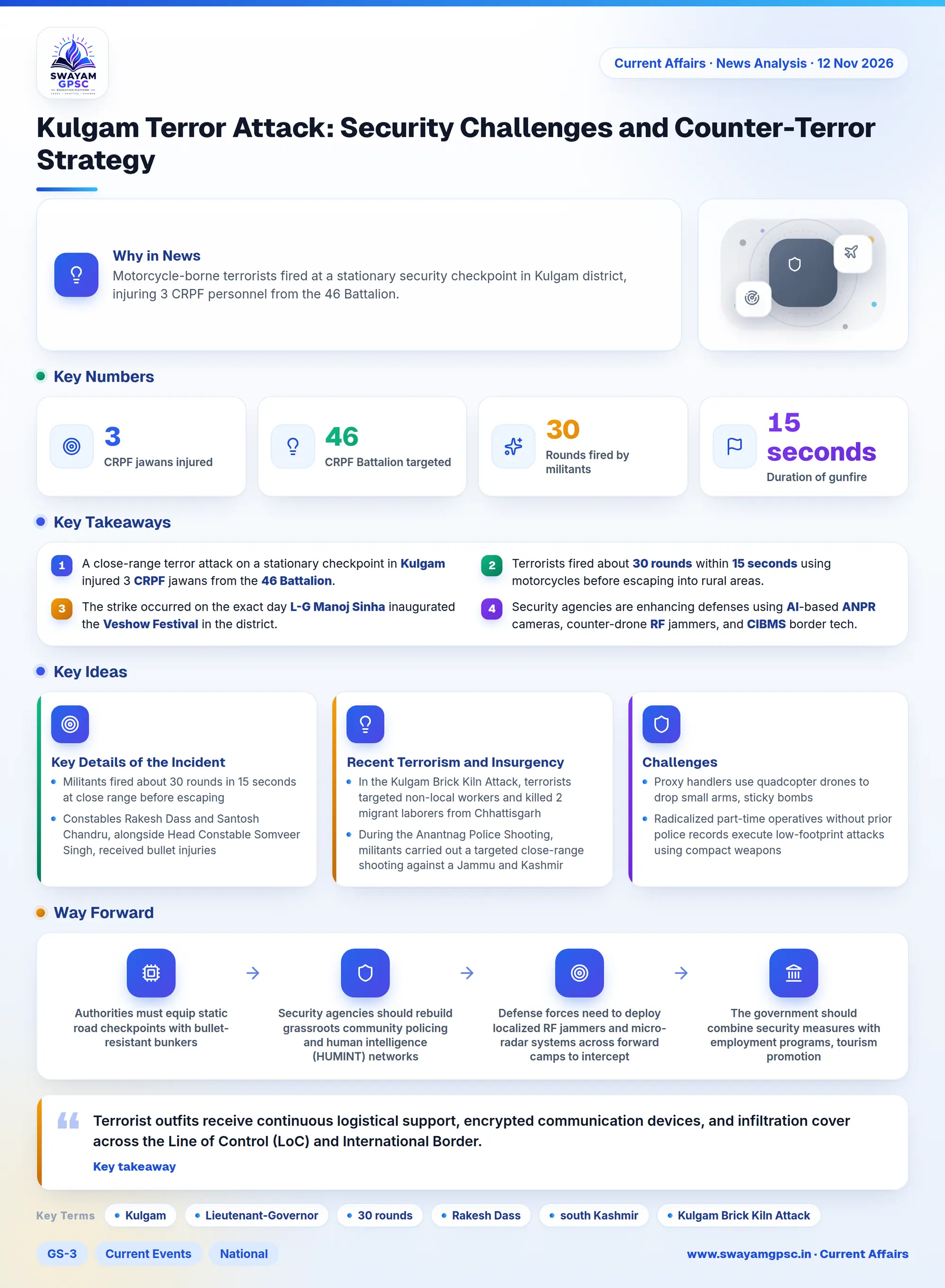
Kulgam Terror Attack: Security Challenges and Counter-Terror Strategy
#GS-3 #Current Events #National #Defence #Cyber Security #Disaster Preparedness
Key takeaways
- A close-range terror attack on a stationary checkpoint in Kulgam injured 3 CRPF jawans from the 46 Battalion.
- Terrorists fired about 30 rounds within 15 seconds using motorcycles before escaping into rural areas.
- The strike occurred on the exact day L-G Manoj Sinha inaugurated the Veshow Festival in the district.
- Security agencies are enhancing defenses using AI-based ANPR cameras, counter-drone RF jammers, and CIBMS border tech.
- Authorities continue to target financial networks and Over Ground Workers (OGWs) using strict UAPA provisions and NIA attachments.
Why in News
- Motorcycle-borne terrorists fired at a stationary security checkpoint in Kulgam district, injuring 3 CRPF personnel from the 46 Battalion.
- The attackers used local surveillance gaps and carried out the hit-and-run ambush on the exact day the Lieutenant-Governor visited the district to inaugurate the Veshow Festival.
Key Details of the Incident
- Militants fired about 30 rounds in 15 seconds at close range before escaping, and local CCTV cameras captured the incident.
- Constables Rakesh Dass and Santosh Chandru, alongside Head Constable Somveer Singh, received bullet injuries, with the critically wounded jawan being airlifted to Badamibagh Army Hospital in Srinagar.
- Security forces quickly dispatched reinforcements, deployed armored vehicles, and launched intensive cordon-and-search operations across south Kashmir to block escape routes.
Recent Terrorism and Insurgency Incidents in India
- In the Kulgam Brick Kiln Attack, terrorists targeted non-local workers and killed 2 migrant laborers from Chhattisgarh to create fear among external workforces.
- During the Anantnag Police Shooting, militants carried out a targeted close-range shooting against a Jammu and Kashmir Police constable in neighboring Anantnag district.
- In the Sukma IED Blast, 4 CRPF officers sustained injuries when an Improvised Explosive Device exploded during a residual explosive defusal operation at the Alarmedgu camp in Chhattisgarh.
- During the Reasi & Kathua Ambush Waves, cross-border terror modules shifted their focus south of the Pir Panjal range, staging coordinated ambushes on security convoys and pilgrim buses in the Jammu division.
Challenges
- Terrorist outfits receive continuous logistical support, encrypted communication devices, and infiltration cover across the Line of Control (LoC) and International Border.
- Proxy handlers use quadcopter drones to drop small arms, sticky bombs, and steel-core ammunition directly into border districts of Punjab and Jammu & Kashmir.
- Radicalized part-time operatives without prior police records execute low-footprint attacks using compact weapons and quickly blend back into civilian life.
- Motorcycle-borne attackers fire rapid bursts at stationary checkpoints in places like Akhran and disperse through rural orchards before quick-reaction teams can arrive.
- Militants deliberately time strikes to coincide with high-visibility official visits or community festivals to undermine normalcy narratives and discourage public participation.
- Attackers staged the Kulgam firing on the exact day L-G Manoj Sinha inaugurated the Veshow Festival in the district.
- Heavily forested ridges and natural mountain caves offer concealment for small groups of trained foreign mercenaries seeking to evade aerial surveillance.
- Foreign militants actively operate out of dense alpine forests in the upper reaches of south Kashmir and the Pir Panjal belt.
Initiatives Taken to Counter Terrorism
- The government provides security forces with operational freedom alongside synchronized intelligence sharing through the Multi-Agency Centre (MAC).
- Authorities deploy smart fencing, thermal imagers, underground sensors, and anti-drone radar grids under the Comprehensive Integrated Border Management System (CIBMS) along the border.
- The state has revived and armed trained local volunteer networks known as Village Defence Guards (VDGs) in vulnerable rural and border areas to act as first-line deterrents.
- Agencies execute crackdowns on terror financing and Over Ground Workers (OGWs) by using the Unlawful Activities (Prevention) Act (UAPA) and National Investigation Agency (NIA) property attachments.
Way Forward
- Authorities must equip static road checkpoints with bullet-resistant bunkers, AI-enabled automatic number plate recognition (ANPR) cameras, and drone surveillance.
- Security agencies should rebuild grassroots community policing and human intelligence (HUMINT) networks to identify hybrid militants before they acquire weapons or plan strikes.
- Defense forces need to deploy localized RF jammers and micro-radar systems across forward camps to intercept cross-border drone weapon drops.
- The government should combine security measures with employment programs, tourism promotion, and cultural outreach to isolate extremist narratives among local youth.
Conclusion
- The close-range attack in Kulgam shows that even though major terror infrastructure in Jammu and Kashmir has been reduced, small hit-and-run attacks remain a serious security concern.
- Securing long-term peace in the region requires strengthening road checkpoints, neutralizing Over Ground Worker (OGW) support networks, blocking cross-border supplies, and expanding local development opportunities.